Trump's pocket rescission sparks spending power battle
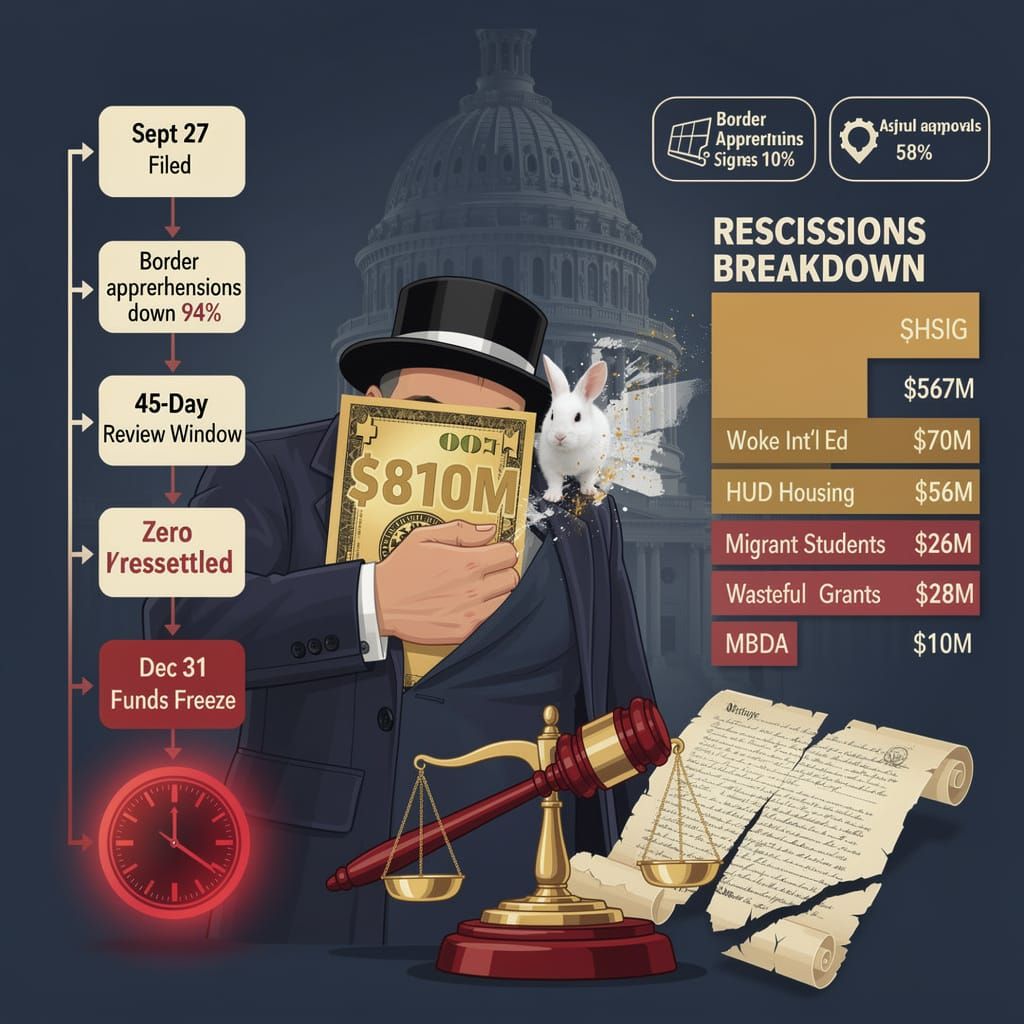
$810 million in congressionally approved spending was just canceled in a move so rare it's happened only twice in 50 years — both times under Trump. 💰⚖️ Filed as the fiscal year hit its deadline, the maneuver freezes the money while the 45-day review window expires, letting it evaporate without a clean vote. The biggest slice: $567M for refugee resettlement and asylum-seeker support. The justification? A border reality where DHS logged 15 straight months of zero migrant releases. But Senate Appropriations chair Susan Collins — a Republican — calls it "illegal" and an "end-run around the constitutional power of the purse." Is this a one-off fight, or the blueprint for a new executive power play on spending? That decision may land at the Supreme Court — and the outcome shapes what Congress's wallet really controls. 🇺🇸
Somewhere in Washington right now, constitutional lawyers are likely rereading the Impoundment Control Act with the same bewildered expression people reserve for a magician who just pulled a rabbit through a wall. On September 27, President Trump announced he was canceling roughly $810 million in congressionally approved spending — and he did it using a maneuver so rare it's happened exactly twice in the last half century. Both times, fittingly, under Trump.
Here's the play. The White House, via OMB, submitted a rescission package late Friday, just as the fiscal year was careening toward its September 30 deadline. The timing wasn't accidental. By filing at the end of the calendar, the administration effectively froze the money — feet up, frozen solid — while the 45-day congressional review window bled out against the fund-expiration date. Under the GAO's interpretation, that's a problem: pocket rescissions are supposed to be off the table when the calendar makes it impossible for Congress to actually decide anything before the funds expire.
Call it legisla-shuffle. Congress never gets a clean vote, and the money evaporates anyway.
The biggest single target? A $567 million slice of the HHS Refugee and Entrant Assistance account — the programs funding refugee resettlement, asylum seeker support, and unaccompanied minors in federal care. That's not a rounding error; it's the difference between beds, caseworkers, and legal services existing or not. The package also carved up Commerce's Minority Business Development Agency ($10 million of a $50 million program the White House calls "unconstitutional race-based"), a $70 million "Woke International Education" line, $56 million in HUD housing counseling grants, $25 million for migrant student education, and a $28 million HHS "wasteful grants" bucket. Eleven rescissions across six or seven agencies, plus international assistance, all wrapped in a bow labeled "most harmful government spending."
The administration's justification leans on a genuinely different border reality — and the numbers are, shall we say, uncooperative with the skeptics. DHS just logged its 15th straight month of zero migrant releases at the southern border, with July apprehensions down to 11,298 — 94% below the Biden-era monthly average. Fentanyl seizures hit 800 pounds in May; apprehensions are running 96% below the December 2023 peak. Whether you buy "so the pipeline is overfunded" or not, the premise isn't pulled from thin air. The mechanism is where the theater starts.
Senator Susan Collins didn't mince words. The Senate Appropriations Committee chair called the maneuver "illegal," "unreported impoundment," and an "end-run around the constitutional power of the purse" — notable because she's a Republican saying it about a Republican president. That's her literal words, and she's said them out loud. This is the same administration that resettled exactly zero Christians fleeing persecution in FY2026 and dropped asylum approval rates from 58% in 2023 to 10% this year — so the "overfunded" pitch carries a certain... flavor, depending on whose lives you're tallying.
Here's where it gets genuinely messy for separation-of-powers purists: Congress handed the executive a loaded weapon and seems surprised it got fired. The Impoundment Control Act has always been the statutory leash on presidential spending whims, and this administration has been pulling that leash taut — a $4.9 billion foreign aid clawback in 2025 set the table. The Supreme Court even issued a preliminary order upholding a freeze on expiring foreign aid, which the White House reads as a green light.
The clock is running. A bipartisan stopgap — the Continuing Appropriations and Extensions Act, 2027 — was signed into law in September, funding Washington through December with margins of 90-6 in the Senate and 370-48 in the House. But the House stays dark until November, and the Senate only resumed September 30, which is exactly why the timing smells deliberate. The shutdown deadline may be pushed out, but the 45-day rescission window is the real countdown. If Congress doesn't act, the rescissions take effect by default. If it tries to reverse them, we're looking at a veto, a likely override fight, and quite possibly a Supreme Court showdown on how much power the purse actually has versus how much it's willing to share.
The echo of the 1977 Carter-era rescission precedent hangs over all of this, but that's where the analogy breaks. That fight was about process. This one reads more like a blueprint: file late, cite a statute, dare the courts to catch up. Regardless of where you land on the politics, watching Congress discover its own leash is being yanked is, shall we say, a study in delayed surprise.
The analysis is straightforward: this is less about $810 million than about whether the executive branch can manufacture a default when the legislature won't move fast enough. A $4.9 billion foreign aid precedent, a Supreme Court door cracked open, and a second pocket rescission in as many years — that's not a bug in the system anymore. It's a pattern wearing a suit. Whether Collins's promised pushback turns into an actual defeasance vote, or just another chapter of theatrical outrage, we get to watch the ending in real time.

Comments ()