Another Week, Another Stack of Patches: The Cybersecurity Treadmill Grinds On
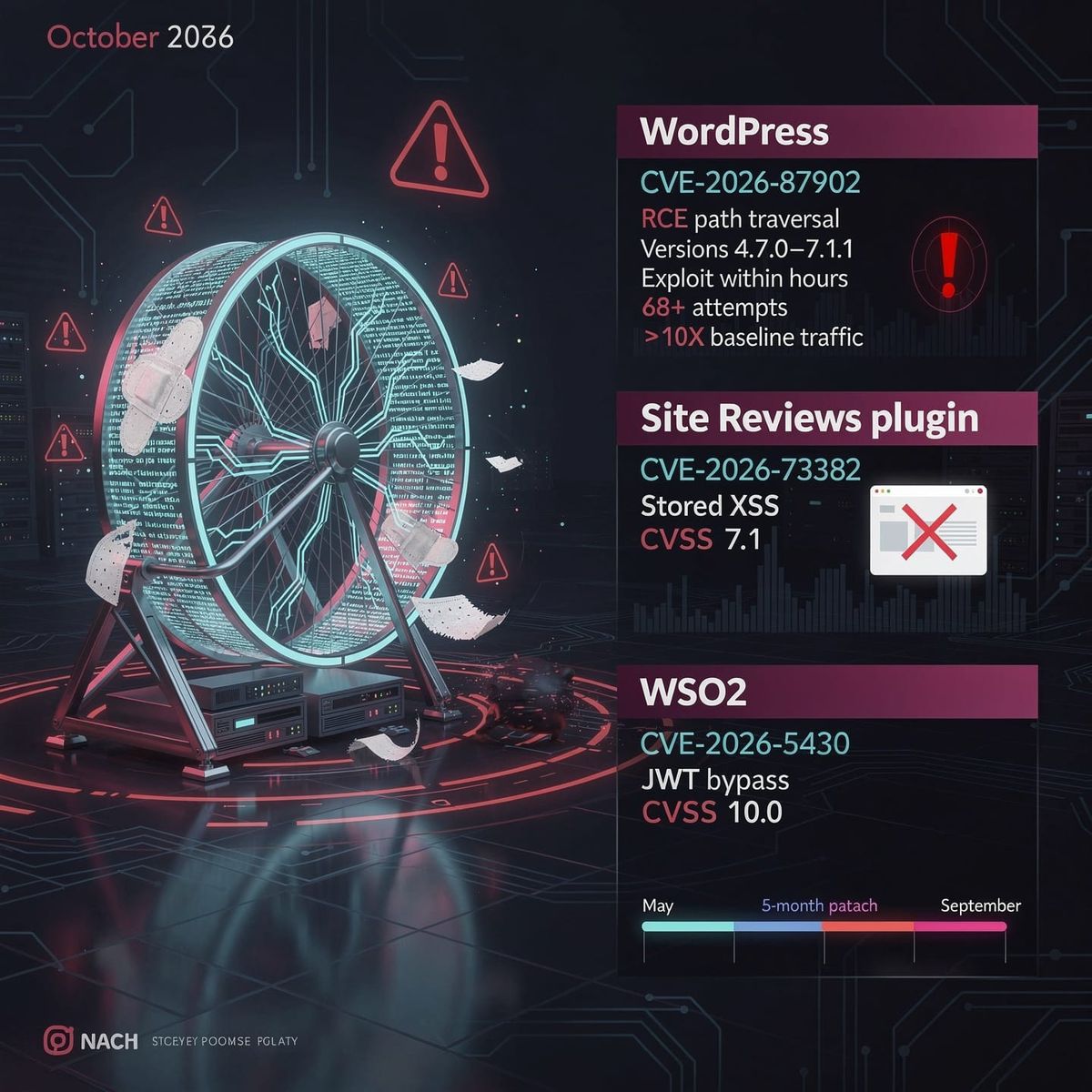
October's patch stack says little about new exploit tricks and everything about how slow we deploy fixes. WordPress's decade-old core bug? Exploited within hours of the Sept 22 patch. WSO2's CVSS 10.0 JWT bypass? Patch shipped May 3, attackers landed five months later. Citrix? Automatable, credential-free DoS. The industry number that says it all: only 9% of organizations remediate critical flaws within 24 hours. The fixes exist. The lag is on us. Verify patch state now — especially on internet-facing authentication layers. 🔧
Publicly disclosed flaws at WordPress, Citrix NetScaler, and WSO2 prove that the real industry trend is the inability to stop shipping software that breaks itself — and the stubborn refusal to patch it once it does.
You'd think by October 2026, we'd have learned. But here we are again, sifting through a fresh pile of disclosures from early October, each one another reminder that the security industry's business model depends on your organization being a perpetual beta tester.
The WordPress Wheel Keeps Spinning
Let's start with CVE-2026-73382. Patchstack flagged a stored cross-site scripting (XSS) hole in Gemini Labs' Site Reviews plugin for WordPress, affecting versions up to and including 8.2.0. A CVSS 7.1 "high" severity score, for those keeping track.
The root cause is about as original as it gets: improper neutralization of input during web page generation. Translation: the plugin didn't properly sanitize what visitors could type, leaving the door open for stored scripts. The fix is a modest one — update to version 8.2.1 — yet the industry knows most of these installations will lag for weeks.
And if you want proof of how that "lag" plays out, look no further than the WordPress core disaster that wrapped up in late September. CVE-2026-87902 — a critical unauthenticated remote code execution via page-template path traversal in WordPress core versions 4.7.0 through 7.1.1 — was already being probed by hackers feeding pearcmd.php payloads and writing ARM binaries onto /tmp/.
Here's the uncomfortable timeline that the "patch promptly" crowd would rather skip: WordPress shipped the 7.1.2 fix on September 22, and attackers began exploiting the flaw within hours. Previdian telemetry counted 68+ attempts within days, with exploitation traffic running at >10x the baseline. Yet the bug had been sitting in a page-template resolver for core versions 4.7.0 through 7.1.1 — that's roughly a decade of WordPress installs that only got a backport fix in 4.7.37. The raw exposure wasn't because the exploit was clever; it's because most admins default to slow, manual upgrades rather than automated tooling. The industry's patch data says it out loud: only 9% of organizations remediate critical flaws within 24 hours, and 97% of slow responders land in incidents tied to known vulnerabilities.
WSO2: The Five-Month Head Start
Then there's the WSO2 disclosure package that should make any enterprise admin wince: a critical JWT authentication bypass (via algorithm signature failure) affecting multiple products across the API Manager stack — API Manager 4.1.0–4.6.0, API Control Plane, Traffic Manager, and Universal Gateway.
Here's the part the advisory doesn't shout about loudly enough. This is CVE-2026-5430, carrying a CVSS 10.0 for single-tenant and 9.8 for multi-tenant deployments, and the patch — WSO2-2026-5328 — shipped back on May 3rd. WatchTowr's honeypot captured forged admin JWTs actively exploiting the flaw on September 13th — a five-month lag between patch and first confirmed touchdown, against a vulnerability that hands over administrative accounts, API backends, credentials, and consumer keys. CISA finally got around to adding it to the Known Exploited Vulnerabilities catalog on September 24th with a remediation deadline of September 27th. Let me do the arithmetic for you: the fix was in hand in May, the exploitation landed in September, and the regulator's alarm clock went off in late September. Federal agencies are now racing a 72-hour BOD 26-04 clock against a window that already slammed shut.
Citrix: The Repeater
If you run NetScaler ADC or Gateway, CVE-2026-88779 is your new headache. A memory overflow vulnerability (CWE-119) enabling a network-based denial of service, carrying an 8.7 on the new CVSS v4.0 scale.
The especially charming part: exploitation is currently unobserved, but automatable — no credentials, no user interaction, no human intelligence required. And Citrix isn't stinting on the apology tour: in late September the company dropped a whole family of CVEs (2026-88771 through 2026-88778) spanning RCE via improper input validation, DTLS-enabled memory overflows, HTTP request smuggling, and even TCP ISN prediction on load balancers. Versions below 14.1-73.41 and 13.1-64.28 need attention, and for FIPS builds, there's a second set of thresholds to track. It's a patch stack, not a patch — same as it ever was.
The Recurring Pattern Nobody Wants to Discuss
String these disclosures together and a bleak correlation emerges. Not one involves an exotic new exploit technique. The WordPress core bug was a path traversal, the WSO2 flaw was signature validation that trusts instead of verifies, and Citrix's lineup is unchecked memory buffers and input validation. The innovation budget is clearly not going to preventative security.
What's telling is the breadth of the WSO2 issue alone — a single JWT validation flaw ripples through API Manager, Universal Gateway, Traffic Manager, and a REST API utility. That's not a vulnerability; that's a design philosophy problem.
The sobering projection: These patches will be deployed at the usual lethargic pace. WordPress proved it with a decade-old core bug that only got a backport because attackers were already in the front door; WSO2 proved it with a five-month head start handed straight to attackers; and the industry's own numbers show only 9% of organizations button up critical flaws within a day. The vendor response loop — disclose, patch, hope — is not a strategy. It's a subscription you didn't sign up for.
Given the disruption they can cause, consider this a rolling reminder to verify your patch state, especially for internet-facing authentication layers. Assume that if it's exposed, someone is already probing it.


Comments ()