The Liberating Math of AI Server Backlogs
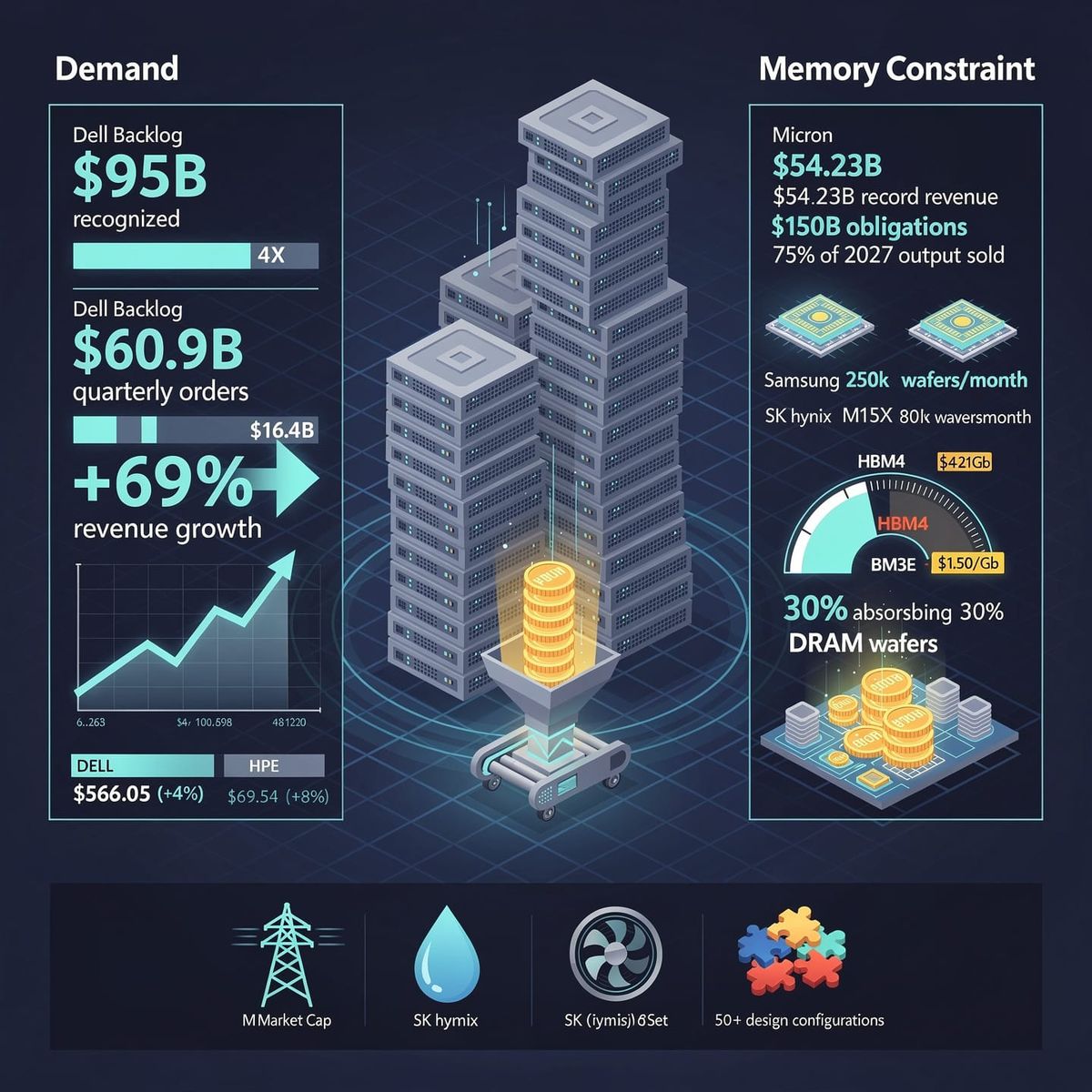
Dell carries a $95B AI server backlog. HPE just landed a large Vultr order. Yet memory supply, not demand, is the gating constraint. The tension: Dell booked $60.9B in new AI orders in a quarter but recognized only $16.4B in revenue — roughly 4x intake versus shipment pace. Q2 free cash flow fell 47% as inventory doubled. Micron expects demand to outpace supply "over the next couple of years" and 75% of its 2027 output is already accounted for. TrendForce pegs 2027 HBM pricing up 121% YoY. A backlog is not revenue, and a record order book is not a shipped unit. Watch memory delivery windows and Dell/HPE quarterly conversion and free-cash-flow figures — those tell you whether this is a build-out or a build-up.
Dell Technologies and Hewlett Packard Enterprise are riding a historic wave of AI server demand. But a mountain of unfilled orders — and the memory supply chains underneath them — raises a question the market seems reluctant to ask: when does a record backlog become a liability?
The headline numbers are impressive. On Friday, October 2, Dell shares closed at $566.05, up 4% in afternoon trading, while HPE climbed 8% to $69.54. Dell now carries a staggering $95 billion AI server order backlog, and the company recorded $60.9 billion in new AI server orders in a recent quarter. Revenue is projected to grow roughly 69% this year, and its market capitalization has tripled year-over-year to about $338.7 billion.
HPE, meanwhile, announced a large AI systems order from cloud provider Vultr, adding to what its leadership calls a record order book. The SPDR S&P 500 ETF rose 0.7% and the Invesco QQQ 1% on the session, buoyed by the sector's momentum.
The Catch Hiding Inside the Numbers
Impressive as they are, these figures deserve a skeptical read. The entire thesis rests on executing those backlogs — converting paper orders into shipped hardware, installed racks, and live compute. And that is precisely where the sector is straining.
The grouping of backlog numbers shows how opaque they can be. Dell's $95 billion figure represents unfilled AI server orders at quarter's end, yet the company recognized only $16.4 billion in AI server revenue during that same period — an intake pace roughly four times the shipment pace. That tension compounds: Dell booked more than $130 billion in AI orders over the past twelve months, while its Q2 free cash flow fell 47% to $986 million as inventory doubled and working capital demands climbed.
The binding constraint is memory supply. Both Dell and HPE have been explicit that memory chip availability, not server demand, is the gating factor between backlog and revenue. Memory fabricators are not disputing the point. Micron's fiscal 2026 ended September 3 with record revenues of $54.23 billion and net income of $37.7 billion, but CEO Sanjay Mehrotra still expects demand to exceed supply "over the next couple of years," and 75% of Micron's 2027 memory output is already accounted for. Micron holds $150 billion in performance obligations — booked revenue backlog — and has collected $32 billion in customer prepayments under 26 supplier agreements covering roughly 35% of revenues through fiscal 2030. Most current sales discussions already concern 2028.
Samsung and SK hynix are still expanding — Samsung plans to double HBM4 output and lift wafer input to 250,000 sheets a month, while SK hynix is scaling Cheongju M15X to 80,000 sheets monthly. Yet the price signals tell the supply-side story. TrendForce now forecasts 2027 HBM blended average selling price up 121% year-over-year, a material upward revision from earlier estimates. Samsung has set its premium HBM4 price at more than three times current HBM3E levels — roughly $4/Gb against $1.50/Gb — with HBM projected to absorb nearly 30% of DRAM fabricators' wafer capacity in 2027, up from 20% this year. Capacity is chasing, not closing, the gap.
Dell's own leadership has publicly acknowledged the tension: AI hardware deployments now regularly involve more than 50 unique design configurations per engagement, up from a handful a few years ago. That complexity taxes the engineering, supply-chain, and deployment muscle that has become Dell's real moat — not just the chips themselves.
A Market Priced for Perfection
The current share price embeds an expectation that backlog conversion proceeds smoothly and fast. But conversion timelines remain the single biggest uncertainty flagged by analysts at Morgan Stanley, Goldman Sachs, Truist, and Evercore ISI.
Dell booked a record $60.9 billion in AI server orders against $16.4 billion recognized, while raising its full-year AI-server revenue target from $60 billion to $74 billion. The $95 billion backlog covers 2.29x the revised annual target — coverage that looks healthy on paper but depends entirely on memory delivery windows narrowing. Bulk of that conversion risk sits with memory, where fabrication lead times stretch well past scheduled deployments.
Forward earnings multiple sits near 21.3x, a premium that presumes sustained double-digit revenue growth well past this year's 69% spike. That is a demanding assumption for a business whose revenue depends on components it does not control.
What Has to Break First
- Memory supply: Micron has effectively sold out next year and is negotiating 2028 allocations; 2027 HBM blended pricing is forecast up 121% and HBM4 commands triple HBM3E pricing. Sustained constraints in HBM and DRAM will push backlog conversion out, inflating the "days of orders" the market already prices in.
- Power and cooling: Grid, water, and cooling constraints at facility level add months to deployments, independent of hardware availability. Virginia utility authorities rejected a 6 MGD data-center water request in May citing insufficient capacity, and regulators in New York and Texas have halted or probed deployments over reliability concerns.
- Execution complexity: The 50-plus designs per engagement mean faster order intake does not automatically translate to faster delivery.
The two companies' fortunes have already diverged once on identical fundamentals — after Dell's Q2 report, its shares reversed 6.8% in a single session despite the company beating on revenue and guiding full-year AI-server targets up 23%. Expect more of that volatility as quarterly conversion numbers land.
The smart posture here is not dismissive, but unconvinced. These are genuinely exceptional businesses riding a real structural shift. But a backlog is not revenue, and a record order book is not a shipped unit. Dell's Q2 free cash flow, cut nearly in half as inventory doubled, shows what prolonged conversion does to a balance sheet. Until memory delivery windows compress and conversion rates visibly accelerate, the market is paying full price for goods not yet delivered.
Watch memory supply commentary from SK Hynix, Micron, and Samsung — and Dell's and HPE's quarterly conversion and free-cash-flow disclosures. Those, more than any share count, will tell you whether this boom is a build-out or a build-up.
Comments ()