AWS's $1B community fund lands against a trillion-dollar buildout
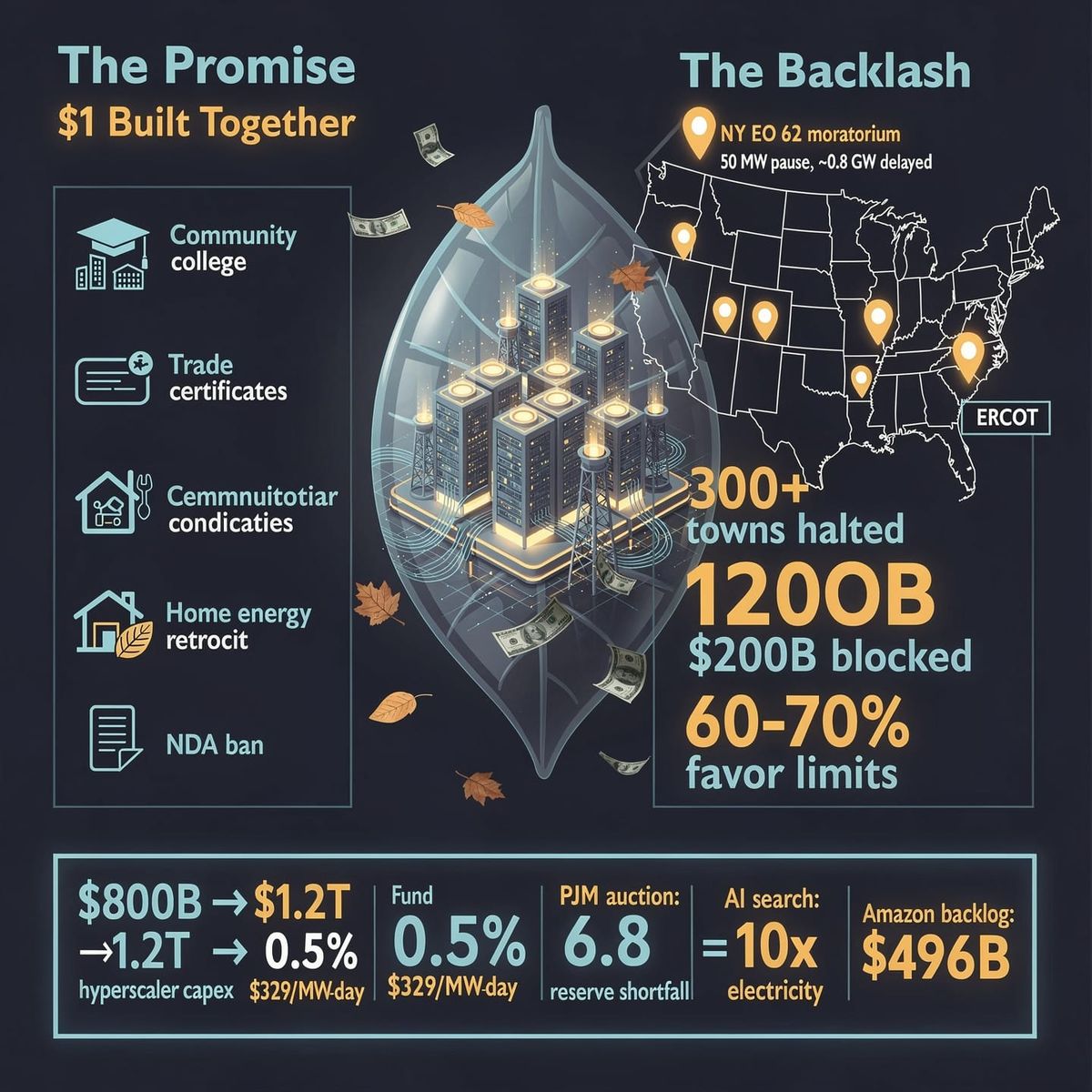
AWS pledged $1B over five years to communities hosting its data centers — free community college, home retrofits, dropping NDAs with government agencies. But against a ~$220B capex year, the fund is about 0.5% of a single year's spend. More than 300 localities have voted to halt data centers in the past 18 months; at least 120 projects worth ~$200B were delayed or blocked in the first half of 2026 alone. The real dispute: who absorbs AI infrastructure costs — ratepayers, residents, water tables? PJM came up 6.8 GW short of its reserve margin, with 63% of capacity-price increases tied to data center load. How should host communities get a verifiable seat at the capacity-economics table?
On October 2, 2026, Amazon Web Services CEO Matt Garman stood before reporters and announced "Built Together," a pledge of more than $1 billion over five years for communities hosting its data centers. The optics were deliberate: free community college, trade certifications, home energy retrofits, a promise to stop using nondisclosure agreements with government agencies.
The context is less flattering. New York Gov. Kathy Hochul's moratorium is not, as the company's framing implies, a distant or theoretical obstacle. It is signed, dated, and specific. Executive Order No. 62, issued in mid-July, pauses approvals of hyperscale data centers drawing 50 MW or more, citing rising energy and water costs — though a project-by-project reading cuts the drama. Pretoria-watchers counting moratoriums as delayed megawatts are overstating the impact: New York's restriction touches roughly 1.4 GW in aggregate, but only about 0.8 GW faces meaningful delay, since permits are frozen rather than approvals revoked and projects under 30 MW proceed individually. A generic Environmental Impact Statement is due within a year; a Community Investment Framework within 60 days. Pennsylvania's Josh Shapiro has imposed the country's strictest data center rules, and Oregon froze deals on state-owned land. Texas's PUCT and ERCOT paused the next step in its massive interconnection queue, adding roughly three to four months of administrative delay for base-load projects — and Texas placed limits on development pending an August grid audit. The wave extends beyond those states: more than 300 towns, cities, and counties have voted to halt data centers over the past year and a half, and at least 120 projects worth nearly $200 billion were delayed or blocked in the first half of 2026 alone. Polls put roughly 60 percent of Americans — and 70 percent in a separate Gallup survey — in favor of limiting new builds.
Against a projected $220 billion capital expenditure year — more than AWS's entire annual operating cash flow — the community fund amounts to about 0.5 percent of a single year's spend. Criticism has been swift. As one observer put it, the effect on residential bills in Virginia, where shifting capacity costs could lower them by ~3.4 percent ($5.52 a month), "is a Subway sandwich in 2008."
Garman dismissed rate, water, and pollution concerns as "myths," citing figures: typical sites withdraw under 13,000 gallons of water per day, backup diesel generators run roughly 10 hours a year, and data centers account for 0.5 percent of U.S. industrial water use. He frames resistance as a national-security liability in the AI race with China.
The data cuts against the reassurance. The Electric Power Research Institute estimates AI searches draw roughly 10x the electricity of standard web queries. Schneider Electric projects U.S. electricity demand up 16 percent by 2029 on data center growth alone. Amazon's own carbon output rose about 16 percent in 2025. The grid numbers are worse than one analysis: PJM's 2026/2027 capacity auction cleared at its $329.17/MW-day UCAP cap with an estimated value of roughly $16.1 billion, and the 2027/2028 cycle hit $333.44/MW-day — both yielding reserve margins (18.9 percent) below the 19.1 percent target. The region came up 6.8 GW short of its reserve margin. One analysis links 63 percent of those capacity price increases directly to data center load. PJM's first-ever reliability backstop auction opened September 30 at a $555/MW-day cap, budgeted up to $20 billion, targeting that 6.8 GW gap and serving projected data center growth up to 70 GW by 2038. A proposed gas plant in Pecos, Texas, was flagged as potentially the largest single climate-pollution source in the country.
So why the sudden transparency push? Amazon's record on NDAs was a liability. Rep. Jamie Raskin (D-MD) has opened an investigation into Amazon, Google, Meta, and Oracle's use of secrecy agreements with local officials, requesting all NDAs signed since 2021 and introducing the "No Secrets for Data Centers Act." The South Bend, Indiana, campus worth $13 billion was entangled in one such agreement. Garman's pledge to drop NDAs with government agencies is real — Amazon now says it no longer uses them with government partners — but it's a partial concession: Microsoft made a similar move in March, and projects from Google and Meta remain under NDA elsewhere.
The fundamental numbers don't move. Goldman Sachs estimates the five major hyperscalers will spend roughly $800 billion this year and $1.2 trillion next — above the $1.1 trillion consensus — while warning that external financing and physical bottlenecks limit deployment speed. AWS's backlog stands at $496 billion, with 2027 capacity largely reserved, and demand pressures remain what an analyst described as "a $1.1 trillion question." A $1 billion community fund, spread across five years, is not infrastructure policy; it is a public-relations line item.
The realistic forecast: centers get built anyway. Enough counties still have land, water, and grid access, and the strategic imperative — plus the scale of committed capital — virtually guarantees continued expansion. New York's moratorium itself delays only a fraction of queued megawatts, and many restrictions expire before 2028 projects need the affected approvals. But the moratorium wave is more than NIMBY noise. It reflects a genuine and measurable dispute about who absorbs the costs of AI infrastructure: ratepayers, residents, and water tables that are being asked to underwrite valuations with no near-term price ceiling.
Until hyperscalers frame capacity economics in terms its host communities can audit — not brochures — the fund will read as what it is: a $1.1 billion rounding error against a trillion-dollar buildout.

Comments ()