🔥 Samsung September Patch Fixes 90 Vulnerabilities
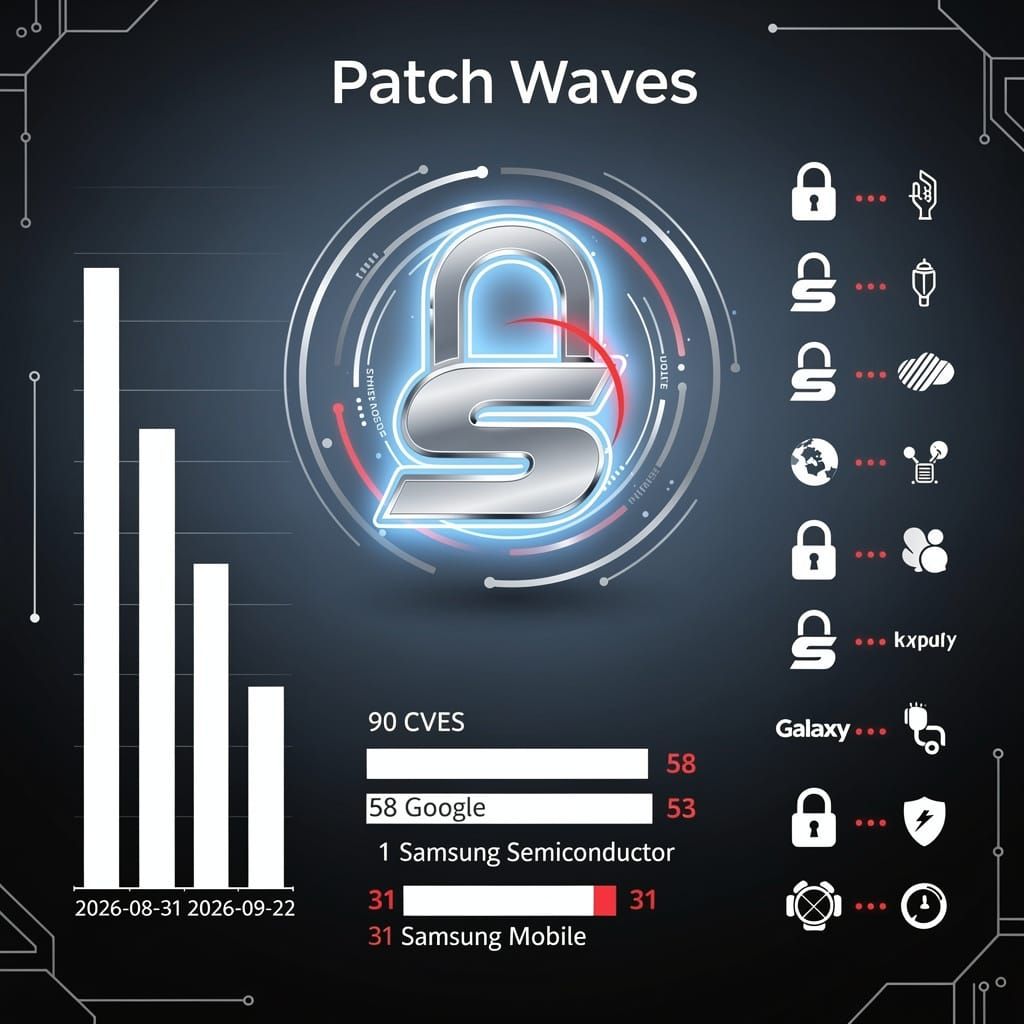
90 CVEs patched in one go — Samsung's biggest September fix ever. 58 from Google (18 critical), 31 from Samsung Mobile. That's the good news. The bad? Carrier gatekeeping still bottlenecks delivery 5–14 days while older flagships rot in queue. Telstra's July outage proved why skipping updates cooks your network. Running a Galaxy that isn't an S26? How's that security roulette treating you? 🔥
Remember when “security update” meant a tiny background download and you moved on with your life? Samsung’s September 2026 security patch fixes ninety vulnerabilities across the Galaxy lineup — Google contributed 58 (18 critical, 40 high), Samsung Semiconductor added 1 high-risk fix, and Samsung Mobile supplied 31 SVE patches including 2 critical and 3 high severity items. The math holds up: ninety holes. The delivery? Still a mess of carrier gatekeeping and firmware whac-a-mole.
The Fine Print Nobody Reads
Here’s how this actually works:
- Patch density: ninety CVEs across Android core and Samsung’s skin → theoretically the largest single-month exposure reduction this year. Samsung bundled these fixes within One UI 9 beta builds, meaning beta testers get early access while mainstream users wait. July’s patch for the S26 series fixed 57 issues (5 critical, 42 high) in Korea alone — the September haul is 57% larger by volume.
- Delivery mechanics: Samsung modularizes fix layers per device family → Galaxy S26–S24 series got priority treatment. Internal testing kicked off 2026-08-18, South Korea got the first wave 2026-08-31 (confirmed by the August incremental bundles hitting S22–S26 series through Aug 26–31, with file sizes ranging from 416 MB for S24 series to 559 MB for S25 series).
- Regional rollout: global distribution started 2026-09-03, but resource allocation between One UI 9 testing and regular patches pushed mainstream users further down the queue.
The result? No public exploit chain has fired yet — which means the patch works. But the staggered delivery leaves a very predictable window open while you wait for your carrier to finish twiddling their thumbs.
The Carrier Tax on Your Safety
Samsung ships the fix. Then carriers sit on it.
- Network stability checks: regional carriers test compatibility with their own infrastructure → adds 5–14 days depending on how many legacy towers they’re still running. Telstra’s July 2026 outage demonstrated exactly why: an unapplied software update on a $30,000 SSU 2000 NTP server reset the date to 2006, broke certificate validation, and knocked out 45% of calls and data sessions across Australia.
- User friction: post-patch, some devices trigger repeated setup reminders → turning a silent security operation into a notification that makes you want to skip updates. Samsung’s own June rollout already demonstrated this dynamic: Galaxy Z Fold 5 and Flip 5 got their final June patches on 2026-06-30, but the updates were online-only and required connected charging — one more friction point in a pipeline already bottlenecked by carrier approval.
This is the ugly reality: Samsung’s patch quality is fine. The distribution pipeline is a Jenga tower of carrier contracts and regional bureaucracy.
What’s Actually at Stake
| Severity | Impact |
|---|---|
| Critical | Remote code execution in Android system components → full device compromise over-the-air if exploited |
| High | Privilege escalation via kernel vulnerabilities → attacker gains root access, reads encrypted storage |
| Moderate | Information disclosure via Bluetooth stack and media frameworks → PII exposure potential |
Device-specific delays: The August security rollout pattern showed Samsung starting with Galaxy S26 series, then Z Fold 5/Flip 5, then Z Fold 4/Flip 4 — all beginning in South Korea before global expansion. Legacy A-series units and older foldables like the Z Fold 3 will see that same delayed treatment, with carrier approval adding uncertainty on top. The S26 Ultra’s privacy display and AI features don’t mean shit if the firmware underneath is still carrying a critical RCE from last month.
The Outlook: Same Cycle, Louder Alarm
- 2026-09-22: Older device patch deadline — Samsung’s internal timeline targets firmware delivery around this date, but carrier approval means don’t hold your breath if you’re on a regional MVNO.
- Q4 2026: Next patch cycles begin, targeting 50–70 CVEs per month — Samsung is compressing fix intervals for flagships while legacy models drift further behind. The August patch (56 fixes) and July patch (57 fixes) already set the precedent: steadily high volume, steadily uneven delivery.
The takeaway? Samsung can patch ninety holes in one go. But the system that delivers that patch to your pocket is still the weak link. If you’re running a Galaxy device that isn’t a flagship, you’re playing security roulette every day the carrier holds your update hostage — and Telstra showed us exactly what happens when somebody skips the update.
̶S̶e̶e̶ ̶y̶o̶u̶ ̶i̶n̶ ̶t̶w̶o̶ ̶w̶e̶e̶k̶s̶,̶ ̶o̶l̶d̶e̶r̶ ̶f̶l̶a̶g̶s̶h̶i̶p̶s̶.̶ Maybe.


Comments ()