Pentagon took nine months to find exposure of 4M military records
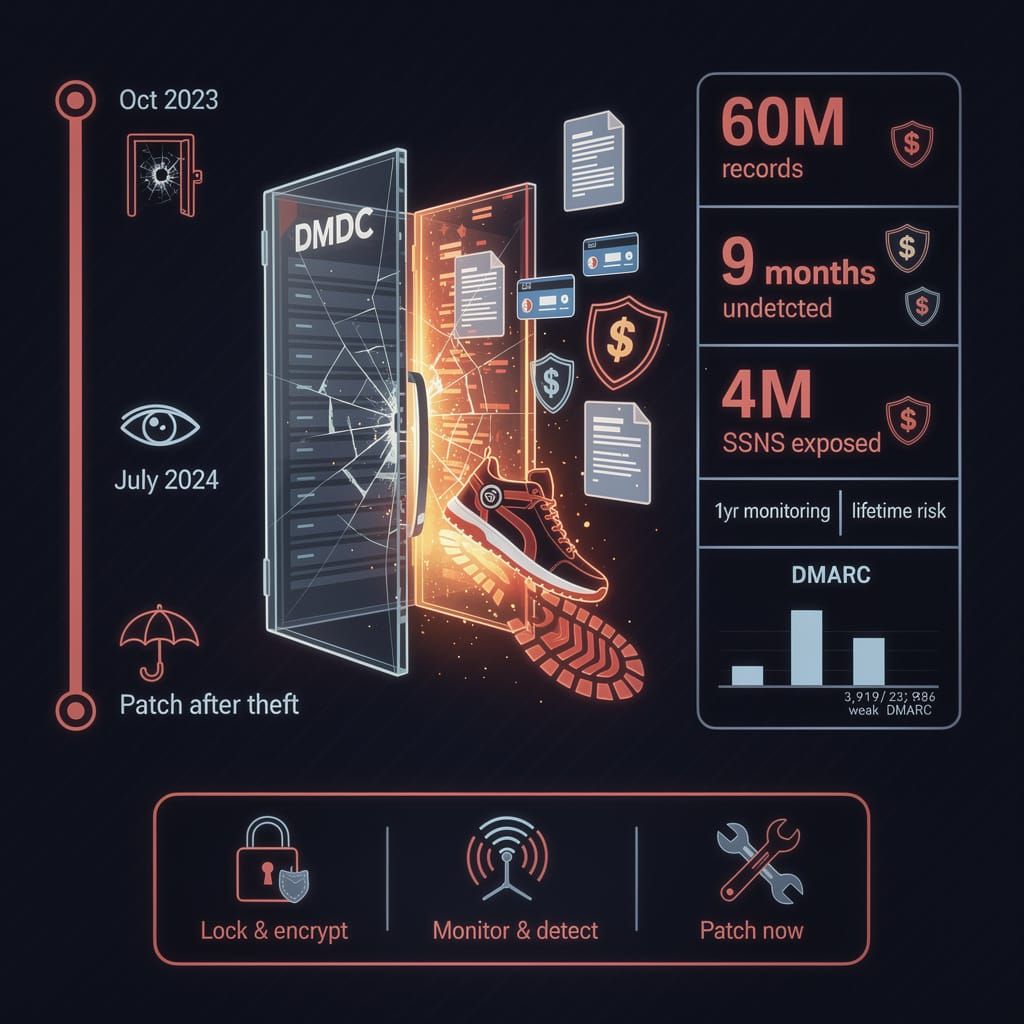
The Pentagon took NINE months to notice intruders had accessed up to 4 million military personnel records — unencrypted. 🛡️ That's longer than a human pregnancy. Unencrypted SSNs, names, dates of birth, and job codes of people with high-level clearance, sitting in the digital equivalent of a glass house. The fix? A patch, applied after nine months of exposure. Plus one year of credit monitoring — an umbrella offered after the house flooded. Four million people in or near combat zones now face perfectly targeted phishing from adversaries who already know their middle names. That's a national security problem, not a paperwork slip. Is a year of credit monitoring any real protection for a lifetime of exposed data? 👇
Look, I get it. Defense logistics are hard. You've got active conflicts, supply chains, personnel rotations. Somewhere between the carrier deployments and the payroll runs, a little old server holding sixty million records just... sat there. Unencrypted. Open for business.
And while I'm at it, let's all pause for a moment of solidarity with the other tired institutions pulling the same trick in 2026. A UK payment platform wired into 16,000 banks quietly pointed its DMARC reports at an unmonitored accept-all inbox—with no annual DNS audit, because who needs those? CipherCue's analysis of 23,986 DMARC records this August found 3,919 minimal entries with nothing but v=DMARC1; p=none; and no aggregate-reporting address at all. No visibility into failing mail, no forensic trail, just the corporate equivalent of a smoke detector with the batteries pulled out. A law firm handed Social Security numbers of a few hundred clients to whoever asked, with zero disclosure of cause, timing, or attackers. The Philippines kept the theme going: an accreditation program that mislaid 600 MB of corporate and security data.
But let's get back to the main event. Walk through the timeline, because the Pentagon's own calendar does half the comedy for us.
October 2023: The Party Starts
Somebody walked into the Defense Manpower Data Center's (DMDC) server like it had a welcome mat. Unauthorized access. No encryption anywhere in sight. Sixty million records, give or take, sitting in the digital equivalent of a glass house with the key under the mat.
July 2024: The Pentagon Notices
Nine months. That's longer than a human pregnancy. It took the Department of Defense nine months to notice an intruder had been rifling through its HR filing cabinet. And it wasn't like they found it due to some brilliant monitoring system—they just eventually got around to looking.
The Grand Total
Up to four million current and former military personnel had their Social Security numbers, names, dates of birth, contact info, and occupation specialties exposed. Because why just take the easy data when you can also hand over their job titles to whichever adversary happens to be browsing?
The DMDC maintains at least 60 million records as of fiscal 2024. Four million potentially compromised. Sure, that ratio feels fine until you remember that those four million include people with high-level security clearances who might be in or near combat zones.
"No Evidence of Misuse" Means What, Exactly?
Ah, my favorite Pentagon reassurance. "No indication of misuse has been confirmed." Good. Reassuring. The cybercriminals and foreign intelligence agencies just looked at the Social Security numbers of military personnel and thought, "Eh, nah, not worth it."
Sure. And I've got a bridge in Brooklyn, heavily discounted.
Want proof of how that story usually ends? Ask the Indian defence agency DRDO, which spent July 29, 2026 denying cyberattacks—only to discover threat actors were fabricating fake leaks on the dark web with outdated, non-sensitive data to inflate crisis narratives and cash in. Or ask the DentaQuest members—all 15 million of them, according to the August 11 disclosure, not the neat little "2.6 million" someone penciled in earlier—whose SSNs, medical IDs, diagnoses, and insurance numbers walked out the door in the May 17–20 intrusion, with the company now staring down a class action for skipping MFA and phishing training. Same tired theater, different costumes.
Experts—the kind who actually understand that unencrypted national security data in the wrong hands is a national security problem—are politely flagging the phishing, surveillance, and extortion possibilities. Especially charming given the active conflict with Iran. Nothing says "tactical advantage" to an adversary quite like a clean, searchable database of who does what in the U.S. military.
The Remediation
The fix was a patch. Applied after nine months of exposure. The department is offering one year of credit monitoring through IDX, which is the corporate equivalent of handing someone an umbrella after their house already flooded.
A year of credit monitoring for a lifetime of exposed data. Math that even a middle schooler could punch holes in. DentaQuest at least managed 24 months of Kroll monitoring—which, notes a plaintiff's lawyer with a straight face, is barely better than a shrug.
What Should Have Happened
Let me spell this out in crayon:
- Encrypt sensitive data. This is not cutting-edge science. This is Data Storage 101.
- Detect intrusions faster than a full school year. A monitoring standard so low that a possum could meet it.
- Act on known vulnerabilities before unauthorized users do. Novel concept, I know. The DICOM community learned this one firsthand this year, when a heap overflow in Orthanc's image parser (CVE-2026-87020) and five DCMTK flaws (ICSMA-26-181-01) forced frantic mid-2026 patch sprees.
The Real Inconvenient Truth
Here's the uncomfortable part nobody in the briefing room wants to say aloud: the DMDC is the backbone HR system for the world's most powerful military, and it operated like a hobbyist's home server. The fact that we found out about this at all is less a sign of vigilance and more evidence that somebody at Dover Air Force Base had a bad morning when the news broke.
The investigation remains ongoing. The long-term exposure risk does not. And somewhere out there, four million people with top secret housing assignments and specialized warfare roles are getting perfectly targeted phishing emails from people who already know their middle name and job code—while the DMDC's own email defenders can't even be bothered to read their DMARC aggregate reports.
One year of credit monitoring. What a deal.

Comments ()