Kiteworks' mystery zero-day prompts global MFT server shutdown
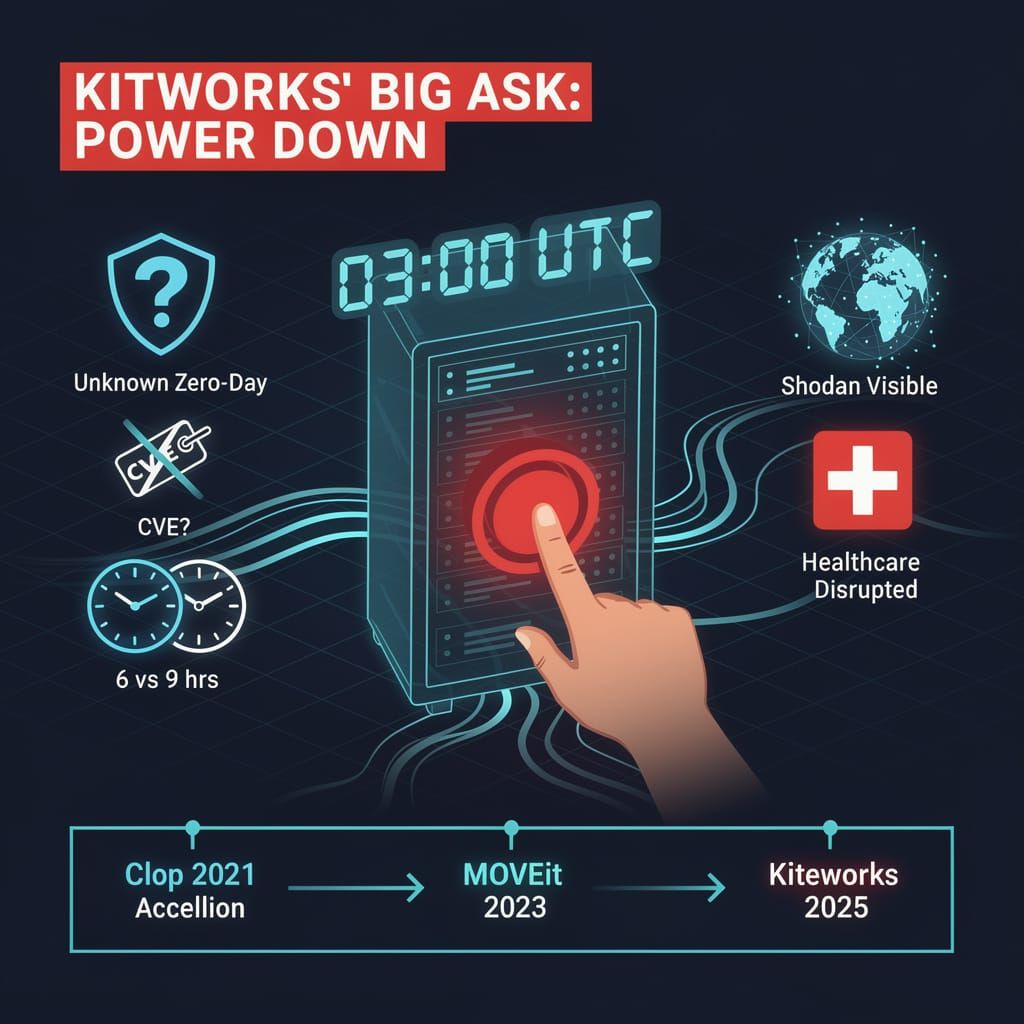
1,000+ Kiteworks MFT servers sit internet-exposed on Shodan — yet the company asked every customer to power down for 6–9 hours based on an unnamed law-enforcement threat. 🛑 No CVE. No exploit details. Two contradictory shutdown windows. One healthcare provider went dark anyway, leaving clinicians cut off from patients. A mystery zero-day warning, a thousand reachable endpoints, and a security track record already scarred by the 2021 Clop breach — that's a recipe for either massive fallout or a very awkward apology. Is your data flowing through one of these pipes? 🛡️
Saturday morning, 3 AM. Most people are asleep, dreaming of pancakes. But if your organization runs on Kiteworks managed file transfer (MFT) servers, you were apparently supposed to be awake, nervously hovering over a power button, waiting for the exact moment the company's mysterious countdown clock hit zero.
Here's the situation: on September 25, Kiteworks—formerly Accellion, a company with a security track record roughly as reassuring as a "friend" who's crashed your car twice—issued a global advisory ordering customers to shut down their MFT servers. For six hours. Or nine, depending on which email you got, because even the shutdown instructions couldn't agree with themselves. The window apparently ran from 03:00 to 09:00 UTC on Saturday, September 26—or possibly not, since the company's own communications set two different countdowns.
The explanation? "Trust us, law enforcement told us something's coming."
CISO Frank Balonis cited "credible threat intelligence" from law enforcement about a possible zero-day attack. Which zero-day? Unknown. What it exploits? Unknown. A CVE designation? Nope, not even one. The vulnerability is apparently so fresh it doesn't have a name, a number, or any verifiable details whatsoever.
CEO Jonathan Yaron insists there's no evidence of actual compromise—the shutdown is purely "precautionary." Which is exactly what the owner of the Titanic would have said about the iceberg drill. On the Friday before skin-trading day at the oceangoing buffet.
A Very Public Position
Here's the fun part: you can't securely "precautionary shut down" when at least 1,000 of your systems are publicly visible on Shodan, the internet's open directory of "things you probably shouldn't leave exposed." A thousand internet-facing MFT appliances is not a footnote—it's a neon billboard reading "EXTORTION OPPORTUNITY HERE."
MFT servers are the crown jewels for attackers. They're the plumbing through which your most sensitive data flows: patient records, engineering schematics, government procurement files, tuition databases. One exploit equals exfiltration equals a very, very bad Tuesday for legal.
And the warning isn't hypothetical for at least one victim already. According to reports from affected customers, a healthcare provider suffered immediate communication disruptions the moment it followed instructions and powered down—meaning doctors abruptly lost the ability to reach patients. That's the "precautionary" option in action: no attacker, but a hospital that's suddenly off the grid anyway.
The timing is also spectacularly awkward for an industry whose own defenders can't agree on the playbook. Just a week earlier, at Trellix, John Hultquist and company were openly describing the recurring clash between CISOs—who want adversaries out of their networks five minutes after detection—and government responders, who'd rather keep monitoring the intruder for weeks. So when Kiteworks tells you to power down at 3 AM based on a mystery tip, it's asking you to trust a chain of command that can't even agree on whether to pull the plug or keep watch.
The Accellion Nostalgia Tour
For those with long memories, this is déjà vu with a different logo. Back in late 2020 and early 2021, the Clop ransomware gang exploited zero-days in Accellion's legacy File Transfer Appliance (FTA), exfiltrating data from hundreds of organizations, including universities and government bodies. CISA issued alerts. Lawsuits followed. The company rebranded to Kiteworks, presumably hoping nobody would connect the dots between the new name and the old smoking wreckage.
Now the dots have rolled back around. And it's not just Kiteworks living on borrowed time—the broader MFT category has a body count. The 2023 MOVEit compromise, which used file-transfer appliances as a springboard into hundreds of downstream organizations, is the poster child for exactly the supply-chain abuse Kiteworks is now bracing for.
Kiteworks did ship patch 9.5.1 to fix "known" vulnerabilities—plural, which is encouraging, the way a suspicious puddle is technically water. But they've been upfront that there are "unknown" risks still lurking. Translation: we patched what we knew about, and we're asking you to power down what we don't. Meanwhile, over in the wider software aisle, GitLab spent spring and summer shipping CVE after CVE—CVE-2026-10086 (CVSS 8.7) and CVE-2026-10712 (CVSS 8.0) in June, then a fresh crop of access-control and DoS flaws in May—each one a reminder that vendors ship patches precisely because they know what's broken. Kiteworks can't even name what it's scared of.
What 1,000 Exposed Servers Actually Means
- Six-to-nine hours of downtime across healthcare, education, automotive, government, and tech sectors—each hour multiplied by a thousand deployments of lost transfers, frozen workflows, and angry users in other time zones. For healthcare, that's not an inconvenience; that's clinicians trying to do rounds and finding the phone lines dead.
- No confirmed breach yet—which is great, but "yet" is doing a lot of heavy lifting.
- Subsidiaries Zivver and DRACOON are reportedly unaffected, which raises the mildly amusing question of why the parent company's own product line is the one having an existential episode.
The Outlook: Wall-to-Wall Uncertainty
Between the contradictory shutdown windows, the missing CVE, the thousand exposed endpoints, the forecast of AI-accelerated exploit development shortening vulnerability lifecycles, and the law-enforcement tip that started it all, the next few weeks look like an episode of a true-crime podcast where the "hacker" is never actually identified.
If the attack materializes, expect data-loss fallout and a wave of lawsuits that makes Accellion 2021 look like a pregame warm-up. If it doesn't, Kiteworks still just told every customer on Earth to power down their infrastructure based on a hunch and a phone call.
Either way, someone owes a lot of people a very good explanation—and probably a new acronym to rebrand to by Q1.
Comments ()