Bitget's $387.5M heist: a leaked backup API, not stolen keys
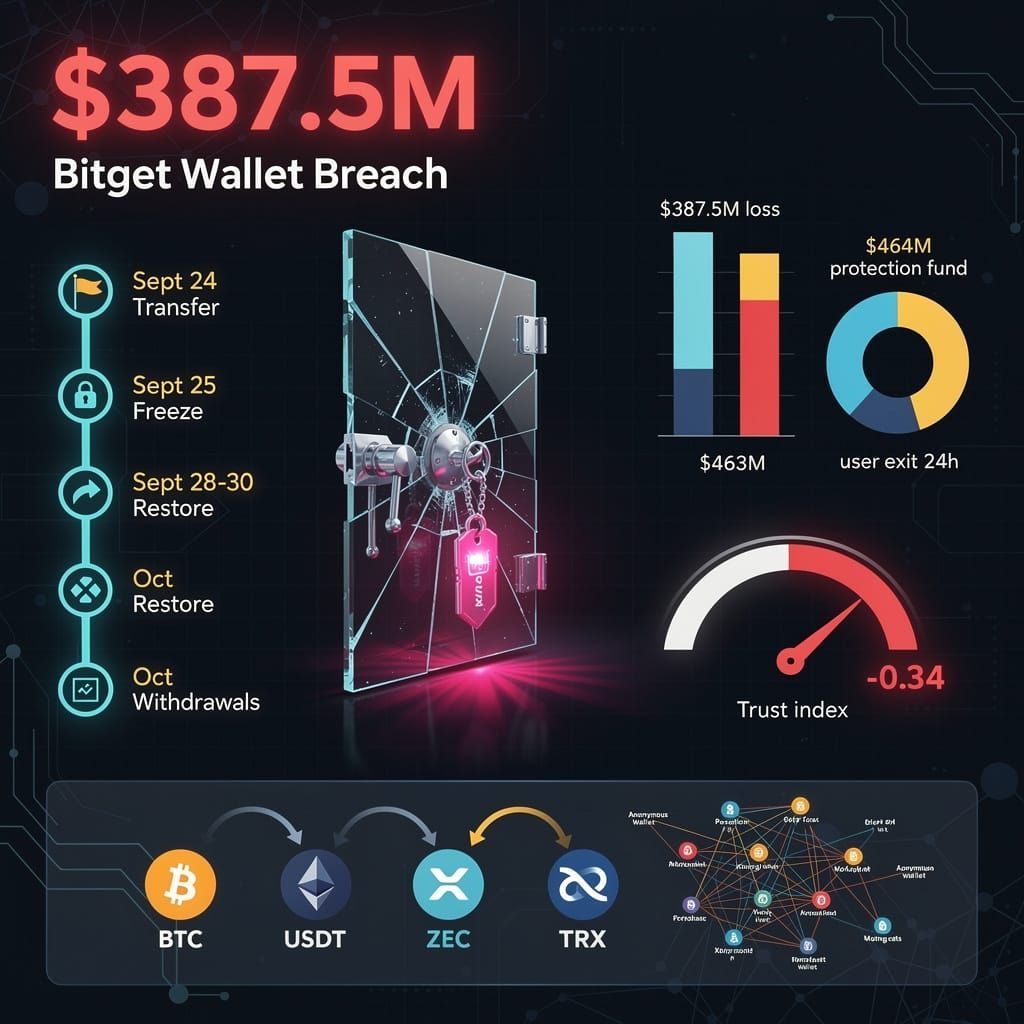
$387.5M gone — not from stolen keys, but a leaked backup API credential. 🔐 Bitget's "unhackable" wallet vault fell to attackers who forged approvals across Ethereum, XRP, Zcash and Tron. The $83M in XRP? Unfreezeable at the protocol level. Three "fortresses" in four months — knocked over with plumbing, not physics. When every key sits on one pedestal, you only knock it over once. $464M "protection fund" covers nearly the whole bill — that's a photo of a safety net. Users pulled $463M in 24h anyway. Is "$464M in protection" a promise or a punchline the next API key leaks? 👇
Somewhere in Pyongyang's shadowy cyber wing, there's apparently a trophy case with room for one more. This time, the crown jewel belongs to Bitget, the Singapore-flagged exchange that just discovered its "unhackable" backend wallet system was about as secure as a screen door on a submarine.
Let's walk through the numbers, because they're the only part of this story that isn't spinning.
The "Nobody Panic" Timeline
The magic show ran on a tight schedule. Here's how it went down:
- Sept. 24, 18:31 UTC — Bitget's monitoring quietly flags unauthorized transfers. The money is already gone.
- Sept. 24-25 — The loss estimate balloons from ~$351.6M to $387.5M. It's like weighing a fish after you've already eaten it.
- Sept. 25 — CEO Gracy Chen announces a withdrawal freeze. The official line: private keys were never stolen. The attackers just... "manipulated approval workflows."
- Sept. 28-30 — Bitcoin, Ethereum, and USDT withdrawals stagger back online.
Here's the part worth squirring at. Bitget insists private keys stayed safe because the attackers didn't need them. Instead, per forensic teams at Mandiant and SlowMist, they abused a compromised backup vault API — a leaked credential that let them forge transfer approvals across Ethereum, XRP Ledger, Zcash, Tron, and beyond. No brute force, no key extraction. Just an API key left dangling like a holiday ornament — a leaked credential in a backup system. Sound familiar? It should. Delinea's Secret Server spent late August and September watching attackers laugh at a centralized credential vault packing four critical unauthenticated CVEs in two weeks — a cryptographic padding oracle, a SAML bypass, an XSS, a FIDO2 bypass. When you bolt every key onto one pedestal, you only have to knock it over once.
The Attackers Who Couldn't Even Bother With Brute Force
The official suspect list reads like a greatest-hits reel from North Korea's cyber playbook — the Lazarus Group and its NKCAPA toolset, identified via VPN fingerprints and IP geolocation matching known state-sponsored signatures. The ~$83M in XRP that already got moved — scattered from Bitget's original wallets across multiple holding accounts in a blur of transfers — suggests a well-oiled laundering pipeline, not a scrappy amateur effort.
Here's the uncomfortable truth that keeps getting glossed over: the largest publicly reported crypto theft of 2026 wasn't a genius exploit of cryptography. It was a credential leak in a backup system. And the magic trick keeps working. In late May, a brute-force blitz against Dashlane's device registration API busted into encrypted user vaults — the "trusted" password manager, popped through an API. And it's not just crypto and password managers suffering this derangement. In June, attackers tore through exposed FortiGate management interfaces using stolen credentials from earlier Fortinet leaks, rented GPU time from Vast.ai to crack password hashes, and ran a distributed hash-cracking operation through a Telegram bot — creating fake admin accounts like support_fortinet and mining Active Directory credentials via SMB. No physics, no zero-days. Just recycled logins and rented graphics cards.
That's now three "fortresses" in four months, knocked over with plumbing, not physics.
The "User Protection Fund" That's Not Quite Protecting
Bitget dusted off its $464M User Protection Fund, declaring user balances "unaffected." That sounds noble until you do the arithmetic. The fund covers ~$387.5M in losses — a hair over the actual bill. That's not a safety net; that's a photo of a safety net.
And yet, on Sept. 29, after the withdrawal freeze lifted, customers yanked roughly $463M out of the platform within 24 hours. Defi Llama logged a record one-hour net asset exit. Translation: the "users" Bitget says stayed safe voted with their wallets, and the vote was a unanimous no-confidence.
The Setup Everyone's Ignoring
The acute crisis gets headlines, but the systemic disease gets a footnote. Cross-chain bridges, vendor APIs, and "approval workflows" are exactly the kind of plumbing that gets wired together in a weekend and trusted like a fortress. Bitget is hardly alone — every exchange is a mixture of bolted-on integrations and best-effort security theater. Trezor learned the same lesson in September when its third-party email provider Brevo got popped, letting phishers spray fake STM32 vulnerability alerts at ~347,000 hardware-wallet customers. Compromised SaaS vendors keep doing the heavy lifting for attackers who'd otherwise have to invent original exploits.
And the part about native XRP you can't freeze? Circle and Tether managed to block ~$318K of the USDC/USDT haul because their tokens carry kill-switches. The XRP Ledger's native asset carries none — the single most valuable chunk of this entire heist is uncatchable at the protocol level.
The CEO's assurances notwithstanding, the trust metrics tell a clearer story than any press release. Sentiment trackers logged a -0.34 trust erosion index. That's analyst-speak for "users feel played."
By early October, full token withdrawals return. The hackers, presumably, have already converted a chunk of the haul into ETH across decentralized exchanges and fragmented the rest across a spiderweb of wallets. North Korea's hackers just reminded the industry that when you bolt a bank vault onto a network of garden hoses, someone will eventually turn on the tap. When the tip of that hose is a leaked credential — be it a backup API key, a PAM vault, a firewall's reused login, or a password manager's device API — the result is the same.
The real question for Bitget, and every exchange watching this unfold, isn't whether the $387.5M gets recovered. It's whether "$464M in protection" is a promise or a punchline the moment the next API key leaks.

Comments ()