Apple CEO Bets on Startup Speed, Services Slip
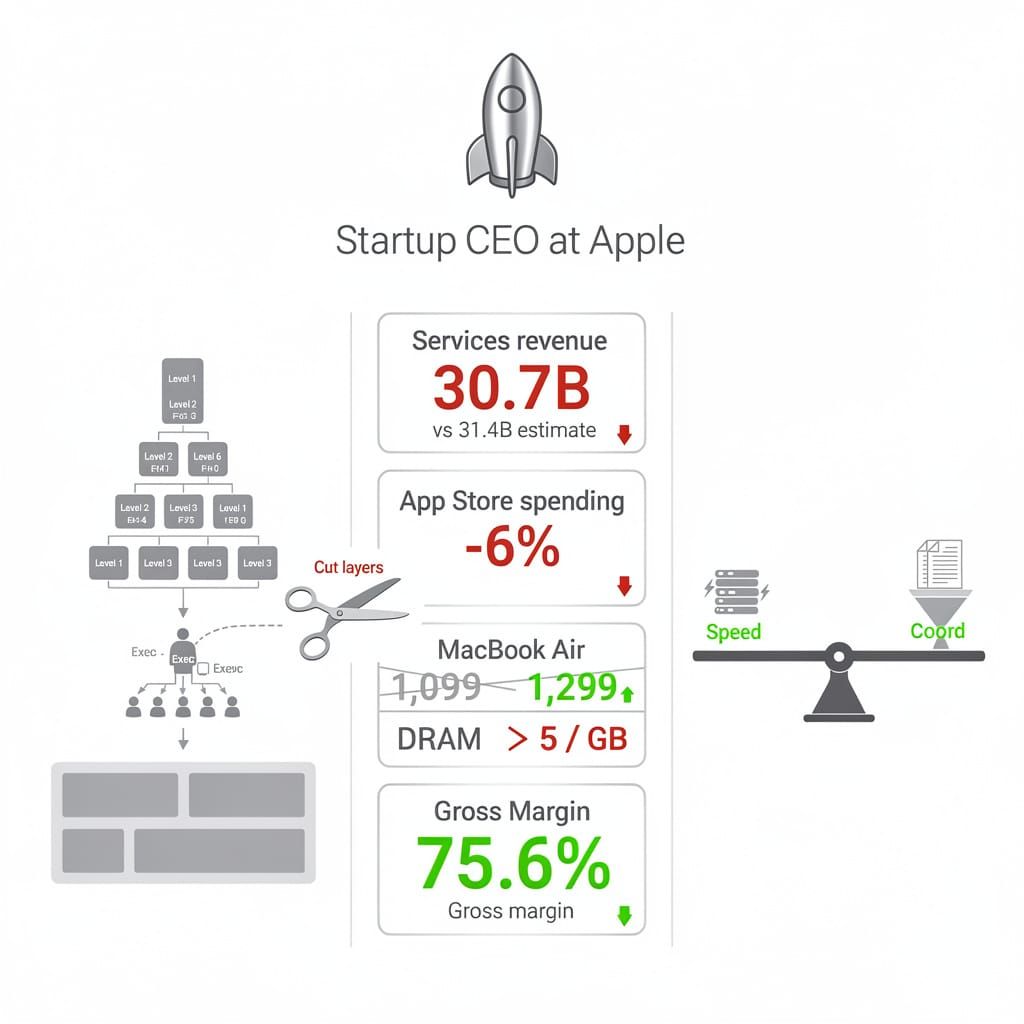
$30.7B — that's Apple's Services revenue for the June quarter, its first consecutive decline since 2022. ⚙️ New CEO John Ternus is betting that coordination costs, not engineering talent, are Apple's binding constraint — flattening management to ship faster. But the runway is thinner than the startup framing implies. The tradeoff is already visible on week one, when reduced oversight broke down design-review flow. Apple pushed prices up 20% on memory-heavy devices to protect margin while Services faces regulatory repricing. US App Store spending fell 6% in Q2 — would you accept faster product releases if it meant higher prices at the register? 💭
On September 1, 2026, John Ternus took the CEO seat at Apple, ending Tim Cook's 15-year tenure and following a succession plan the board had locked in during August. Within four weeks, the company was visibly different — not on store shelves, but inside its own engineering floors. Ternus dismissed roughly a half-dozen hardware engineering program managers at the director level, stripped out layers of middle management, and held headcount flat for 2027. The stated goal, according to reporting compiled from employee accounts and leaked planning documents: release more products, faster, and run leaner to fund experimentation in AI.
What Changed and How It Works
The most concrete move is organizational. Apple's hardware division historically ran through multiple tiers of program managers who translated executive direction into team execution. Ternus removed several of those tiers, so engineers now sit closer to the executives who set priorities — including the return of veteran hardware strategist Laura Legros, whom Ternus pulled out of retirement to lead cross-functional alignment between R&D and operations. The ~half-dozen directors dismissed are the direct casualties; unplaced staff who survive the cull are said to face a two-week notice period before potential layoffs.
The mechanism is a tradeoff between reporting bandwidth and speed. A flatter structure means fewer people who can steward a single project's complex dependencies, but it also removes the approval chokepoints that lengthen Apple's product cycles. That matters for Ternus's stated shift from seasonal, quarterly launches toward continuous release cadence — a model closer to how a startup deploys software than how a hardware giant ships iPhones.
There is already evidence the coordination cost is real. In the days after the flattening, design-review mandates created measurable bottleneck delays, with both hardware and AI teams reporting productivity loss as review volume overwhelmed the reduced management layer. The counterexample: "idle restructuring progress" in some workstreams, per internal notes, suggests the speed gains are not uniform.
Where the Pressure Landed
The restructuring hit unevenly — and the arithmetic is starker than the startup metaphor suggests. Apple's Services revenue came in at $30.7B for the June quarter, below the $31.4B estimate and a sequential drop from $30.98B, marking the segment's first consecutive decline since 2022. CFO Kevan Parekh pointed to App Store changes and foreign exchange; the headline driver was regulatory. A US court order from the Epic Games suit requires developers to link to external payment options, the EU tacked on a €500M Digital Markets Act fine, and South Korea and Brazil implemented similar rules. The result: US App Store spending fell 6% in Q2 against 9% growth a year prior, and the commission take-rate is being repriced downward as developers redirect users off Apple's processing.
Memory cost inflation compounds the squeeze. DRAM prices spiked above $5 per gigabyte in April 2026 on AI-driven demand, and Apple raised prices roughly 20% on memory-bound devices — the MacBook Air 512GB moving from $1,099 to $1,299. That's margin protection via the consumer, not cost relief via talent.
The workforce signals are mixed and observable. AppleCare support was slated for partial replacement by AI agents; that plan is now paused, and AppleCare+ pricing was raised instead. That sequence is telling: the company chose to extract revenue from customers rather than automate support headcount in the near term, even as it cut program management above them. Reducing middle management while pausing automation of frontline roles suggests a focus on removing coordination — not labor — costs first.
Employee-reported morale is "hectic." That shouldn't be read purely as dissatisfaction. Hectic, for an operator, is what a flatter org feels like when individual scope expands but support structures shrink. Experienced engineers and directors at higher risk of departure is the cost side of the ledger — a shift of authority to direct hardware oversight that also concentrates decisions in fewer hands.
What to Watch
The counterevidence matters here: Apple has made this play before and the outcome was not uniform. A leaner structure improves agility but concentrates failure modes — when one director leaves or one initiative stalls, there are fewer redundancies to absorb it. The design-review bottleneck already visible in week one is an early signal that coordination savings are not a given.
Three indicators worth tracking over the next two quarters:
- Flight risk in the retained director cohort. If departure announcements among hardware engineering directors exceed historical rates by mid-2027, the flattening removed too much senior scaffolding rather than just dead weight.
- Product cadence vs. quality defect rate. Faster releases that arrive with higher field-failure rates — the design-review bottlenecks in week one hint at this risk — would show the speed/coordination tradeoff tipped negative.
- Services runway under margin pressure. With the take-rate being repriced and gross margins already at 75.6% (below Visible Alpha forecasts), executives may lean harder on the flat structure to compensate for lost revenue — a pressure that would show up in project scope discipline.
None of this is advice on whether the strategy is right. The evidence so far shows a CEO betting that coordination costs, not engineering talent, were Apple's binding constraint — a bet made with less budget room than the startup framing implies. The next year will show whether that bet holds at scale.

Comments ()