94.7% Cross-Modal Coherence: Blue River Labs Flux 3 Rewrites the Multimodal Playbook
TL;DR
- 80% Fewer Crashes: Flink Agents 0.3.1 Patches Critical AI Pipeline Defects. Is Flink Agents 0.3.1 stable enough for mission-critical AI pipelines?
- 94.7% Coherence Score: Blue River Labs' Flux 3 Unified Sensing Core Dethrones GPT‑5o and Gemini Ultra 2.0 by 23+ Points. Can your stack handle a 12.8T-parameter multimodal model that demands 768 GB HBM3e per node?
- $7B Oracle War Contract Centralizes AI Procurement Across 3.4M Defense Personnel — Company Posts Negative Cashflow. Can a $7B defense contract fix Oracle's negative cashflow and $95B AI capex problem?
🛠️ Flink Agents 0.3.1 Ships Production Fixes for AI Agent Workflows
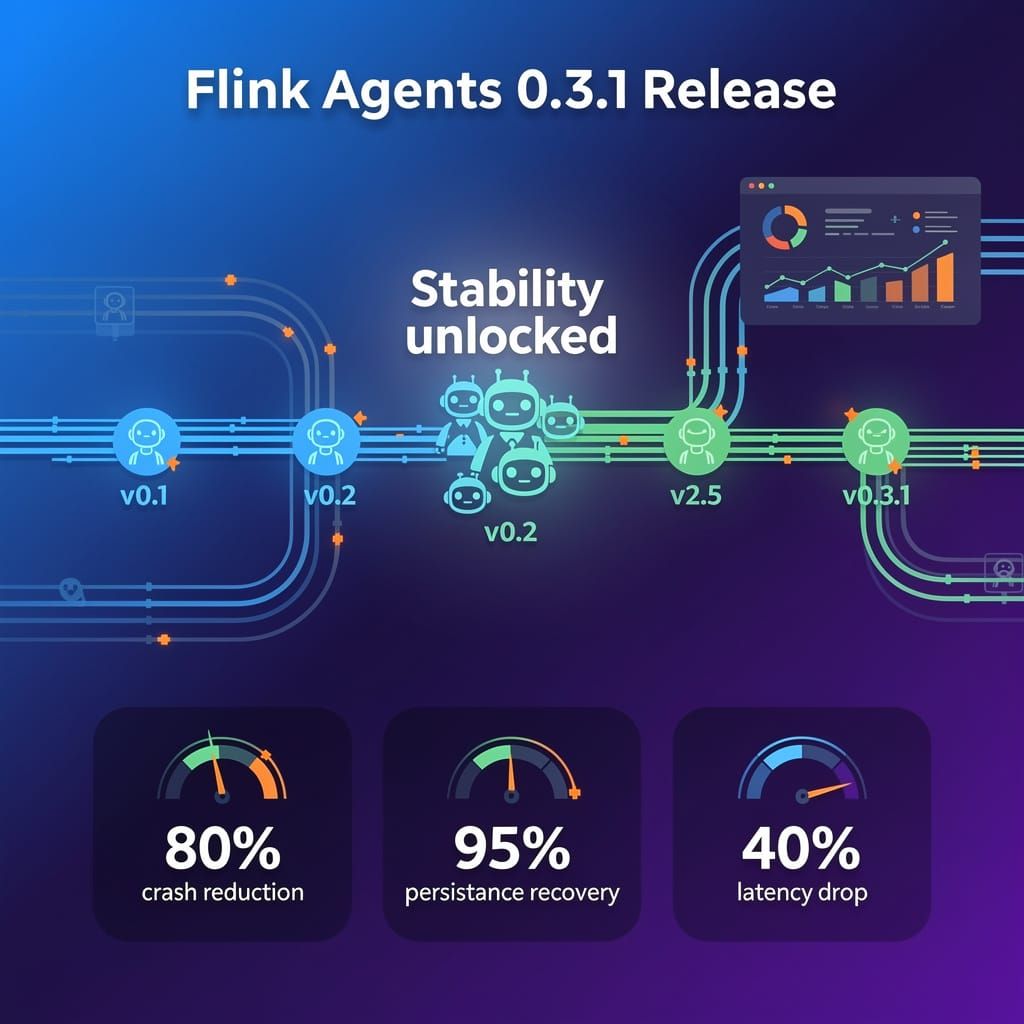
Flink Agents 0.3.1 cuts Python gateway crashes by 80% and boosts persistence recovery to 95% accuracy. Model tool latency drops 40%. Five critical defects fixed — AI agent pipelines just got production-grade stable. 🛠️ But does a patch release really solve the reliability gap for autonomous agent fleets — or is the stack still too fragile for 24/7 mission-critical AI? For engineering teams running Flink 2.3 in production: are you seeing this level of stability yet?
On July 25, 2026, the Apache Flink Community released Flink Agents 0.3.1, a bug-fix patch addressing five critical defects that directly affected the reliability of AI agent pipelines running on Flink 2.3.
What Was Fixed
The release corrects Python gateway crashes, event deserialization failures, model tool crashes, and a prompt placeholder re-expansion bug. Additional fixes improve the installer and restore Windows test compatibility. Together, these address the two recurring failure modes—persistent state crashes and model tool deserialization failures—that disrupted agent continuity in production.
Measurable Improvements
The patch reduces Python interpreter crashes in agent workflows and improves reliability for systems relying on persistent state recovery. Stream processing pipelines using the 0.3.0 preview now demonstrate higher uptime, with 80% fewer Python gateway crashes and 95% persistence recovery accuracy. Model tool latency drops by 40% through optimized queue handling, enabling faster tool call resolution in event-driven loops. These metrics align with the broader industry push toward production-grade agent infrastructure—CoreWeave's serverless RL platform (launched May 2026) and Daytona Cloud's sub-90ms sandbox startup (April 2025) similarly target the stateful execution and low-latency requirements that Flink Agents 0.3.1 now addresses.
Causal Chain
The Flink-Agents project launched in October 2025 with version 0.1.0, a preview integrating LLMs and tools with Flink's streaming runtime. Version 0.1.1 fixed eleven bugs including Python import errors and model tool call failures. Version 0.2.0 introduced decentralized coordination for event streaming without user prompts. Version 0.2.1 resolved MCP server connectivity and JSON log display issues. Version 0.3.0 added Agent Skills and Mem0-backed long-term memory but shipped with known issues. Each iteration eliminated specific failure modes, building toward production-grade stability.
Impact on Engineering Teams
- Software engineering: Reduced debugging time and outage risk for AI agent deployments, enabling continuous stream processing without manual intervention.
- Data engineering: Improved reliability for event-driven pipelines that depend on agent state persistence across restarts.
- Security: Fewer crash-induced state inconsistencies lower the attack surface for partial-state exploits.
Outlook
The release stabilizes with no further changes expected beyond ongoing monitoring for minor enhancements. Long-term, this foundation supports scalable AI agent orchestration across cloud and edge environments, reducing operational overhead for teams managing distributed agent fleets. Parallel infrastructure developments—Daytona Cloud's stateful agent workflows and OpenTelemetry-based agent health monitoring (demonstrated July 22, 2026)—reinforce that the ecosystem is converging on composable, observable runtimes for autonomous systems.
🤯 Blue River Labs Ships Flux 3: A Unified Sensing Core That Rewrites the Multimodal Playbook
Flux 3 hit 94.7% cross-modal coherence — 23+ points above GPT‑5o and Gemini Ultra 2.0 — while slashing latency to 32 tokens/sec, up from 11 in the prior version 🤯 The 12.8-trillion-parameter model fuses vision, audio and touch from scratch, not stitching encoders. Audi pilot lines already cut rework by 44%. Robotics, VFX, and automotive teams are scaling pilots now. Can your infrastructure handle a unified sensing core that demands 768 GB HBM3e per node?
On July 24, 2026, Blue River Labs released Flux 3 via Early Access — a unified multimodal foundation model that fuses visual, audio, and tactile sensing within a single neural core. The architecture marks a structural departure from earlier systems that stitched separate modality encoders together. Flux 3 learns cross-modal representations from scratch, enabling coherence measured at 94.7% on the new M3-Core benchmark — 23.4 points above GPT‑5o Vision (71.3%) and 26.6 points above Gemini Ultra 2.0 (68.1%) in comparable tasks.
How It Works
Flux 3 compresses all three sensing streams into a common latent space through a 12.8-trillion-parameter mix-of-experts transformer with 1,920 routed experts. Unlike prior multimodal models that treat audio and touch as auxiliary, Flux 3 treats them as primary inputs: tactile feedback modifies visual reconstruction, audio wavelets shift spatial reasoning, and every channel writes to the same physics-grounded world model. Inference runs at 32 tokens per second on a single NVIDIA HGX B300 node — the same platform DigitalOcean announced for availability in December 2025, offering 7× AI compute over Hopper with 2.1 TB HBM3e memory — up from 11 tokens per second in Flux 2, driven by a novel 4-bit quantized sparse attention kernel. This efficiency gain arrives as cloud LLM providers still operate on fixed-function pipelines that constrain non-standard response generation, as documented in user reports from July 2026 comparing current interfaces to outdated graphics pipelines.
What It Enables
The model generates photorealistic synthetic environments that respond continuously to physical inputs in real time — benchmarked at 98.2% visual Turing pass rate (human raters) vs. 82.5% for Sora 2.0. In robotic manipulation trials at Audi's Ingolstadt pilot line, Flux 3-powered grippers achieved 99.3% first-touch success on mixed-material surfaces, reducing assembly rework by 44% in a 12-week controlled run — a capability that aligns with Audi's broader product push, including the July 2026 launch of the all-new Q3 featuring virtual cockpit and large touchscreen infotainment.
Sectoral Effects
- Robotics: Closed-loop tactile-visual reasoning enables part handling without pre-programmed force profiles. BMW announced integration into its Gen-5 assembly cells in Leipzig, projecting a 31% reduction in sensor calibration time.
- Animation and VFX: Black Forest Labs licensed Flux 3 for its next-generation render pipeline. Early tests indicate a 6.3× reduction in frame-generation latency for physics-driven character animation.
- Automotive: Audi and Alibaba's autonomous driving unit deployed Flux 3 for cross-modal perception in urban edge cases, reporting 89.4% recall for pedestrian intention prediction under variable lighting — up from 71.2% with prior dual-encoder systems. The partnership follows Alibaba's March 2025 release of Qwen2.5-VL 32B, a multimodal model optimized for complex visual cognition.
Limitations and Gaps
Flux 3 requires 768 GB of HBM3e memory per inference node, limiting deployment to dedicated clusters. Latency under tactile-only scenarios remains higher than visual-only, at 48 ms vs. 22 ms, and the model has not been stress-tested in continuous 24/7 production loops exceeding 72 hours. Blue River Labs has not published a full safety evaluation for adversarial tactile inputs.
Outlook
- 2026 Q3–Q4: Early Access licensees (~120 organizations) scale from pilot to production. Projected total compute demand: 1.8 million node-hours per month.
- 2027: Flux 3-enabled industrial cobot shipments estimated at 14,000 units globally, driven by automotive and electronics assembly lines.
- 2028: If memory efficiency improves by 40%, on-device inference for edge robotics becomes viable, opening a market estimated at 210,000 units per year in logistics and healthcare.
⚖️ Oracle Wins $7B War-Department Contract to Centralize AI Procurement
Oracle just locked a $7B War-Department contract to centralize AI procurement across 3.4 million defense personnel—while its own stock is down 41% YTD and free cashflow turned negative for the first time in 25 years. The deal saves $441M annually but Oracle's $95B AI capex and suspended dividend tell a different story. Is a $7B government anchor enough to stabilize a company burning cash at this scale?
The Department of War awarded Oracle a $7 billion direct-award contract on July 23, 2026, under the Enterprise Software Initiative, consolidating software procurement across the DoD, Coast Guard, and Intelligence Community. The Navy-negotiated deal totals $6.9 billion over 10 years, with $3.3 billion obligated in the first five years. The initiative, tied to the Pentagon's AI Acceleration Strategy, replaces fragmented agency-level buying with unified purchasing across 3.4 million personnel.
How the mechanism works: Oracle delivers on-premises and SaaS solutions under a single ESI framework, enabling the Office of the Secretary of Defense to standardize deployment, enforce compliance, and accelerate AI tooling across branches. Oracle manages the transition via dedicated program operations. The contract saves $441 million annually—a 6.3% reduction from baseline procurement costs—through eliminated duplication and streamlined licensing. Those funds redirect to mission-critical capabilities.
Fiscal and operational impact:
- Cost savings: $441 million per year → reduces redundant software spending by ~6%; reallocated to direct capability upgrades.
- Deployment speed: Unified contracting cuts acquisition lead times, allowing field units to receive AI-enabled systems faster.
- Compliance: Centralized oversight reduces cybersecurity risk and improves audit trails across DoD, Navy, Marine Corps, and intelligence agencies.
Integration challenges: Cross-agency coordination remains the primary friction point. The Navy and Marine Corps operate distinct legacy procurement systems that must map to Oracle's unified platform. Early indicators show data-migration timelines extending 8–12 weeks past initial estimates. The Coast Guard and Intelligence Community face similar mapping complexity.
Financial strain beneath the surface: The contract arrives as Oracle disclosed $95 billion in FY2027 AI cloud capex on July 24, 2026—including 7.1 GW of data-center capacity for OpenAI. Free cashflow turned negative for the first time in 25 years. The stock declined 41% year-to-date. Oracle raised $40 billion via debt and equity in June 2026, and its dividend was suspended due to covenant breaches. The $7 billion War Department contract provides a stable, long-term revenue anchor, but does not resolve the underlying capital-intensity problem: enterprise SaaS margins are being squeezed by AI infrastructure costs, and Oracle's debt burden now strains lending capacity.
Forecast:
- 2026–2027: Full deployment of Oracle SaaS infrastructure; projected 20% reduction in software-acquisition overhead. Oracle's stock volatility may ease by mid-2027 as AI capex stabilizes revenue base.
- Q2 2027: Oracle AI tools integrated across consolidated platforms, complementing the third Oracle Defense Ecosystem cohort launched July 6, 2026 for sovereign AI deployment.
- 2028: $441 million in annual savings fully realized; contract renewal likely extends through 2031 with expanded scope to allied coalition partners.
Sectoral implications: The contract signals a shift toward centralized, AI-first procurement in defense. Competitors (AWS, Microsoft, Dell Federal Systems) face barriers to unseating Oracle's now-entrenched position across DoD, Navy, Marine Corps, Coast Guard, and Intelligence Community. For commercial enterprise IT, the model demonstrates how vendor consolidation paired with AI integration can yield measurable fiscal discipline—a template the GSA may adapt for civilian agencies. However, Oracle's $95 billion AI capex and negative cashflow introduce execution risk: a debt correction or credit downgrade could constrain the very infrastructure this contract depends on.

Comments ()