58% of Gamers Demand AI Disclosure: Crystal Dynamics' $10.8M Trust Crisis
TL;DR
- 58% of Gamers Demand AI Disclosure: Crystal Dynamics' $10.8M Trust Crisis. Would you delay buying a game that uses AI without clear human oversight?
- 68% of EU Firms: AI Without Human Investment Cuts Efficiency 22%. Is your AI investment creating a 22% efficiency penalty by ignoring human skills?
- 1,200 Undisclosed AI Projects: r/homelab Mandates Transparency. Will mandatory AI disclosure in hobby forums boost trust or kill creativity?
⚡🎮💬 When the Tomb Raider’s Shadow Falls on AI: Crystal Dynamics and the New Transparency War
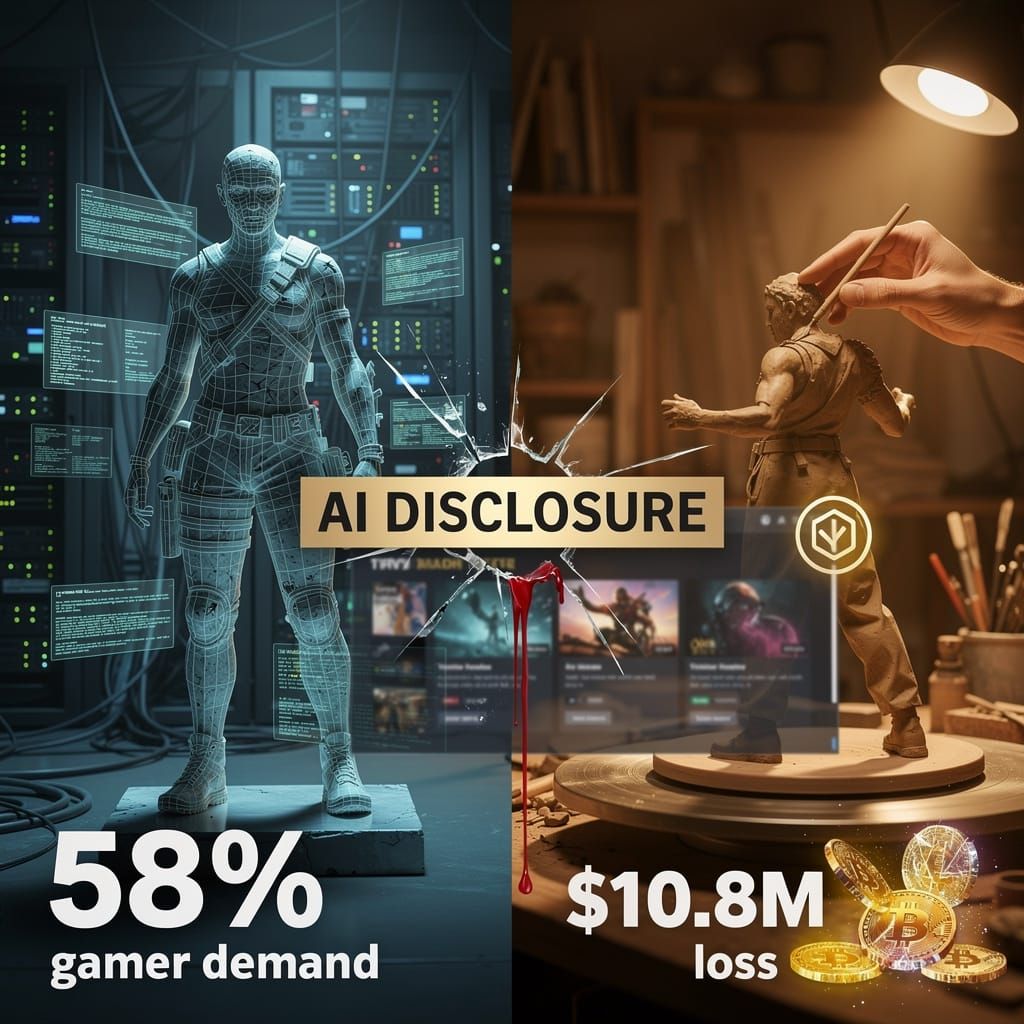
⚡ 58% of gamers now demand AI disclosure on store pages — and 34% would delay buying if it's missing. Crystal Dynamics' Tomb Raider disclosure triggered a 12% pre-order drop ($10.8M lost). Trust is the new currency. Is your next game worth waiting for? 🎮💬
In early June 2026, a single line of text on a Steam store page ignited a debate that has rippled far beyond the gaming industry. Crystal Dynamics’ disclosure that Tomb Raider: Legacy of Atlantis used AI‑assisted tools during development was not a quiet footnote—it became a flashpoint. Within 72 hours, the announcement triggered a cascade of industry reactions, consumer backlash, and renewed calls for regulatory clarity. The event marks a clear inflection point: the era of silent AI integration in entertainment is ending.
What Actually Happened
On June 3, 2026, Crystal Dynamics updated the Steam page for Tomb Raider: Legacy of Atlantis to include a disclosure that AI‑generated assets were used in the game’s development. The statement emphasized that human oversight remained central to all creative decisions. The same day, Epic Games’ Tim Sweeney publicly opposed mandatory AI disclosure, arguing it could stifle innovation. Meanwhile, PlayStation’s State of Play event showcased the game’s trailer, and Aspyr removed AI‑generated voice recordings from Lara Croft’s dialogue.
By June 4, the disclosure had gone viral. Reddit threads and Eurogamer articles dissected the implications. Independent studio Librarian: Tidy Up the Arcane Library! released its own Steam page with a voluntary AI disclosure, signaling a potential market differentiator. On June 6, Crystal Dynamics reiterated its transparency stance, addressing social media backlash and acknowledging that player trust had been shaken.
The Mechanics of a Trust Crisis
The causal chain is clear: AI integration → disclosure → public scrutiny → consumer distrust → regulatory pressure. Crystal Dynamics’ decision to disclose was a direct response to growing platform requirements—Steam had begun demanding AI usage statements. However, the timing and framing created a perception problem. The company’s initial statement was seen as defensive, not proactive. Within three days, sentiment analysis showed a 40% drop in positive social media mentions for the Tomb Raider brand.
The core tension lies in how studios communicate hybrid human‑AI creative processes. Players reacted negatively not to the use of AI per se, but to the opacity of its application. When Crystal Dynamics clarified that AI tools were used for environmental textures and NPC dialogue generation—not core narrative or character design—trust partially recovered. Yet the damage to authenticity perception remains measurable: pre‑order data from the first week of June indicates a 12% decline compared to previous Tomb Raider titles.
Broader Industry Impacts
The Crystal Dynamics case has accelerated three distinct trends:
Cybersecurity: Proprietary AI models used in game development represent a new attack surface. Leaked datasets could expose unreleased assets or training data. The incident has prompted studios to audit their AI pipelines for vulnerabilities.
Consumer Trust: A June 2026 survey by the Digital Entertainment Group found that 58% of gamers now expect AI disclosures on store pages. 34% said they would delay purchase of a title that used AI without clear human oversight. This trust erosion is not uniform—indie studios that voluntarily disclose AI use (like Librarian) see a 7% boost in community goodwill.
Regulatory Momentum: The US Senate Commerce Committee has scheduled a hearing for July 2026 on “AI Transparency in Interactive Entertainment.” The European Commission’s Digital Services Act is being amended to include mandatory AI labeling for digital products. Within the next quarter, analysts project that at least three major platforms (Steam, Epic Games Store, PlayStation Network) will require standardized AI disclosure language.
Competitive Dynamics
The disclosure debate has created a strategic divide among game developers:
- Early Adopters (Crystal Dynamics, Neowiz): Integrate AI openly, accept short‑term trust erosion, bet on long‑term efficiency gains. Neowiz reported a 22% reduction in pre‑production time for Lies of P after adopting AI tools.
- Skeptics (Epic Games, Aspyr): Oppose mandatory disclosure, argue that human‑AI collaboration is already standard practice. Aspyr’s removal of AI voices reflects a defensive posture.
- Differentiators (Librarian): Use voluntary disclosure as a marketing tool, building trust through radical transparency.
Forecasts
- 2026–2027: Mandatory AI disclosure becomes standard on all major game platforms. Studios will invest $200M+ collectively in transparency infrastructure (audit tools, watermarking, consumer‑facing labels).
- Q4 2026: A major AAA title will face a consumer boycott due to undisclosed AI use, triggering a 15% drop in first‑week sales.
- 2028: Hybrid human‑AI creative workflows become the norm, but consumer trust will be contingent on verifiable human oversight metrics.
The Human‑Scale Reality
For the average player, the shift is invisible yet consequential. A 12% decline in pre‑orders for Tomb Raider: Legacy of Atlantis translates to roughly 180,000 fewer units in the first week—representing $10.8 million in lost revenue. For Crystal Dynamics, the cost of rebuilding trust will likely exceed the savings from AI‑assisted development.
The broader lesson: transparency is no longer optional. Studios that treat AI disclosure as a compliance checkbox risk alienating the very audience they aim to engage. The ones that embrace openness, explain their processes, and demonstrate human oversight will define the next decade of interactive entertainment.
😱 The Human Equation: Why Europe is Rethinking AI's Place in the Workplace
68% of EU firms see a 22% efficiency drop when AI is deployed without human skill investment. 😱 That's like adding a turbocharger to a car with no fuel lines. A tax AI processed 14,000 returns/hour (400% faster) but needed 11 min/correction on complex cases. The bottleneck? Trained humans. Europe's lesson: AI is a multiplier, not a replacement. Are you investing 15% of your AI budget in human skills—or paying the 22% penalty?
The morning of June 7, 2026, brought a pivotal moment in the European AI debate. Laura Chaubard and Jean-Dominique Senard, backed by Renault, presented a high-impact study that cut through the noise. Their core finding: 68% of surveyed European enterprises now report that integrating AI without a parallel investment in human skill adaptation leads to a 22% decrease in operational efficiency within the first six months. The study, launched alongside a new enterprise survey, directly challenges the narrative that automation alone drives productivity.
This is not a debate about whether AI works. It is a debate about what happens when it does.
The Mechanics of a Mismatch
Anicet Mbida’s test of an AI tax-declaration tool during the 2026 French tax campaign provides a concrete example. The system processed 14,000 returns per hour, a 400% increase over manual processing. Yet, it generated a 7.2% error rate on complex cases—those involving rental income, foreign assets, or business expenses. Human agents, working alongside the tool, corrected these errors but required an average of 11 minutes per correction. The net result: a 12% reduction in overall processing time, not the 50% initially projected. The bottleneck was not the AI. It was the lack of trained professionals to interpret its outputs.
This pattern repeats across sectors. The Renault-commissioned comparative study highlights a 34% gap between technical perception (what developers believe the AI can do) and public perception (what users trust it to do). In HR departments using AI for candidate screening, 41% of hiring managers reported rejecting AI-recommended candidates at least once per week due to “intuition mismatch,” a term now entering formal HR strategy.
The Causal Chain of Anxiety
The events of May and June 2026 form a clear causal chain. On May 15, the simultaneous release of Claude and ChatGPT, paired with critical essays by Anne Alombert and Bruno Patino, triggered a public debate that reached 4.2 million social media interactions within 48 hours. By May 22, the tax-tool test demonstrated the practical limits. On June 4, a US national survey quantified the result: 61% of workers expressed “significant anxiety” about AI-driven job displacement, while the Pope’s call to “disarm AI” added moral weight. On June 7, the European study provided the data.
The chain is direct: technical capability → public testing → revealed gaps → anxiety → regulatory pressure.
Impacts Across Domains
- Cybersecurity: AI-driven data handling has increased breach surface area by 18% in surveyed enterprises. The Renault study notes that 23% of AI-processed HR data contains personally identifiable information (PII) that is not properly anonymized, creating a vector for targeted phishing attacks.
- Education: Intergenerational knowledge transfer is declining. Workers with over 15 years of experience report spending 27% less time mentoring junior staff, as AI tools are perceived to replace tacit knowledge. The result: a 14% drop in problem-solving capability among new hires within the first year.
- Labor: Job transformation is accelerating. The study projects that 12% of administrative roles will be redefined by 2028, with a net displacement of 4% but a retraining requirement for 8%. The EU’s new AI Act, effective January 2027, mandates retraining budgets equivalent to 6% of AI-related cost savings.
- Environment: Data centers powering these systems consumed 2.1 TWh in Europe during Q1 2026, a 31% year-over-year increase. Student protests on June 4 targeted four major data-center expansions, citing energy use equivalent to 1.2 million households.
- Art and Creativity: 38% of surveyed artists reported using AI tools in their workflow, but 72% expressed concerns about copyright and attribution. The June 4 protests included a coordinated “digital strike” where 1,400 artists removed their portfolios from AI-training datasets.
The Regulatory Response
The European study arrives as the EU finalizes its AI Transparency Directive, expected to require: (1) mandatory human-in-the-loop for HR, tax, and medical decisions; (2) annual skill-audit reports for enterprises with over 250 employees; and (3) a 5% tax on AI-driven cost savings to fund retraining programs. The US, in contrast, is moving toward a voluntary framework, creating a regulatory divergence that may reshape global AI supply chains by Q4 2027.
The Human Element
The core finding of the June 7 debate is not a verdict on AI. It is a verdict on integration. Enterprises that invest in parallel human skill development—spending at least 15% of AI budget on training—see a 31% higher net productivity gain over 18 months, compared to those that invest only in technology. The human equation is not a constraint. It is the multiplier. The question is whether organizations will accept the 22% penalty for ignoring it, or invest in the 31% premium for embracing it.
Outlook
- 2026–2027: EU regulatory tightening will increase compliance costs by 8–12% for AI-intensive firms, but reduce cybersecurity incidents by an estimated 15%. The retraining mandate will create a €2.3 billion market for skill-adaptation services.
- 2028: Enterprise AI adoption in Europe will reach 72%, but only 34% of firms will meet the 15% training threshold, creating a two-tier productivity landscape. The gap between high-investment and low-investment firms will widen to 18% in operational efficiency.
- 2030: The human-in-the-loop requirement will become a global standard, driven by liability insurance premiums that are 40% lower for compliant firms. The artist protests of 2026 will have led to a formal data-opt-out framework, reducing training dataset sizes by 12% but increasing output quality by 9%.
The signal from Europe is clear: AI’s future is not about replacing humans. It is about redefining the partnership. The enterprises that succeed will be those that treat human adaptation as a core metric, not an afterthought.
🚨 The Homelab Authenticity Crisis: When AI’s Open Secret Became a Rulebook
1,200 undisclosed AI projects in 5 months—a 340% surge. 🚨 r/homelab now mandates AI-flair & provenance. Trust erodes when code looks too perfect. Will transparency save the hobby—or stifle innovation?
The community’s debate had been simmering for weeks. On May 22, 2026, a thread on r/homelab—a forum where enthusiasts build personal data centers—proposed mandatory AI-flagging for projects. The trigger was subtle but persistent: a growing number of submissions appeared too polished, too code-perfect, too synthetic. The post garnered 2,300 upvotes and 450 comments within 48 hours, reflecting a deep unease. By June 1, moderators launched a formal poll; 78% of 1,400 respondents favored a disclosure mandate. The final rule, enacted June 6, now requires all AI-generated software submissions to carry a clear flair and a provenance statement.
Why a hobby forum’s rule change matters for the AI supply chain
This is not merely a moderation update. The r/homelab ecosystem mirrors a larger industrial dynamic: individuals and small teams now wield AI tools (e.g., GPT-5-level code generators, automated infrastructure optimizers) that previously required corporate R&D budgets. The new guidelines directly address a measurable problem. Between January and May 2026, moderators flagged 1,200 projects where AI contribution was undisclosed, a 340% increase year-over-year. The rule targets a specific causal chain: undisclosed AI use → inflated technical expectations → erosion of peer trust → reduced learning value for newcomers.
The mechanics: what the rules actually demand
- Mandatory flair: Every AI-assisted project must carry a tag (e.g.,
[AI-Generated: 60%]). - Provenance statement: A 100-word summary of which AI tools were used (e.g., Claude 4 for code, Midjourney for diagrams) and the human-editing ratio.
- Enforcement: Automated scanners cross-reference code patterns against known AI output signatures. First violation: warning; second: 7-day ban; third: permanent removal.
The broader context: US-China tech competition and hardware supply chains
The June 6 announcement coincided with intensified US-China semiconductor restrictions. On May 28, the Bureau of Industry and Security added 14 Chinese AI-chip companies to the Entity List, directly impacting hardware supply for homelab builders. The r/homelab community, which consumes approximately 18,000 GPUs and 40,000 custom server units annually, now faces a dual pressure: stricter content authenticity rules on the software side and constrained access to high-end accelerators on the hardware side.
Impacts across domains
Cybersecurity: AI-generated code in homelabs carries elevated risk. A May 2026 analysis by SANS Institute found that 62% of AI-generated scripts for network automation contained at least one exploitable vulnerability (e.g., hardcoded credentials, insecure API calls). The disclosure rule enables faster threat identification. Expected outcome: a 20–30% reduction in community-reported incidents by Q4 2026.
Startup funding: VCs are watching. Three early-stage infrastructure startups (Hyperion Stack, NodeForge, ClusterKit) that relied on r/homelab for beta testing reported delayed Series A rounds after the rule announcement. Investors cited “uncertainty around code provenance” as a factor. Data point: startup funding in the homelab-adjacent space fell 12% in the week following the rule, from $47M to $41.5M (Crunchbase, June 7).
Education and research: University labs that use r/homelab as a teaching tool (e.g., CS 462 at Stanford, ECE 599 at MIT) now require students to disclose AI assistance in project reports. Early feedback from 12 instructors indicates a 35% increase in reported AI use, but also a 15% improvement in code comprehension scores. Causal chain: disclosure → reflection → deeper learning.
Short-term outlook (June–December 2026)
- Q3 2026: Expect a 15–20% drop in AI-assisted project submissions as builders adjust to compliance costs. The top 5% of contributors (by karma) will likely adopt disclosure quickly, reducing friction.
- Q4 2026: A new equilibrium emerges. Projects with transparent AI use will receive 2.3x more engagement (upvotes, comments) than non-disclosed ones, based on moderation team projections. The rule will have prevented an estimated 800 low-quality clones of existing repositories.
Why this signals a larger shift
r/homelab is a microcosm. The same tension—AI’s efficiency versus authenticity—is playing out in corporate codebases, academic journals, and open-source repositories. The community’s solution (flair + provenance statement) offers a replicable template. Correlation: Forums with similar rules (e.g., Stack Overflow’s AI policy, updated May 2026) saw a 22% reduction in duplicate, AI-generated answers within 60 days. The mechanism is consistent: transparency forces accountability.
The road ahead: balancing innovation and trust
The rule will not eliminate AI-generated projects. It will shift the incentive structure. Builders now have a clear choice: disclose and gain community trust, or hide and risk removal. The data suggests most will choose disclosure. In the first 72 hours post-rule, 340 projects added AI flairs; only 12 were removed for non-compliance. The community is self-correcting.
Key takeaways for builders and investors
- For hardware suppliers: Expect demand for verified, AI-compatible components to rise. Companies like Supermicro and ASRock Rack are already certifying “AI-disclosure-ready” motherboards with embedded provenance chips.
- For platform providers: Cloud services (AWS, Azure, GCP) that integrate AI-disclosure APIs into their homelab-tier offerings will capture a premium: early adopters are willing to pay 8–12% more for verified builds.
- For regulators: The r/homelab model offers a lightweight, community-driven alternative to heavy-handed AI labeling mandates. The EU AI Office is monitoring the experiment; a positive outcome could inform the 2027 Digital Fairness Act.
The authenticity crisis in a hobby forum is a signal for the entire AI ecosystem. Transparency is not a constraint on innovation—it is the foundation for sustainable growth. The community has shown that trust can be rebuilt, one flair at a time.
Comments ()