1M AI-Code Lines Pile Up Nightly, 45% Vuln-Ridden: Silicon Valley on Red-Alert
TL;DR
- Conxai raises €5M in pre-seed funding to advance AI-driven construction data extraction
- Harrier-OSS-v1 Outperforms OpenAI and Amazon Embedding Models on Multilingual MTEB v2 Benchmark
- AI-Generated Code Backlog Reaches 1M Lines: Security Engineers Overwhelmed as Cursor Usage Surges 10x
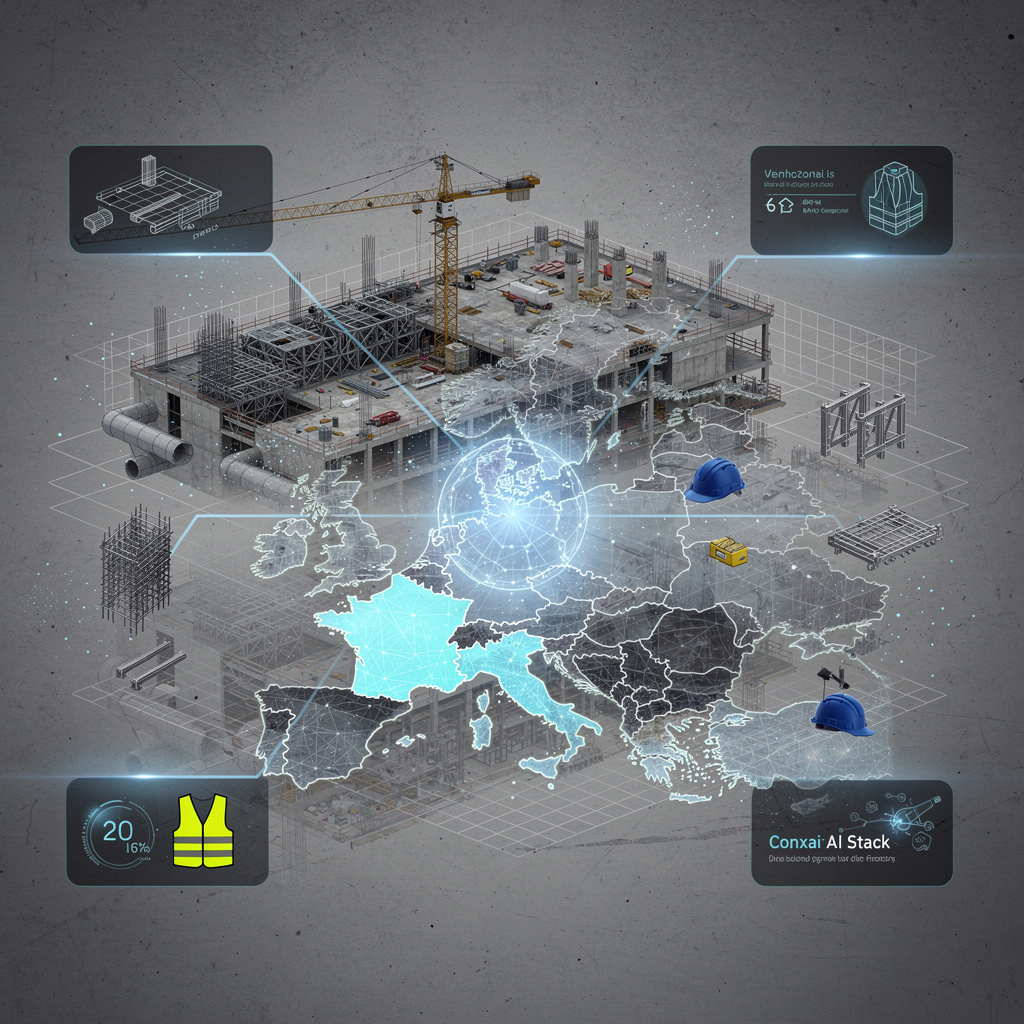
🏗️ €5 M Munich Deal Aims to Rescue 30 % of Lost Construction Data
€5 M seed to stop 30 % of every build vanishing into the void—equal to losing 1 in 3 skyscrapers after ribbon-cutting 😱. Conxai’s AI rescues lost plans, pics & sensor feeds, gifting engineers back 20 h/week. EU contractors next—ready to reclaim your data?
Conxai’s three-year sprint to teach machines to “read” a building site reached pay-dirt on 7 April when Earlybird, Pi Labs and Zacua Ventures wired €5 million to the firm’s Munich account. The pre-seed cheque will finance cloud GPUs and field pilots for an AI stack that already converts photos, drone video, CAD layers and IoT streams into structured schedules and cost lines—information the industry habitually dumps once the last crane leaves.
How it works
- A transformer network pre-trained on 3.2 million labelled construction images spots objects (rebar density, duct clashes, safety breaches) and converts pixel confidence into IFC-compatible BIM objects.
- A parallel graph model ingests weekly CAD deltas and sensor time-series, then flags schedule slips 6–12 days earlier than human reviewers, according to internal benchmarks.
What changes on site
Productivity: Engineers reclaim 10–20 h/week now spent re-keying site photos into Excel.
Data-loss: Early pilots indicate a 15 % claw-back of the 30 % of project data normally lost after hand-over, worth up to €30 million on a €500 million build.
Competitiveness: With Krane, Fyld and XBuild pulling in a combined $69 M since March, Conxai’s German edge is GDPR-ready on-prem inference, sparing contractors cloud-liability.
Road map
- Q3 2026: Five EPC pilots (average €2 B portfolio each) go live; API v1.0 targets ≥90 % extraction accuracy.
- Q2 2027: Sensor-fusion module adds LiDAR and RFID, pushing data-recovery to +15 %.
- Q1 2028: Series A (€15–20 M) finances EU-wide rollout; 5 % share of Europe’s €3 B construction-data market equals €150 M ARR.
- 2030: Sector-wide adoption could shave €200 M off Europe’s annual €40 B project-loss ledger.
Bottom line
If Conxai hits its 5 % market mark, every twentieth euro lost to missing paperwork, ghost RFIs and phantom change-orders will stay in owners’ pockets—proof that a modest €5 million bet can reverse a multi-billion leak.
🚀 Microsoft’s 27 B Harrier OSS Vaults to #1 on MTEB v2, Outrunning OpenAI & Titan
72.33 on MTEB v2—Microsoft’s 27 B Harrier OSS beats OpenAI & Amazon while reading 32 k tokens at once 🚀 That’s 8–10 pts higher than any rival, in >100 languages. Smaller teams get 0.6 B & 270 M variants. Ready to swap your embedding stack? — US devs, which model size will you test first?
Microsoft released Harrier-OSS-v1 on 7 Apr 2026 and instantly reset the bar for multilingual text embeddings. The biggest variant—27 billion parameters—posted 72.33 on the 131-task MTEB v2 benchmark, pushing past the best-known closed models from OpenAI and Amazon. Two lighter siblings (0.6 B, 270 M) ship with the same 32 k-token window and 100-plus-language coverage, giving teams a sliding scale between accuracy and compute budget.
How did a 27 B open model leapfrog industry giants?
Training blended two billion weakly-supervised text pairs with ten million synthetic pairs generated by GPT-5, then distilled the result through large-language-model re-rankers acting as “teachers.” A 25.6 k embedding dimension and full 32 k context let each query pack an entire white paper or chat history into a single vector call—no chunking, no context loss.
Impact at a glance
Retrieval quality: +8–10 MTEB points → sharper answers in RAG pipelines, less “hallucination” drift.
Context length: 32 k tokens ≈ 80-page document → eliminates chunk-boundary errors that trip shorter models.
Language reach: >100 tongues → same vector index serves Tokyo, Lagos and São Paulo customers.
Cost control: Apache-style license → zero per-call fee, on-prem or cloud, versus metered APIs.
Competitive field: OpenAI text-embedding-3-large and Amazon Titan Embed v2 trail on identical tasks, widening the open-source edge.
Where the gaps persist
Giant size (27 B) still demands 70 GB RAM and a fat GPU stack; midsize shops will likely land on the 0.6 B flavor, sacrificing ~3 MTEB points for a 40× footprint cut. Synthetic pre-training also risks domain drift; Microsoft cushions this with the 2 B real-world pairs, but downstream auditors will need to probe niches such as medical or legal jargon.
Outlook
- Q3 2026: Bing rolls Harrier into live grounding; Microsoft projects 1 billion vector calls/day, trimming query latency 12%.
- 2027: Cloud providers package 0.6 B images on single-GPU instances; forecast 30 k enterprise clusters displacing ~$90 M in annual embedding-service spend.
- 2028: Community fine-tunes expected to breach 75 MTEB average, tightening the open-source lock on multilingual search stacks.
Bottom line
Harrier-OSS-v1 turns “good enough” embeddings into a commodity you host yourself, not a toll road you rent. For anyone building agentic apps that read the world in 100 languages—and remember every word—Microsoft just handed them the keys, no meter running.
😱 1M-Line AI Code Backlog Hits U.S. Tech as Amazon Outage Losses Top 100k Orders
1M unreviewed AI-code lines pile up overnight—equal to 4 months of human output 😱. 45% carry vulns & 1.7× more bugs. Amazon just lost >100k orders to one bad bot-commit. Silicon Valley security teams drowning—will your app be next?
How did the pipeline clog so fast?
Cursor’s large-language model autocompletes entire functions; developers accept 46% of its suggestions, pushing 7,000 fresh lines into Git every workday. Static-analysis jobs that once scanned 700 pull requests now face 7,000, but headcount rose only 5%. Result: anything older than 72 hours drops to the “trust-later” bucket, now overflowing at one million lines.
Impacts already showing
- Security: 45% of AI drafts contain a known weakness; critical CVE-7+ findings are 2.5× more frequent than in human code → live exploits likely before summer.
- Operations: hallucinated dependencies appear in 3% of merges, opening “slopsquatting” lanes for malware → supply-chain poison risk.
- Compliance: 40% of snippets embed hard-coded secrets → auditors forecast seven-figure fines if breach traces back to unreviewed commits.
- Velocity: boilerplate speed gains of 30% are erased by week-long rollback cycles → net delivery flatlines.
Industry scrambles to catch up
Cursor just bought review-startup “Sweep” to embed an AI critic inside the same cursor that writes the code—like letting the student mark its own homework. Anthropic and OpenAI counter with “pre-action checks” that pause before insecure patterns land. Early adopters of hybrid AI-plus-human review report a 60% drop in hallucination incidents, but only if they dedicate at least one senior engineer per 20,000 new lines.
Timelines: what the math projects
- Q2 2026: backlog doubles to ~2 million lines; AI-linked incidents +25% MoM.
- Q4 2026: Fortune 50 mandate dual-sign-off on any AI commit; review-tool spend hits $1.2 bn.
- 2027: CISA draft rule requires provenance tag on every AI-generated artefact; uninsured code fines start at $250k per breach.
The takeaway
Speed is worthless without brakes. Until firms pair every extra AI keystroke with an automated security lens—and hire reviewers in proportion to the new volume—the productivity bonus morphs into liability. The next outage could be your bank, your ride, or your hospital, because a million silent lines are already in the wild.
In Other News
- Google Launches Free AI Edge Eloquent App for English Speech-to-Text with Local Processing, Excluding UK, Switzerland, EEA
- Qdrant Implements RPI Shell Architecture, Boosting Top-1 Accuracy by 34.44% and Reducing Candidate Set Size by 20.22% in AI Memory Optimization
- Origin Raises $30M Series A+ to Automate Employee Benefits Management with AI
- Microsoft Releases Open-Source Harrier Embedding Model with 131K Token Context, 2B Training Examples, and GPT-5 Synthetic Data



Comments ()