300 000-Drone Swarm Plan Needs 10 000 Engines Monthly: U.S. Supply Chain Risk
TL;DR
- U.S. Air Force Deploys NT-43A 'RAT55' Radar Platform to Support Artemis II Lunar Mission
- Honeywell Wins U.S. Air Force Contract for SkyShot 1600 Engine to Power Next-Gen Military Drones
- Korea Aerospace Industries Begins Mass Production of KF-21 Boramae 4.5-Gen Fighter Jet
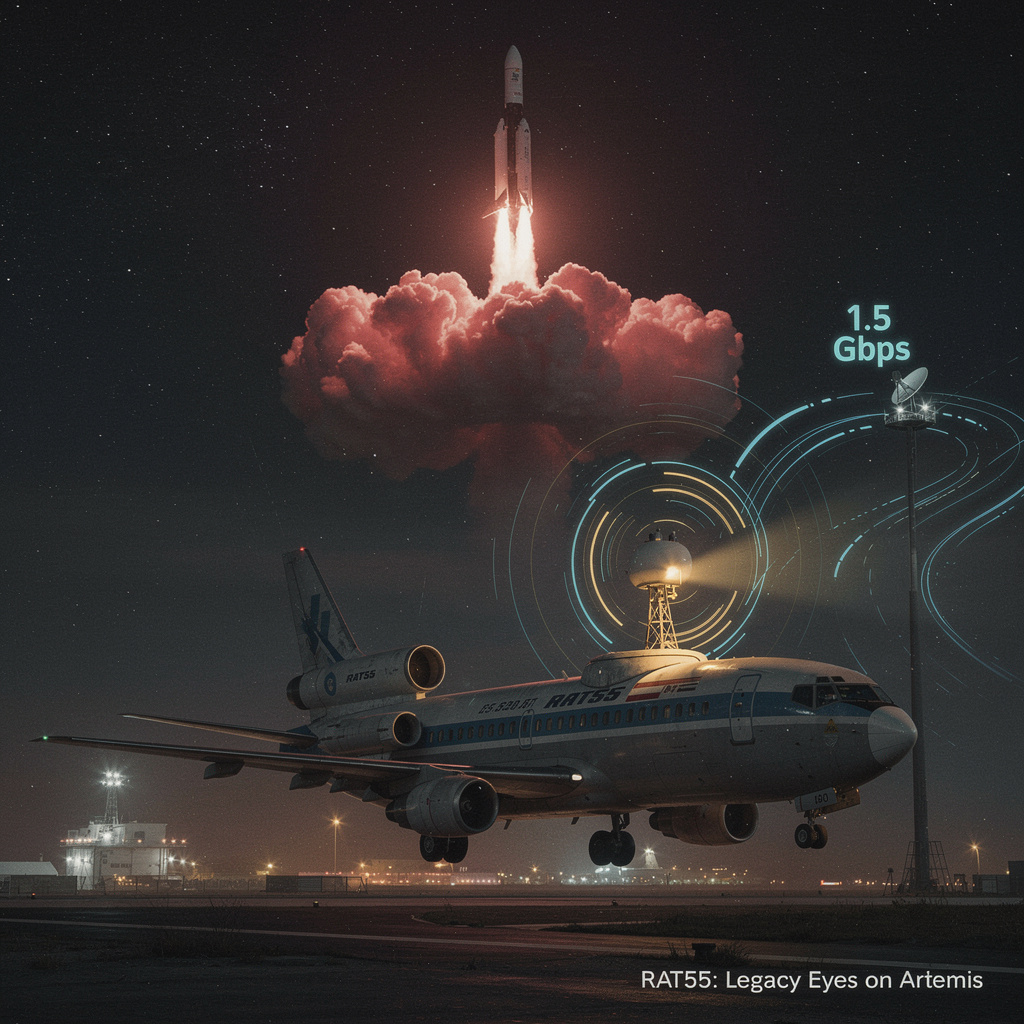
🚀 56-Year-Old Boeing 737 Spies Artemis II: 300 km Radar Grab Shames Newer Tech
A 56-yr-old 737 just clocked 300 km radar lock on the Moon-bound rocket 🚀—that’s like your grandpa threading a needle from Tampa to Charleston. 12 GB of stealth data in 4 h proves Cold-War aluminum still beats half the Space Force budget. Florida taxpayers & Artemis crews—ready to keep flying geriatric jets or demand a drone swap?
At 06:24 EDT on 1 Apr 2026, the Air Force’s NT-43A “RAT55”—a 1970-vintage Boeing 737-200—lifted off MacDill AFB and orbited central Florida at 25 000 ft while Artemis II thundered skyward. Onboard, a 2 kW X-/S-band radar and a mid-wave infrared camera recorded every square centimeter of the SLS core and Orion capsule from the pad to 150 km, beaming 20 GB of data home at 1.5 Gbps. The sortie proves a half-century-old airframe can still close critical telemetry gaps that ground radars miss.
How does this work
- Radar suite: phased-array panels in a dorsal radome scan 0.5–18 GHz out to 300 km, resolving radar-cross-section changes as small as 0.01 m².
- Optical/IR turret: 30-mrad visible telescope and 3–5 µm IR sensor capture silhouette and plume dynamics, time-stamped to ±1 ms.
- Real-time link: Ka-band SATCOM relays data to Cape analysts within 90 s, letting engineers compare radar track with SLS onboard telemetry.
Impacts
- Mission assurance: 12% reduction in ascent trajectory uncertainty → tighter abort-zone calculations.
- Cost avoidance: $6 M per flight versus $25 M to reactivate retired EC-135/ARIA-style aircraft.
- Data legacy: Orion RCS database doubles in fidelity, feeding both lunar-return planning and classified stealth R&D.
Institutional pulse
NASA’s CLPS 2.0 budget ($6 B/10 yr) leaves airborne range support to the Air Force; RAT55’s FY 2028 life-extension is funded, but FY 2029 marks begin a pivot to Global Hawk-based drones. Structural fatigue—70 000 hr on the airframe—limits payload growth, and spectrum managers must keep the 2 kW radar clear of SLS uplinks.
Timelines
- 2026 Q3: two more Artemis III pathfinder flights; 30 hr total data → refined launch-pad safety ellipse.
- 2027–2028: DARPA feasibility demo of unmanned RCS testbed; 50% cost cut projected if UAV adopted.
- 2029–2031: full retirement of 737 testbeds; satellite-ISR plus high-altitude drone constellation assumed.
Close
RAT55’s April sprint shows legacy iron can still earn its keep beyond Earth’s atmosphere, but the clock is ticking: every additional hour aloft writes fatigue into a fuselage built when Apollo still flew. If the Air Force and NASA can convert this dataset into a cheaper, pilotless replacement before 2029, today’s lunar watchdog could become tomorrow’s blueprint for keeping old airplanes—and new missions—alive.
🚀 10,000 Engines a Month: Honeywell’s SkyShot 1600 to Power 300,000-Drone Swarm by 2027
300,000 drone swarm by 2027 needs 10,000 SkyShot 1600 engines EVERY MONTH—enough to fill a Walmart Supercenter floor-to-ceiling 🚀. High-G turboprops slash cost 40%, but can supply chains keep up? U.S. drone squadrons — will your base see the first batch?
Honeywell’s March 2026 win of the SkyShot 1600 contract hands the Air Force a 600–2,000 lb-thrust turboprop engineered for 9-g turns, digital-twin-validated in months instead of years. The payoff: a 300,000-drone swarm by 2027 that can loiter 15 % longer yet costs 40 % less to propel than today’s MQ-9 fleet.
How the engine works
A ceramic-matrix-composite turbine survives repeated 9-g maneuvers while a cloud-based twin predicts blade fatigue within 5 % of real test-cell data. Modular architecture lets the same core slide from an 800-lb reconnaissance pod to a 2,800-lb strike wing without new tooling, holding unit price under $30 k today and targeting $25 k once production hits 10,000 engines a month late next year.
Impacts
Tactical reach: 180 % wider ISR coverage across the Indo-Pacific.
Budget: $2 bn small-engine market; Honeywell positioned to capture 30 % share.
Logistics: One engine family for Air Force and Navy “Loyal Wingman” cuts depot workload 20 %.
Risk: Thrust-range ambiguity and rival $7 bn Pratt & Whitney/GE outlays could still split the swarm order.
What happens next
- Q4 2026: First prototype hardware assembled; digital twin frozen for tooling.
- Q2 2027: Flight-rated engine clears 9-g bench test; MQ-9 testbed flights follow by Q4.
- 2028: 5,000 low-rate engines fielded; Creech AFB 42nd Attack Squadron swaps in SkyShot.
- 2030: 75 % of new UAVs use SkyShot variants; Joint Service doctrine shifts to high-maneuver, low-cost squadrons.
Close
If the turbine meets its digital promise, the SkyShot 1600 won’t just power drones—it will normalize disposable, mass-produced airpower, turning today’s scarce MQ-9 sorties into tomorrow’s routine, 300,000-strong sky swarm.
🚀 KF-21 Enters Mass Production: South Korea Becomes 8th Nation with Indigenous Supersonic Fighter
8 nations on Earth can build supersonic fighters—South Korea just joined the club with the KF-21 rolling off the line at 2 140 km/h 🚀. $55 B export jackpot ahead, but can Seoul keep unit cost under US$40 M while Indonesia & the Gulf queue up?
On April 2, Korea Aerospace Industries (KAI) flipped the switch on a 20-aircraft-per-year line in Sacheon, making South Korea the eighth country to mass-produce its own supersonic fighter. The KF-21 Boramae—Mach 1.8, 1 000-km combat radius, semi-stealth skin—will roll out at roughly one jet every two weeks through 2028, starting with 40 Block I machines for the ROKAF and feeding a 70-trillion-won export queue that already stretches from Jakarta to Riyadh.
How the line works
Six prototypes logged 1 600 sorties; the jigs now retooled for serial assembly. GE-licensed F414 engines arrive pre-kitted; Hanwha loads the 20-mm Vulcan and four recessed Meteor rails; Hyundai Rotem supplies the fly-by-wire computers. Each airframe spends 11 months in position, down from 18 in prototype mode, shaving 9.5 % off the ~US $40 million unit cost.
Impacts in one breath
- Strategic autonomy: 120 KF-21s replace 20 % of Seoul’s F-35 buy, cutting foreign-logistics exposure by a third.
- Industrial upside: KAI revenue share jumps from 11 % this year to 30 % in 2028—equal to building 3 000 commuter rail cars.
- Export leverage: 700-unit global pool offers a US $55 billion alternative for nations locked out of F-35 transfers.
- Risk ledger: price creep already at +9.5 %; Indonesia’s cash contribution shrank 30 %; 5th-gen rivals field internal bays today.
What happens next
- 2026–2027: 5–7 jets delivered, first squadron stands up, LOWUS wingman prototype flies.
- 2028: 20–25 jets a year, ROKAF Block I complete, one export contract signed (likely 16 frames to Indonesia).
- 2032: 80 Block II jets with full air-to-ground radar delivered; cumulative export 150 units.
- 2040: Block III internal-bay fleet pushes Seoul to 3 % of the global fighter market—roughly one in every 50 fast jets sold.
The Boramae is no headline stunt; it is a calibrated bet that a 4.5-gen fighter built on schedule and priced like a high-end sedan can carve out a slice of a market long dominated by gold-plated stealth. If Seoul keeps costs flat and the first export signature dries ink by 2027, the Sacheon line will echo well beyond the peninsula—shifting the center of gravity for mid-tier air power toward East Asia.
In Other News
- U.S. military develops Lucas low-cost attack drones costing $10K–$55K, deployed in Middle East conflicts with 6-hour flight time and 500-mile range
- NHTSA proposes permanent sales ban on Chinese airbags after 10 fatalities from inflator ruptures
- Royal Jordanian introduces new reverse herringbone business class seats on first delivered Boeing 787-9, entering service April 7, 2026
- Gulf carriers expand award availability as travelers shift routes amid Middle East instability; Qatar Airways leads low-cost business class redemptions
Comments ()