44,000 Daily Flights Held Hostage by 36-Year-Old Towers That Black-Out Triple-Time
TL;DR
- FAA mandates energy resilience upgrades for 250+ air traffic control towers after repeated outages and health incidents
- An-26 military aircraft crashes in Crimea, killing 29 aboard amid investigation into flight rule violations
✈️ $2B FAA Battery Blitz to Halt 44k Flight Blackouts by 2028
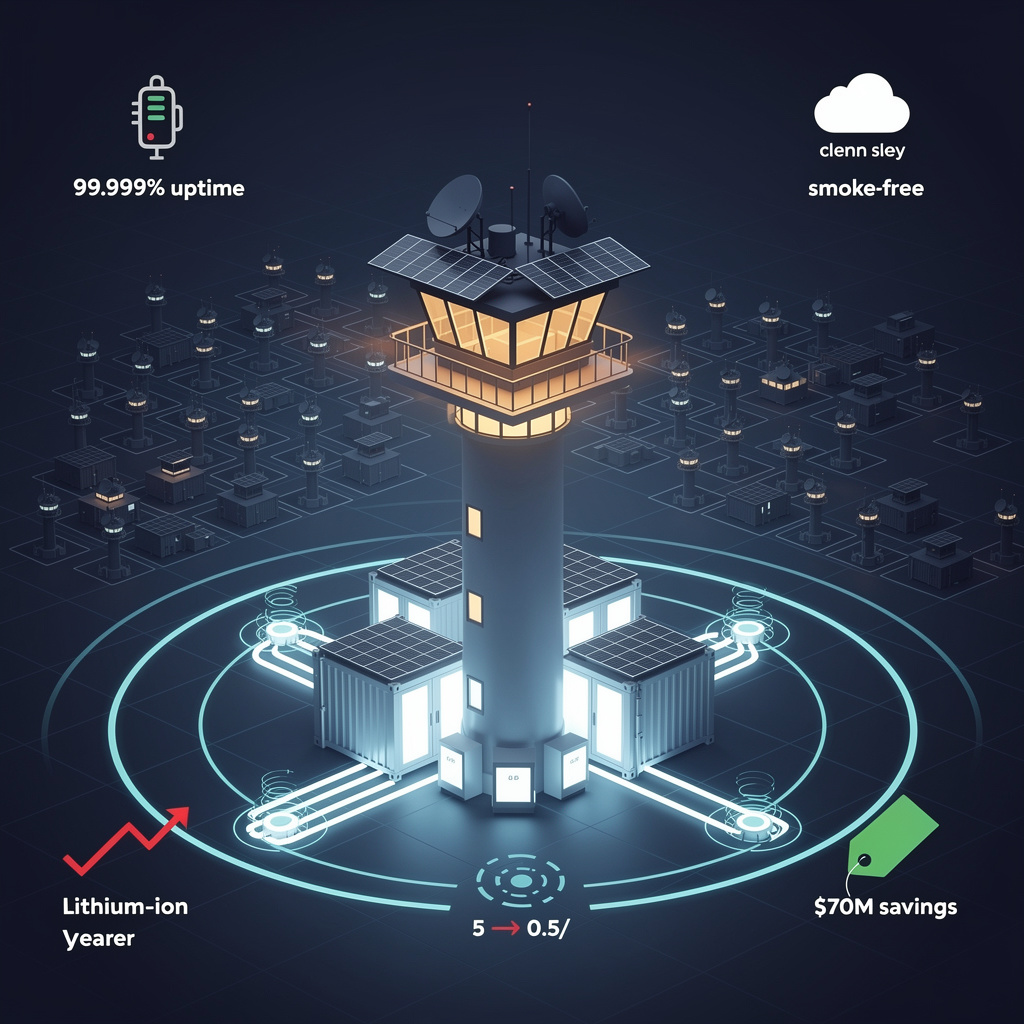
44k daily flights ride on 36-yr-old towers that still black-out 3× a year—costing 2.3 hr delays & $1.5B in power bills. $2B battery + solar surge will cut failures 90%. Fly much? Your next on-time arrival hinges on these towers—ready for a blackout-proof sky?
For the second time in 18 months, Potomac TRACON filled with acrid smoke, forcing controllers to evacuate and leaving 2,300 daily flights circling blind. The FAA’s response, issued this week, is blunt: every U.S. air-traffic tower—250-plus of them—must be able to power, cool and talk on its own by 2028.
How does this work
Each site gets a modular lithium-ion pack (0.5–2 MWh, 30-minute rating) plus, where real estate allows, 150 kW rooftop solar. Thirty-four towers already swapped legacy analog voice switches for digital units that sip 30% less electricity and guarantee 99.999% uptime; 428 more switches follow by 2028. The $2 billion pot is locked in this year’s DOT budget, and containerized batteries will squeeze into space-starved rooftops like Colorado Springs.
Impacts at a glance
- Safety: >90% cut in power-failure ground stops, from five a year to <0.5.
- Health: controller smoke-exposure incidents drop from 12 in 2024-25 to <0.1 per year.
- Economics: towers with solar-plus-storage trim utility bills 15% in year one, saving $70 million network-wide.
- Ops: 44,000 daily flights gain a fallback nerve center that keeps radios and radar hot even when the county goes dark.
Still on the radar
Strength: federal cash and proven battery tech. Weakness: 12% of towers need creative retrofitting. Opportunity: surplus battery power can sell frequency regulation back to the grid, netting $50-70 million annually by 2030. Threat: every new digital switch is a fresh cyber target; quarterly penetration tests are now mandatory.
Timeline
- 2026–2027: 150 towers get batteries; 50 add solar; analog switch count falls 70%.
- Q4 2028: full compliance; outage-related delays down to statistical noise.
- 2029-30: ATC network becomes a 1.2 GWh national micro-grid, bankrolling further tower tech upgrades.
Bottom line
Air travel already bounces back from weather and labor shocks; energy resilience is the last unguarded runway. If the FAA hits its 2028 mark, the template will migrate to hospitals, data centers and every other node Americans never notice—until the lights go out.
😱 An-26 Crash: 29 Dead as Cold-War Relic Falls Near Sevastopol
29 souls lost in 1 An-26 crash—equal to a full classroom erased in seconds 😱 A 40-yr-old Soviet turboprop fell from Crimean skies after yet another engine failure. 1/3 of Russia’s 2026 military crashes trace to engines starved of spare parts. Black Sea troops now down one lifeline—how many more Cold-War relics can they still risk?
On Tuesday evening, 29 people boarded an An-26 turboprop near Sevastopol; minutes later, the 55-year-old airframe slammed into a Crimean cliff, erasing every life on board and exposing the brittle spine of Russia’s Soviet-era transport fleet.
How an aging workhorse faltered
The Antonov An-26, designed in 1969 for 40 paratroopers or 5.5 t of cargo, carries two Ivchenko AI-24 engines whose reliability has slipped as Western sanctions choke spare-part pipelines. Investigators have opened a criminal case under Article 351—flight-rule violations—yet the early wreckage narrative points to engine or hydraulic failure, not enemy fire.
Impacts ripple outward
- Human cost: 29 fatalities, a 100 % casualty rate that leaves no witness to narrate the final seconds.
- Operational cost: one airframe subtracted from a Crimean fleet already stretched thin across the Black Sea theater.
- Regulatory cost: every An-26 logbook in Russian service now faces microscopic audit; compliance lapses could ground dozens more.
Institutional response and gaps
Emergency teams recovered the flight recorders within 36 hours, but the “black box” is a 1980s analog unit with limited data capacity. A preliminary teardown of the starboard engine is scheduled inside 14 days; meantime, the Defense Ministry has ordered fleet-wide inspections of AI-24 combustion chambers and hydraulic pumps—components that accounted for 33 % of Russian military aviation mishaps between December 2025 and January 2026.
Short / mid / long-term outlook
- 0–30 days: forensic report pinpoints primary mechanical fault; safety bulletin mandates temperature-band checks before every An-26 take-off.
- 3–12 months: airframes older than 30 years face either refurbishment or retirement; budget line for 20 new turboprop transports inserted into 2027 procurement plan.
- 12–36 months: phased replacement by Il-112 or foreign alternatives ends An-26 operations in high-temperature, high-humidity zones such as Crimea.
Close
Until metal is swapped for microchips, the Black Sea skies will remain a museum of Cold War aluminum—where every flight hour is a gamble with history, and where 29 fresh graves remind generals that logistics delayed can become lives destroyed.
Comments ()