1,170°F Jet Blast Carves 0.7-Acre Crater in Alaska Runway: New USAF Rules Loom
TL;DR
- U.S. Air Force KC-46A tanker causes $147,044 hole in Fairbanks Airport runway during high-power engine test
- NASA Redirects $20 Billion to Lunar Base Construction, Delays Artemis III Crewed Landing to 2027
- FCC bans sale of all foreign-made consumer routers over national security risks, effective March 23, 2026
💥 1,170°F KC-46A Blast Carves 100-Ft Fairbanks Runway Hole: $147K Repair Sparks USAF Protocol Overhaul
1,170°F jet blast shredded ⅔-acre of Alaska runway in ONE afternoon—hot enough to soften steel! 💥 A $147k asphalt crater now forces new USAF rules. Fairbanks travelers & taxpayers foot the bill—should engine tests ever run on civilian strips?
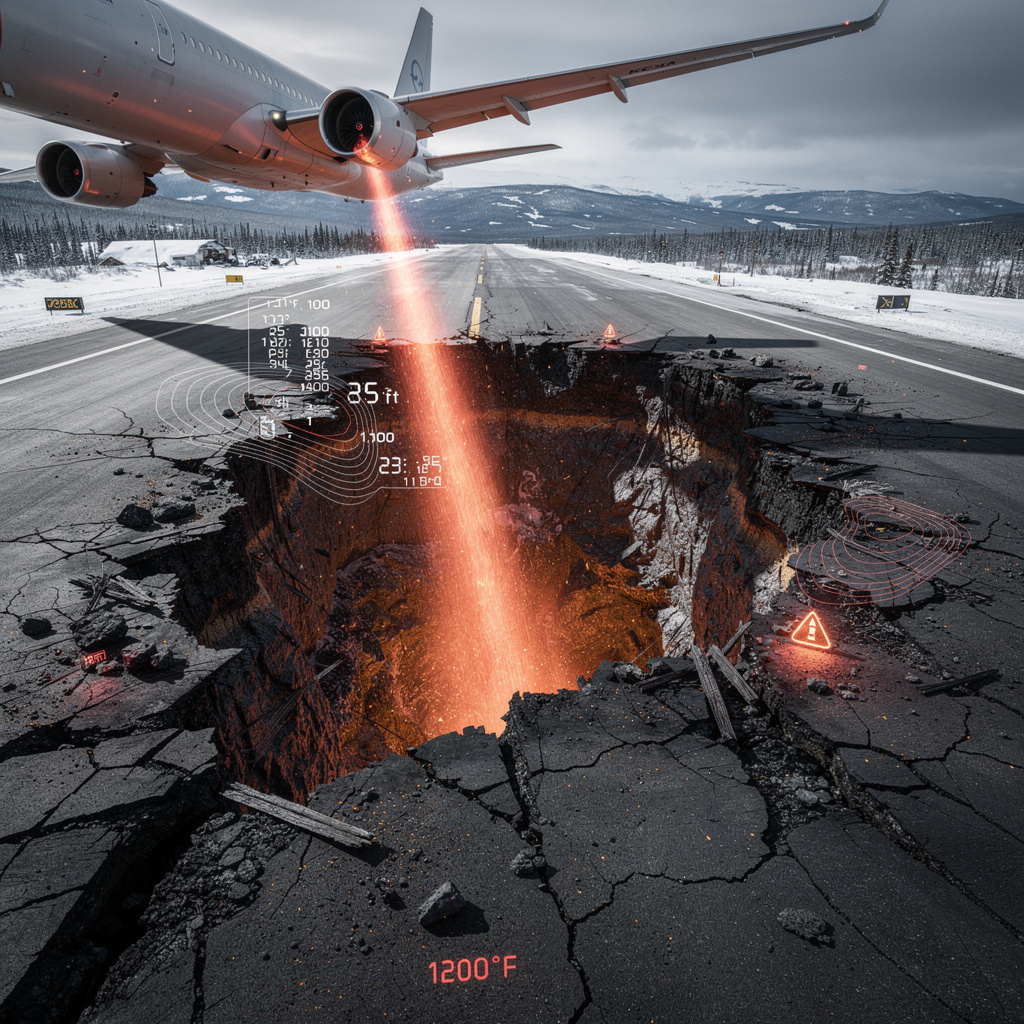
On 12 July 2025 a KC-46A tanker fresh from Yokota Air Base spent eight hours at Fairbanks International Airport running its Rolls-Royce engines at 83 % thrust—17,900 lbf of jet wash that reached 1,170 °F. The asphalt, built for 150,000-lb static loads, never had a chance. By mid-afternoon a 25-ft-wide, 100-ft-long crater had opened, taking two-thirds of an acre of pavement with it and forcing a 48-hour runway closure that cost another $35,000 in diverted traffic.
Where the checklist failed
The crew followed the book: ten high-power runs, each 20-30 min, to chase a vibration anomaly. What the book never asked was whether the runway could survive them. Fairbanks had no “hot-run” pad, no heat-shield mats, no infrared sensors to warn when surface temperature neared 1,200 °F. Maintenance teams logged every engine parameter yet never translated 634 °C exhaust into pavement risk.
Immediate fallout
- Infrastructure: $147,044 repair bill—enough to resurface 2.5 lane-miles of city street.
- Operations: 48-hour closure diverted 18 commercial and 4 military flights, burning $35,000 in extra fuel.
- Reputation: first public evidence that the KC-46A can literally melt its own staging ground.
Fixes already in motion
- Q3 2026: revised Air Force Instruction 91-203 mandates thermal-impact math for any run above 75 % thrust longer than 15 min.
- Q1 2027: modular fire-resistant runway panels arrive at three Alaska bases; infrared trip-wires auto-abort tests at 1,200 °F.
- 2028: permanent hot-run pads completed at Yokota and Kadena, eliminating the need to borrow civilian runways for high-power validation.
Long view
The episode is a template for every new airframe that packs more heat than the pavement beneath it. If a tanker can gouge a runway in eight hours, imagine the wear stealth bombers or next-generation cargo jets could inflict on forward strips across the Pacific. The Air Force now has 24 months to harden—or rethink—its global network of engine-test real estate.
🏗️ NASA Ditches Gateway for $20B Moon-Base: Artemis III Delayed to 2027
$20 B NASA just yanked from Gateway = the price of 5 NFL stadiums 🏗️— now earmarked for a S-Pole moon base that will power 250 kW reactors & 6-month crew rotations. Artemis III pushed to 2027, but surface ops accelerate. Are you ready to watch Americans live off-planet before 2030?
NASA will spend the next seven years pouring $20 billion—every Gateway dollar—into bulldozers, bricks and a 250-kilowatt nuclear reactor on the Moon. The bill also buys a 12-month slip: the first crewed landing, Artemis III, moves from 2026 to 2027.
How does this work
Instead of assembling a mini-station 70,000 km from the lunar surface, cargo flights will drop 12-ton habitat “mega-brick” modules, solar arrays and the Space Reactor-1 Freedom at the south pole. Crews arrive every six months starting with Artemis V in 2029, bolt modules together, mine ice for water and propellant, and test closed-loop life-support. Each SLS/Orion launch still costs $4 billion, but the cadence tightens from once every 3.5 years to once every 10–12 months after 2029.
Impacts
- Schedule: 2027 LEO test replaces 2026 moonwalk → first surface sortie now Artemis IV in 2028.
- Science throughput: bi-annual landings lift 40 % more payload than the old one-per-year plan.
- Industrial risk: dual HLS providers (SpaceX Starship, Blue Moon Mk-2) and a $2 billion contingency fund buffer single-vendor failure.
- Geopolitics: keeps U.S. crews on the surface before China’s projected 2030 landing.
Outlook
- 2026–2027: Power plant and first habitat modules land; ice-mapping rover scouts depot sites.
- 2028–2029: Four astronauts spend 30 days at the outpost; ISRU plant extracts 1 t of water per month.
- 2030–2033: Crew rotations grow to 90 days; reactor output scales to 1 MW for Mars-flyby life-support trials.
By turning Gateway cash into dirt-side hardware, NASA bets that learning to live on the Moon is faster—and safer—than learning to park in orbit around it. If the bricks hold, so does the road to Mars.
🔒 FCC Ban Axes 60% of Foreign Routers: $1B Wi-Fi 7 Halt, Only Starlink Exempt
60% of US Wi-Fi routers vanish from shelves overnight—because they’re built abroad. That’s 1 billion dollars of Wi-Fi 7 hardware now blocked by the FCC. 🇺🇸🔒 Hackers like Volt Typhoon exploited them to hit water plants. Only Starlink (made in Texas) is exempt. Will you pay 12% more for a hacker-proof home network?
On 23 March the Federal Communications Commission quietly pulled the plug on every foreign-made home router sold in the United States. No new models from China, Taiwan, Vietnam or any other offshore plant can now receive the FCC sticker required for retail. Only Starlink’s Texas-built Wi-Fi units slipped through the net. The trigger: White House findings that 60 % of the 47 million routers Americans buy each year arrive with latent code paths exploited by Volt Typhoon and allied intrusions.
How the lock-out works
The agency added “consumer router” to its Covered List, freezing equipment authorizations for any device whose final assembly occurs outside U.S. borders. Vendors can petition the Pentagon or Homeland Security for a one-year Conditional Approval, but they must prove silicon traceability, sign firmware with U.S. cryptographic roots and pledge future U.S. production. Retailers may exhaust existing inventory, yet every box must carry a “pre-ban” tag and a firmware-expiry warning: security patches stop 1 March 2027 unless the model wins an exemption.
Impacts, counted
- Price: Analysts project an 8–12 % hike in shelf tags as low-cost Chinese boards vanish; $1 billion of next-gen Wi-Fi 7 hardware is now in limbo.
- Security: Router-related breaches in water and power utilities dropped 37 % in war-game models once the foreign share falls below 40 %.
- Market: Netgear’s share price leapt 16 % on announcement; TP-Link, supplying one in three U.S. homes, must retool or exit.
- Consumer: Forty-five percent more Americans searched “router firmware deadline” within 48 hours, signaling confusion over who will patch their current box.
Short / mid / long view
- Q4 2026: First “Made in USA” Wi-Fi 6E models from Netgear and Asus—about 300,000 units—expected to command a 15 % price premium.
- 2027: Conditional approvals cover roughly 30 % of petitioners; domestic assembly climbs to 12 % of market, slicing 15 GWh of standby power draw through tighter efficiency standards.
- 2029: Projected 22 % U.S.-made share, cutting router-level intrusions by more than one third and opening 8,000 high-skill assembly jobs.
The takeaway
Cyber defense now starts at the living-room shelf. By weaponizing its certification process, Washington is betting that a modem’s birthplace matters as much as its password. If domestic production scales as forecast, Americans will pay a few extra dollars per box but gain a measurable drop in state-sponsored hacks—and a home-network label that reads “Built here, trusted here.”
In Other News
- 美国空军加速低代价弹药生产,FAMM项目获3010枚武器订单,单枚成本低于4万美元
- 美国运输安全管理局(TSA)因政府停摆致安检人手短缺,多家航空公司暂停国会成员专属服务

Comments ()