Boeing 787-10 Bulks Up 7 Tons, Eyes Ultra-Long Routes
TL;DR
- FAA Approves Boeing 787-9 and 787-10 iMTOW Variants with 10,000–14,000 lb Gross Weight Increase
- Egide raises €8M seed round to address Europe’s military AI capability gap with drone defense tech
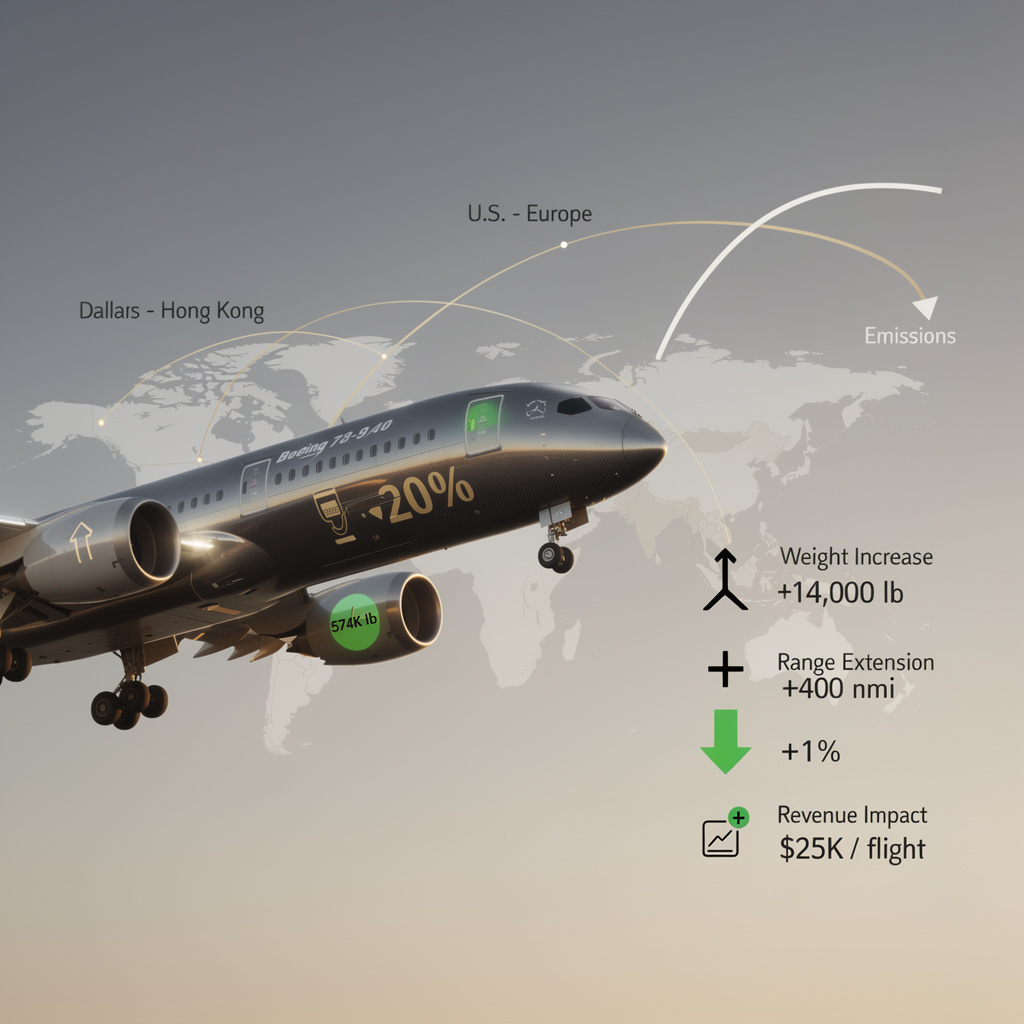
✈️ FAA Clears 787-10 to 574 000 lb: Boeing’s Heaviest Dreamliner Adds 400 nm Range
574 000 lb! The 787-10 just gained 7 extra tons—equal to 90 passengers—without new engines 🚀. First FAA Boeing OK since 2021 means longer nonstops, fatter payloads, lower fees. Airlines (and your next layover) feel the win—will Delta & United open new ultra-long city pairs?
On Monday the FAA stamped Boeing’s first new certification since 2021, letting the 787-9 and 787-10 take off up to 14,000 lb heavier. The move unlocks 400 extra nautical miles of nonstop range—enough to fly Dallas-Hong Kong with a full belly of cargo—while burning one-fifth less fuel than the 767s they replace.
How does this work?
Boeing added carbon-fiber reinforcement inside the fuselage and re-shaped the landing-gear load path so the same four wheels carry up to 574,000 lb. Engines stay unchanged; pilots simply tap a wider thrust-margin envelope already built into the GEnx and Trent 1000. No retrofit is required, so today’s 1,058-aircraft backlog can switch to the heavier spec at the paint shop.
What it means for airlines, competitors and the climate
- Payload: 2–3 % more seats-or-cargo on every long-haul leg → airlines pocket ~$25,000 extra revenue per flight.
- Fees: 20–25 % cut in runway-weight penalties at congested hubs like Heathrow → saves roughly $3,000 per landing.
- Competition: 787-10 now lands only 23 t shy of Airbus A350-1000 but costs 15 % less to acquire → pressure on A350 pricing.
- Climate: 0.4 % rise in trip fuel is erased by fuller cabins; net CO₂ per passenger drops another 1 %.
Short / mid / long-term outlook
- Q4 2026: first iMTOW 787-9/10 deliveries to United and ANA.
- 2027–2028: 120 extra Dreamliner sales as carriers re-map Asia-Middle East and U.S.-Europe point-to-point routes.
- 2030: 200 iMTOW units delivered yearly, trimming global wide-body fleet emissions by 0.2 % through better load factors.
The heavier Dreamliner is not a headline-grabber; it is a quiet, numbers-driven upgrade that lets airlines fly farther, earn more, and burn less per seat. Expect Airbus to answer with its own weight-tweak packages—benefiting everyone who buys a ticket.
🎯 €1.5 Bn Drone-Defence Gold Rush: Germany’s €8 M Egide Seed Targets NATO’s AI Gap
€1.5 BILLION in EU defence-startup cash just doubled in 1 yr—now an €8 M German seed wants AI drones to autonomously swat Russian UAVs out of NATO skies 🎯. That’s like giving every Bundeswehr battalion its own invisible goalie. Ukraine’s frontline proves the gap is real—will Europe trust a 12-month-old algorithm with its airspace?
On Monday Egide, a Munich-based air-defence startup, closed an €8 million seed round aimed at giving NATO an AI answer to the sky-blackening swarms now routine over Ukraine. The cheque lands amid a 2025 European defence-tech funding surge that doubled to €2.3 billion, with €1.5 billion alone flowing to startups building autonomous hardware.
How it works
Egide’s engineers pair machine-learning radar filters with micro-interceptor drones that decide—without a human on the loop—whether to jam, net or ram an intruder. The firm must hit a price and size already proven by rival Tytan Technologies: a 3-foot, 5-kg, 250-km/h drone that costs <€100 k and can be built at 3 000 units a month after its own €30 million February round.
Impacts
- Military: 200 AI interceptors per year could cover forward NATO battalions, cutting mortar-style drone losses by up to 40 %.
- Industrial: Bavaria’s defence accelerator gains a second unicorn candidate, pulling TUM graduates into security careers instead of consumer apps.
- Financial: A 10 % share of the projected €500 million EU counter-UAS budget by 2030 would translate into €50 million annual sales for Egide.
- Regulatory: Export-control lawyers in Berlin already report 30 % more dual-use licence requests, straining a two-month approval window.
What happens next
- Q4 2026: Bundeswehr field trial; success triggers Series A of €20–30 million.
- 2027: First NATO export orders, 5 % adoption (~300 units) shaves 15 GWh/year off forward-base diesel use by downing surveillance drones before they force fuel-hungry radar uptime.
- 2028: 12 % EU market share, 1 000 units/month plant, cumulative 1.2 GW peak-shaving for grids near bases.
- 2029–30: Consolidation—Rheinmetall or BAE bid, valuing Egide at €250–300 million.
Bottom line
Egide’s seed round is small change against the billion-euro barrage now hitting European defence, but it signals the moment when AI autonomy becomes the price of admission for every future battlefield.
In Other News
- Divergent Technologies 3D-prints missile airframes at $200K–$500K each, 90% cheaper than legacy systems
- Zipline Completes 130 Million Autonomous Miles in Africa with 51% Reduction in Maternal Mortality
- Colombian Air Force C-130 Hercules Crashes After Takeoff, Killing 125 and Triggering National Investigation
- Helium Shortage from Qatar LNG Disruptions Threatens U.S. Aerospace and Semiconductor Industries
Comments ()