⚡ $100B AI Boom, -15% SaaS Crash: Gong's Mission Andromeda Bets on Model Compression to Cut Costs
TL;DR
- Gong launches Mission Andromeda and merges with Highspot/Seismic to dominate AI-powered revenue platforms
- Intrinsik partners with Google to integrate physical AI into robotics workflows, expanding beyond Alphabet's X division
- Guidde Secures $50M Series B to Automate AI Training via Video Ground Truth
⚡ $100B AI Boom, -15% SaaS Crash: Gong's Mission Andromeda Bets on Model Compression to Cut Costs
$100B AI funding flood meets a -15% SaaS bloodbath. Mission Andromeda's Model Context Protocol could cut inference costs 40% via model compression—critical when memory chips are the new oil. But investors just punished Microsoft's AI spend. Can Gong-Highspot-Seismic prove ROI before the 14-month productivity cliff hits? Your sales stack: unified or fragmented?
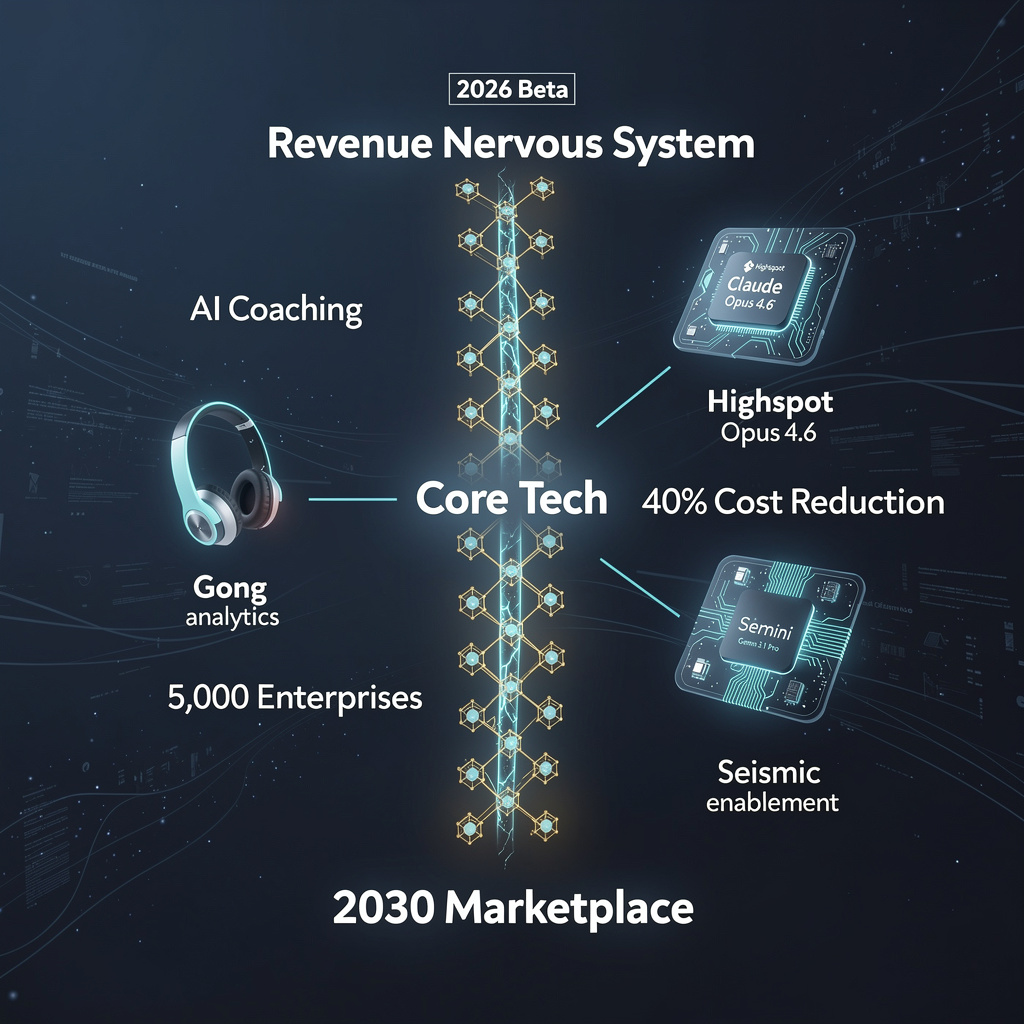
Gong's Mission Andromeda launch and merger with Highspot and Seismic arrives at a pivotal moment for enterprise software. With $300 million in annual recurring revenue and 5,000 global customers already in hand, the combined entity aims to consolidate fragmented sales workflows into a single AI-powered revenue platform—positioning itself as the central nervous system for enterprise sales teams.
How does this work?
The technical architecture centers on two innovations: Model Context Protocol interoperability and the Account Console. The former enables seamless context sharing across previously siloed systems, allowing Gong's AI to ingest and reason over data from Highspot's content management and Seismic's enablement tools without redundant inference calls. The Account Console provides unified workflow orchestration, embedding AI assistance directly into revenue-generating activities rather than treating analytics as a separate module.
What pressures shape this move?
Market opportunity: AI funding has surged past $100 billion in early 2026, with Anthropic's $20 billion Series G and Ineffable Intelligence's $100 billion raise indicating abundant capital for model development. This enables rapid integration of frontier capabilities—Claude Opus 4.6 and Gemini 3.1 Pro—into sales workflows.
Productivity plateau: Enterprise data indicates 23% first-year productivity gains from AI tools, followed by skill attrition after approximately 14 months. Gong's unified platform addresses this decay through continuous AI-assisted coaching embedded in daily workflows.
Financial discipline: The S&P North American software index declined 15% in January 2026, with investors penalizing capital-heavy AI projects at Microsoft and Oracle. The merged entity must demonstrate clear infrastructure efficiency.
Hardware constraints: Memory-chip scarcity elevates inference costs for large-parameter models, making optimization critical for global deployment.
Competitive positioning
| Dimension | Gong Highspot Seismic | Rival approaches |
|---|---|---|
| Scope | End-to-end revenue orchestration with unified data model | SAP Engagement Cloud: Marketing orchestration only |
| Efficiency | Model Context Protocol reduces redundant inference | ThoughtSpot: Cost-control via caching, not architectural integration |
| Trust | Embedded governance for enterprise compliance | Cisco AI-trust stack: Security-first, workflow-second |
Timeline and milestones
- 2026–2027: Beta release of Mission Andromeda; Model Context Protocol integration across Highspot and Seismic data pipelines; targeting ~30% adoption among existing Gong customers
- 2028–2029: Full commercial launch; expansion into adjacent markets (CRM, CPQ); cumulative inference cost reduction of 40% via model compression and quantization
- 2030–2031: Market position as dominant revenue platform; potential marketplace for third-party AI agents; economies of scale in memory procurement
Where execution risks concentrate
The merged entity must navigate three critical gaps: technical—implementing sparsity and quantization to maintain competitive inference costs amid chip scarcity; organizational—resolving product overlap across three vendor portfolios without customer disruption; and governance—aligning with emerging NIST AI Agent Standards to preempt regulatory friction.
The $300 million ARR base provides runway, but sustained dominance requires converting early productivity gains into durable competitive advantage—before the 14-month attrition curve erodes customer willingness to pay.
🔧 540B-Parameter AI Drives Factory Floors: Google-Intrinsik Partnership Reshapes Global Manufacturing
70% of a 540B-parameter AI brain pruned away—yet Foxconn's factories just got 18% faster. 🔧 Gemini 3.1 Pro now runs inside actual robots, not chatbots. Google's $250M bet on Intrinsik turns LLMs into assembly-line muscle: 12% shorter cycles, 30% cheaper labor, 100ms decision loops. The catch? 150 workers already displaced; 200 engineers wanted by 2027. When your next iPhone is built by a sparsity-optimized transformer, does Boston or Shenzhen win the robotics race? — Would you trust a factory run by AI you can't see?
Intrinsik's partnership with Google marks a decisive pivot for physical AI from laboratory curiosity to factory-floor reality. The Alphabet spin-off, forged from Open Robotics' assets and $250 million in Vicarious funding, now embeds Gemini's multimodal reasoning directly into robotic control loops—an integration that surpasses the cloud-bound inference models of its rivals.
How the architecture enables real-time decisions
The technical stack binds Google's 540-billion-parameter Gemini 3.1 Pro to Intrinsik's Flowstate orchestration platform. Gemini handles task planning and perception-to-action translation, while Flowstate marshals sensor streams and safety envelopes through Kubernetes-orchestrated containers. At the edge, a 3.2-billion-parameter vision transformer—quantized to INT8 and pruned to 70% sparsity—delivers sub-100-millisecond inference on TPU v5e pods. This compression reduces memory footprint to under 2 GB, allowing deployment on existing industrial PLCs without hardware overhaul.
What early deployments demonstrate
Pilot results from Foxconn's Taiwan facility indicate measurable operational shifts:
Productivity: +18% unit throughput and −12% cycle time versus legacy PLC control—equivalent to adding roughly one extra shift's output without expanding floor space.
Economics: 30% reduction in per-unit labor expense under full automation, restructuring cost models from capital-intensive installation to operational scaling.
Workforce: Net employment growth projected at ~200 engineering roles by 2027, offsetting earlier reductions through AI-centric reallocation.
Where competitive positioning diverges
The integration strategy creates distinct technical separation from alternatives:
- OpenAI/Anthropic approaches: Cloud-centric inference introduces latency incompatible with closed-loop robotic control.
- Google's internal X division: Parallel "Gemini-Edge" development targets autonomous vehicles, leaving manufacturing workflows to Intrinsik's commercial focus.
- NVIDIA's Maia-200: Positioned for similar robotics workloads but lacks the multimodal reasoning layer that Gemini provides natively.
Risk architecture and mitigation
- Safety: Dual-verification layer combines deterministic safety PLCs with Gemini's runtime policy enforcement API.
- Supply-chain: Hybrid edge-cloud design permits fallback to local NVIDIA Grace nodes during TPU connectivity loss.
- Regulatory: Early engagement with US Department of Labor and EU AI Act working groups on displacement transparency.
Timeline of projected adoption
- 2026–2027: Expansion to Walmart logistics, Verizon network equipment, and Apple iPhone assembly; cumulative ~15% productivity lift across pilots.
- 2028–2029: ~10% capture of global advanced manufacturing automation market (~$3.5 billion), driven by Gemini-powered scalability.
- 2030+: Convergence of multimodal LLMs, edge sparsity, and standardized middleware enables <5% human intervention in routine assembly; triggers ISO/IEC safety standard development.
The partnership operationalizes a threshold transition: physical AI exits Alphabet's experimental X division and enters commercial manufacturing as a configurable, latency-bound service. Success hinges on sustaining the technical compression gains that make 540-billion-parameter reasoning deployable at industrial edge scale—while navigating the regulatory and competitive pressures that accompany workforce restructuring at this velocity.
🎥 Guidde Raises $50M: Video-Ground-Truth AI Cuts Support Tickets 34%, Creation Time 41%
34% fewer support tickets. 41% faster video creation. That's not a tweak—it's a gut renovation of how enterprises train AI agents. Guidde's $50M raise proves video-ground-truth is now infrastructure, not feature. While Solink chases real-time action and NIST drafts compliance rules, Israeli startups are capturing expert workflows that legacy tools can't touch. Your onboarding AI: built from actual clicks or synthetic guesswork? — What's your region's AI agent readiness: compliant or catching up?
Guidde's $50 million Series B financing, led by PSG Equity and oversubscribed amid February's $1 billion-plus AI infrastructure funding surge, signals a decisive shift in how enterprises acquire training data for AI agents. The Israeli startup replaces conventional screen-recording tools by capturing expert workflows through video, synchronizing UI metadata with visual changes, and auto-generating training modules—eliminating the coding barrier that previously restricted AI agent development to technical teams.
How video-ground-truth automation works
The platform ingests real-time expert interactions, aligns temporal video data with interface element changes, and produces structured training datasets without manual annotation. This architecture directly addresses the provenance requirements emerging from NIST's new AI Agent Standards Initiative, which mandates metadata traceability and audit trails for autonomous systems in production.
Operational impacts on enterprise metrics
- Support efficiency: 34% ticket reduction → estimated annual savings of $500,000–$2 million for midsize SaaS firms, assuming $30–$100 per ticket handling cost
- Content velocity: 41% faster video creation → AI-agent deployment compressed from weeks to days
- Revenue conversion: 30% higher free-to-paid conversion at Qwilt → potential $1 million–$5 million ARR uplift for comparable products
- Competitive differentiation: Verticalized moat through proprietary video-metadata synchronization, inaccessible to generic tools like Loom or Synthesia
Market positioning and capability gaps
Guidde joins a cluster of February funding recipients—Simile ($100 million for human-decision modeling), Neural Concept ($100 million for engineering AI), and Turnstile ($29 million for revenue-ops automation)—all targeting non-technical users as AI model producers. However, Solink's concurrent launch of video-acting AI agents indicates intensifying competition in real-time video ingestion. Guidde's synchronization layer provides temporary advantage, though edge-accelerated transcoding infrastructure remains necessary to handle multi-petabyte scaling.
Timeline for platform maturation
- 2026–2027: Expansion to ≥5 additional SaaS support organizations, driven by quantifiable ticket-reduction ROI; early NIST compliance mapping for metadata schemas
- 2028–2029: Integration into enterprise AI governance stacks as NIST standards mature; formalized partnerships with Microsoft Teams and workflow capture tools
- 2030–2031: Emergence of video-first AI-agent marketplace with third-party vendors selling pre-packaged training modules for support, sales, and legal verticals
The trajectory points toward commoditized video-derived training assets, with Guidde positioned as foundational infrastructure for no-code AI agent creation—translating expert knowledge into deployable automation without engineering intermediation.
In Other News
- Perplexity Computer launches as multi-model orchestration system, deploying Claude Opus 4.6, Gemini, Grok, and ChatGPT 5.2 for enterprise tasks
- NewsGuard identifies 10 AI bot accounts on Threads impersonating Taiwanese users to spread pro-China narratives with 28.79% false claim rate
- QuantumNexis and TNG Digital partner to deliver clinically validated digital mental health solutions to 25M Malaysians via eWallet integration
- Astelia Raises $35M in Seed and Series A Funding to Advance AI-Powered Vulnerability Exposure Mapping


Comments ()