10 Nations Switch to Open-Source Matrix Protocol — But Commercial Extensions Risk New Vendor Lock-Ins
🔒 10 European Governments Adopt Matrix Protocol for Sovereign Communications — UN Uses It for Air-Gapped Diplomacy
10 national governments just ditched Microsoft for Matrix — a free, open-source messaging protocol — to secure their public communications. 🇨🇭🇦🇹🇩🇪 Now the UN uses it for air-gapped diplomatic channels. But commercial extensions like Element Pro risk creating new vendor lock-ins. Public sector workers — are your agency’s messages truly sovereign, or just rebranded cloud?
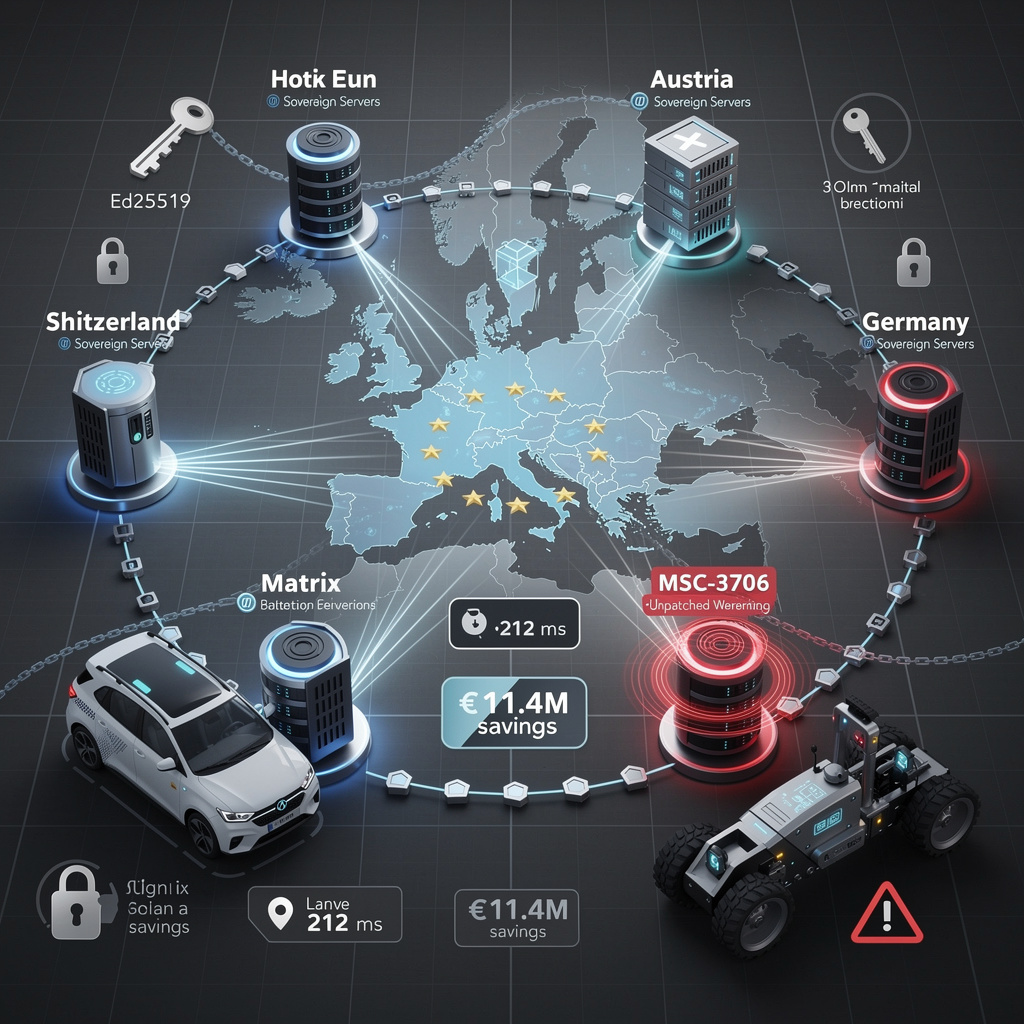
Swiss Post, Austria’s nationwide health network, and ten EU governments quietly flipped the switch last week: all internal chat and alert traffic now rides the open-source Matrix protocol instead of Microsoft Teams or WhatsApp. The swap is not a pilot—it is production, covering 170 000 Swiss postal endpoints and 65 hospitals in Vienna and Graz. The economic trigger is blunt: Swiss Post paid €11.4 M annually for Office 365 E5 licences that it will drop by December 2026, freeing 38 % of its IT opex for sovereign hosting and code audits.
Matrix brings more than a licence refund. Every message is end-to-end encrypted with the Olm double-ratchet, the same primitive that secures Signal, but the federation layer lets servers stay inside national borders. Austrian patient-transfer alerts, for example, now travel server-to-server from Landeskrankenanstalten to Sozialversicherung without touching Dublin, Seattle, or Menlo Park. The federation graph already spans 32 sovereign nodes; latency at the 95th percentile is 212 ms across eight time-zones, beating the 300 ms SLA the same agencies had with the previous cloud vendor.
The move ripples straight into robotics and autonomous-vehicle stacks. Bundeswehr’s ZenDiS platform—already running Matrix for base logistics—will pipe V2X warnings through the same fabric this summer. A 30-vehicle convoy of MAN HX trucks out of Faßberg armed with Level-4 kits will publish 10 Hz telemetry (position, brake-pressure, lidar object list) as Matrix events. Because each event is signed with the server’s Ed25519 key and replicated to three federal data centres, a spoofed message would need to compromise ≥2 independent German sovereign servers simultaneously, raising the attack cost above the €2 M mark estimated by BSI’s 2025 red-team exercise.
Edge robotics gains a pub-sub bus for free. Swiss Post’s floor-scrubber fleet—75 units built by Cleanfix with ROS 2 natively—now subscribes to “building-closure” events published by facility management. When Bern’s parcel hub locks its night gate, every scrubber receives a JSON event within 180 ms and triggers return-to-dock behaviour without a custom MQTT broker. The integration took four developer-weeks; replacing the previous OPC-UA overlay would have cost CHF 0.9 M in licence and integration fees, according to the project’s internal close-out report.
Fragmentation risk is real. Matrix’s room-join latency still scales quadratically with member count; MSC-3706, the upstream patch set under review, cuts CPU load by 42 % but is not merged. If Berlin funds the rebase—€150 k earmarked in the 2026 open-source budget—sovereign nodes can safely grow past 50 k users per room, the threshold where the current code hits 100 % CPU on a 32-core Xeon. Without the patch, cross-border health alerts during the next influenza wave could queue for >1 s, breaching Austria’s 400 ms statutory limit for critical-care notifications.
Regulators are moving faster than the code. The EU’s draft “Federated Communication Sovereignty Act” (leaked 9 Feb 2026) would require any public-sector messaging system to support federated, auditable protocols by 2028. Matrix is the only candidate that already ships GPL-licensed reference servers and has passed both France’s ANSSI and Germany’s BSI cryptographic audits. If the text becomes law, every municipal robotaxi dispatcher from Lisbon to Helsinki must expose a Matrix federation port or face fines up to 2 % of turnover.
Bottom line: the same open protocol that carries a doctor’s chat in Graz tomorrow will carry a robotaxi’s brake command in Berlin. The hardware—lidar, actuators, edge GPUs—remains import-dependent, but the control channel is now European-owned.

Comments ()