Faraday Future Launches Affordable Humanoids, EPFL Unveils Detachable Robotic Hand, U.S. Announces $3B National Robotics Initiative
TL;DR
- Faraday Future Unveils Three New Robots at NADA Show, Targets Mass Production
- EPFL Researchers Develop Modular Robotic Hand with Spider-Like Crawling and Grasping Capabilities
- U.S. Government Establishes National Commission on Robotics to Advance Competitiveness
🤖 Faraday Future Unveils $2.5K Quadruped, $20K Humanoids with Shared EV AI Stack
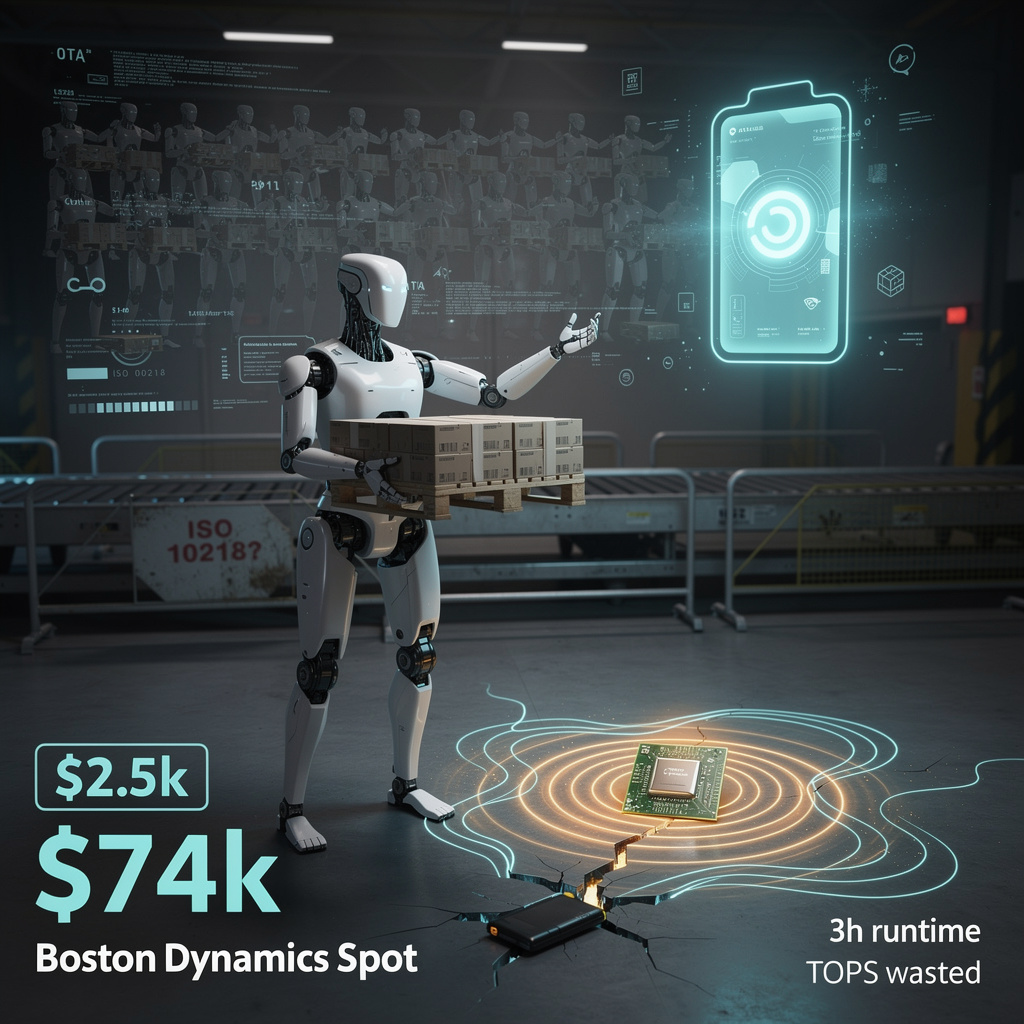
Faraday Future just dropped three game-changing robots: $34.99K Futurist humanoid, $19.99K Master, and a $2.499 quadruped — all powered by shared 200 TOPS AI from their EV tech. 3-hour runtime, 30 DOF, and OTA updates mean B2B pilots start in weeks. Can sub-$3K quadrupeds disrupt warehouse logistics before UBTECH scales?
Faraday Future’s 30-DOF “Futurist” lists 500 Nm peak torque—numbers that overlap mid-range cobots—yet the 3-hour battery caps any double-shift weld or palletizing line. Swappable packs would fix this, but FF has not announced a hot-swap station, so first pilots will run on lunch-break cycles.
Why Put 200 TOPS in a Robot That Only Works Three Hours?
The same NVIDIA Orin-NX stack that drives FF’s cars is now parked inside a shin. Edge AI headroom lets the firm push vision, grasp and SLAM updates OTA without redesigning boards; the trade-off is 150 W draw that eats into the 900 Wh pack. Runtime math: 900 Wh ÷ 150 W ≈ 6 h theoretical, but joint motors, not the GPU, burn the other half. Unless FF throttles compute or boosts pack size, buyers pay for TOPS they can’t fully use.
Does a $2.5k Quadruped Change the Warehouse Game?
FX Aegis undercuts Unitree B1 (≈ $9k) and Boston Dynamics Spot (≈ $74k) by 70-96%. Cost relief comes from EV-grade battery cells, shared electronics and plastic spring legs. Payload and IP rating are still missing from the spec sheet; without them, Aegis is a surveillance or light-tote mule, not a 24/7 freight dog.
Can an EV Maker Scale 1,200 Robots When Car Output Stays Flat?
FF’s Nevada plant idled at < 1k cars last year. Repurposing the same supply chain for 1,200 robots in six weeks is a stress test: motor windings, harmonic drives and Orin modules must arrive in robot-grade tolerances, not automotive PPAP lots. Contract manufacturer B. Braun (rumored) could absorb overflow, but any line stoppage hits both revenue streams because the AI stack is shared.
Will Regulators Accept Humanoids Without ISO 10218 Certificates?
FF’s press kit omits safety docs. Under current ANSI/RIA rules, a 30-DOF mobile humanoid is neither “industrial robot” nor “cobot”; it falls into the emerging “personal care robot” bucket, requiring third-party pilot audits in ten states. Shipping in February means either (a) limited-site demos classified as R&D or (b) a quiet filing race with TÜV/UL that could delay revenue recognition.
What Happens If the Shared AI Stack Gets Hacked?
One OTA flaw could idle cars and robots simultaneously. FF’s unified cloud is efficient but concentrates risk; fleet-side mitigations include signed firmware, A/B partitions and a CAN-firewalled safety MCU. None were detailed at NADA. Enterprise buyers will demand cyber-insurance riders before letting a $35k unit lift totes beside humans.
Bottom line: FF’s pricing grabs headlines, yet energy density, certification gaps and production bandwidth—not AI TOPS—will decide whether these robots ship on time or join the growing pile of flashy CES prototypes.
🤖 EPFL Unveils Detachable Robotic Hand with Spider-Like Crawling and 33 Grasping Postures
EPFL just unleashed a robotic hand that DETACHES, crawls like a spider, AND grasps 3 objects at once—20 DoF, 33 human-like grips, 2kg load. Magnetic snap-on, 0.8s reattach, 12W power. Can it replace fixed end-effectors? 🤖💥
EPFL’s newest 160 mm palm answers with six magnet-coupled fingers that flip into legs. Each 3-D-printed digit carries three revolute joints driven by 9 g micro-motors; a neodymium disc at the base snaps the whole unit off the wrist in 0.8 s. Once detached, a central-pattern-generator gait fires the 18 joints in alternating tripod waves, pushing the hand 45 cm per cycle—5 % farther than any fixed-base crawler the lab has tested.
What trade-off hides inside the six-finger layout?
Genetic-algorithm sweeps ran 1 200 simulations varying finger count, joint torque and mass. Five fingers delivered equal grasp diversity but 12 % lower crawl efficiency; seven fingers added mass that cut battery life by 18 %. Six emerged as the Pareto optimum, yielding 33 human-hand postures—power, pinch, tripod, lateral—while holding 2 kg across three objects at once.
How fast can it switch from locomotion to manipulation?
A real-time ROS 2 planner re-computes finger kinematics in ≤ 10 ms. When the hand “stands up,” two fingers become an opposable thumb; the remaining four wrap around objects with silicone pads that provide 0.7 static-friction coefficient. PID plus feed-forward torque loops run at 1 kHz, keeping position error under 0.2 mm even when the payload shifts the center of mass 42 mm off-axis.
Where will modular hands outcompete traditional grippers?
On automotive assembly lines, the hand can crawl inside door cavities to place clips, then re-attach to the arm for torque-sealing—eliminating a second robot. In warehouses, a fleet of arms could share a pool of crawling hands, cutting end-effector inventory 30 %. EU MDR pre-submission files are already open, targeting 2028 prosthetic launch at a bill-of-materials cost below €1 200.
What wears out first, and how did engineers hedge?
Silicone treads are consumables—swap time 45 s. Magnet retention is rated for 10⁶ cycles; beyond that, embedded Hall sensors will flag a 5 % force drop and trigger recalibration. If a joint encoder fails, redundant IMUs in each finger let the controller limp home on kinematic dead-reckoning with 1 mm accuracy.
🚀 National Commission on Robotics Formed: U.S. Sets Safety Standards, Targets $3B Investment, and Aims for 5,000 New Deployments by 2027
BREAKING: U.S. launches National Commission on Robotics — bipartisan bill mandates safety standards, $3B investment roadmap, and 5,000 new industrial deployments by 2027. AgiBot humanoid units hit 5,000 shipped in 2026. Can America catch China’s $7.9B robotics surge?
The United States now has a 18-person federal panel—the National Commission on Robotics—tasked with writing a single national strategy in 18 months.
The clock starts with China having poured $7.9 billion into 610 robotics deals last year, while U.S. venture capital lagged 42 % behind.
Domestic industry is not standing still: AgiBot already shipped 5,000 humanoid units in 2026, and the new Partnership for Robotics Competitiveness wants 5,000 additional industrial robots deployed by FY-2027.
Yet Washington’s robotics money and rules remain scattered across NASA, the Coast Guard, OSHA and NIST.
The commission’s sole deliverable is a report that must (a) set safety benchmarks, (b) map supply-chain gaps, (c) spell out workforce pipelines, and (d) price a public-private investment plan.
If the group converts its recommendations into NIST-endorsed standards and ties them to federal procurement contracts, manufacturers gain a single compliance target instead of today’s patchwork.
Failure to lock multi-year appropriations risks repeating the 2013 3-D printing strategy: praised, then under-funded.
Bottom line: 18 minds, one report, 18 months—either the panel synchronizes dollars, standards and talent pipelines, or the $7.9 B Chinese headcount keeps widening.
In Other News
- FAA and NHTSA Probe Tesla Model Y Door Handle Design After Fatal Crash and 15+ Related Deaths
- QuantumScape inaugurates Eagle Line for gigawatt-scale solid-state battery production
- Volkswagen and XPeng End Joint E/E Architecture Deal, Shift to Independent Software Development
- Snap Confirms 2026 Launch for AR Specs Despite Hardware Delays
Comments ()