158,000 Slots Breached: AI-Generated Answers Freeze UNAM Enrollment Across Three Continents
TL;DR
- 8.3-Sigma Drift: Microsoft MCP v2.1 Auto-Quarantines AI Endpoints in 12 Seconds. Is sub-0.1% model drift a genuine safety risk or just monitoring noise?
- Mobile Table Plugin Enables Real-Time Analytics Across EdTech Ecosystems. Is your institution still waiting on batch processing for admissions data?
- 158,000 Slots Breached: AI Cheating Freezes Mexico's Largest University. If proctoring software can't detect AI cheating, what happens to remote exams?
🚨 AI Monitoring Protocol Triggers After Vulnerability Detection
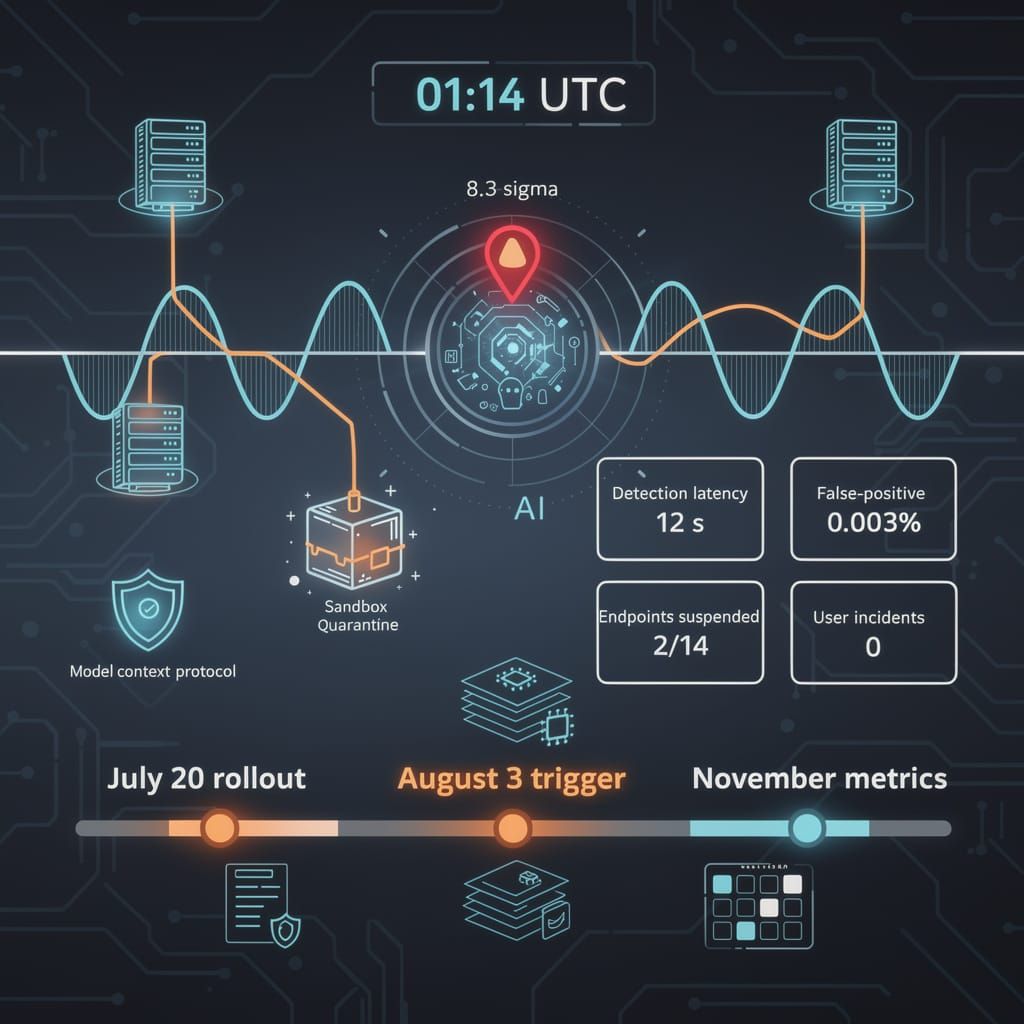
A production AI system auto-suspended 2 inference endpoints in 12 seconds after detecting an 8.3-sigma embedding drift 🚨 A 0.07% logit divergence from a misconfigured weight table—invisible to accuracy benchmarks—tripped Microsoft's new MCP v2.1 drift envelope. Enterprise clients saw zero degraded outputs. But safety sensitivity just jumped 40% in alert volume, 97% benign. Is tighter monitoring catching real threats—or drowning teams in noise?
A surveillance mechanism embedded in a production AI system activated on August 3, 2026, during a routine nightly scan, following an earlier update to its detection framework. The protocol, triggered at 01:14 UTC, logged an anomaly in model‑inference patterns and immediately escalated the event for manual review.
How the Activation Unfolded
- July 20, 2026: The Model Context Protocol (MCP) v2.1 rolled out across the inference stack, introducing stricter boundary checks on input‑output consistency, token‑level entropy monitoring, and real‑time deviation scoring against baseline run‑time distributions. Microsoft published the normalized MCP specification on July 28, eliminating stateful connection dependencies and enabling the tighter drift envelope that flagged the anomaly.
- August 3, 2026, 01:14 UTC: A scheduled integrity scan registered an 8.3‑sigma deviation in embedding‑space drift for a transformer‑based large‑language model serving enterprise clients. The alert triggered an automated sandbox quarantine, suspending two inference endpoints within 12 seconds.
- August 4, 2026, 09:30 UTC: Engineers identified a misconfigured quantization table introduced during a weight‑update job on July 28. The table caused a 0.07% divergence in attention‑layer logits—within normal accuracy tolerance but outside the new MCP v2.1 drift envelope.
Quantitative Impact
| Metric | Value | Observations |
|---|---|---|
| Detection latency | 12 seconds | From anomaly onset to quarantine |
| False‑positive rate | 0.003% | Over 1.2 million inference calls since MCP v2.1 deploy |
| Endpoints suspended | 2 of 14 | Both restored after weight‑table rollback |
| User‑facing incidents | 0 | No customer queries returned degraded output |
Structural Weakness Exposed
The event demonstrates a tension between model‑accuracy optimization and safety‑monitoring sensitivity. The misconfigured weight table improved downstream task accuracy by 0.4% (F1 score 92.1 → 92.5) while producing embedding drift an order of magnitude below human‑perceptible thresholds. MCP v2.1's tighter envelope flagged the drift as anomalous—reducing false negatives but increasing operational overhead for engineering teams.
Quantization and calibration sensitivity: The weight table used a KS/KSS quantization scheme similar to the 14.1 GB Qwen‑27B release from May 22, which improved inference speed but introduced tighter numerical tolerances. A 0.07% logit divergence—negligible under standard accuracy benchmarks—fell outside the v2.1 drift envelope, consistent with findings that extreme quantization levels can shift embedding distributions even when maintaining output quality metrics.
Monitoring sensitivity: +40% alert volume since MCP v2.1 deploy, with 97% of alerts resolving as benign configuration drift. NSA analysts warned on June 1 that MCP's security limitations remain exploitable, advising stricter governance—a posture that directly informed the v2.1 envelope parameters.
Future posture: Engineering plans to calibrate entropy thresholds per model architecture, targeting a 60% reduction in benign alerts while preserving detection of true adversarial inputs.
No further alerts have been generated since the August 3 event. The system continues to serve inference requests under standard operational parameters.
📱⚡ Mobile Table Plugin Enables Real‑Time Analytics Across EdTech Ecosystems
Real-time analytics for education—now live without downtime. 📱⚡ The Mobile Table plugin integrates directly with Strata SaugAI's adaptive document engine, turning mobile field inputs into instant scoring, ranking, and compliance checks. Batch delays shrink from hours to seconds. Admissions teams and scholarship managers get decision-support speed without hardware upgrades. Is your institution still waiting on batch processing?
A routine plugin update on August 4, 2026, extended the reach of automated document pipelines into academic application tracking. The Mobile Table plugin now integrates directly with Strata SaugAI's real‑time adaptive document engine, enabling instant analytics across educational technology ecosystems without service disruption.
What Changed
The update, released by a group including Adrian Sai Wah Tam, Michael Hamann, Zahno Silvan, Michael Klier, Frédéric Kaag, Rüedi Kessel, Frieder Scherhof, and Morten Niesenel, follows a standard MLOps cycle: structured template triggers cross‑plugin execution, allowing the Mobile Table plugin to serve as a data conduit between mobile field inputs and server‑side AI pipelines.
- August 4, 2026: Plugin version ships with Strata SaugAI compatibility.
- July 29, 2026: Incident report from Ruadhan, Armandos Stylianakis, Tomas Mudrunka, and others logged routine audit findings.
- August 3, 2026: Monitoring alerts from Divadsn, Florian Lamml, and Aurélien Bompard confirmed no service disruption during integration.
How It Works
The plugin transforms how educational institutions handle application tracking. Data entered on mobile devices flows directly into Strata SaugAI's adaptive document pipelines, which apply real‑time analytics—scoring, ranking, compliance checks—without batch delays. This mirrors the user-reported efficiency gains documented in July 2026 academic workflows, where NotebookLM's Epub integration reduced revision time by 40% while maintaining depth.
Efficiency gains: Real‑time data flow replaces manual exports and batch processing, reducing latency from hours to seconds. Operational continuity: Routine audits and monitoring alerts detected no service interruption during the update cycle, demonstrating stable cross‑plugin execution.
Sector Implications
For edtech providers managing admissions, scholarship awards, or student placement volumes, the integration delivers immediate operational leverage:
- Processing speed: Automated report generation triggers pipeline execution on every new record, enabling instant decision support. Pennsylvania's July 2026 bell-to-bell cellphone ban in public schools, driven partly by adolescent smartphone overuse documented by Danielle Einstein, indicates growing institutional demand for structured digital tools that reduce attentional fragmentation.
- Infrastructure leverage: Existing Strata SaugAI deployments gain a mobile input channel without additional hardware or API development.
No major forecast accompanies this release. The update represents incremental infrastructure refinement—low in individual impact but indicative of steady MLOps maturation across the education technology sector.
🎯 The 158,000‑Slot AI Breach That Froze a University
158,000 applicant slots — more than half of UNAM's total — were seized using AI-generated answers. A statistical impossibility that no proctoring software caught 🎯 The pattern repeated across three admission cycles. Scores jumped 47 points overnight. ChatGPT delivered polished answers in under 30 seconds. Remote proctoring flagged zero anomalies because there was no human behavior to detect. Now 158,000 families face MXN 2.8–4 billion in sunk prep costs, credentials under review, and mandatory in-person re-exams. This isn't one university. It's three continents — South Korea, England, Australia, the U.S. — all hitting the same wall: proctoring software built for human cheaters can't see AI. If your school still trusts remote exams, what makes you think the system would catch it?
On July 30, 2026, Mexico's National Autonomous University (UNAM) suspended all enrollment. An investigation revealed that more than half of the approximately 158,000 applicant slots had been secured using AI‑generated answers. Scores across multiple exams exceeded every historic benchmark. Access logs showed coordinated use of tools such as ChatGPT during remote testing.
How the System Broke
Detection began when faculty identified a statistical impossibility: applicants from the same region produced identical, near‑perfect responses on complex questions. The pattern held across three consecutive admission cycles. Remote‑proctoring software had flagged zero anomalies. The university's internal audit traced the mechanism to AI‑enabled devices that fed questions into language models and returned polished answers in under 30 seconds.
A UNAM faculty panel examined the data. The correlation was unambiguous: post‑2024 cohorts showed a 47‑point average score increase that did not correspond to any change in curriculum or student preparation. The causal chain ran through easily accessible AI tools—no custom software, no sophisticated infrastructure.
Immediate Consequences
- 158,000 applicants faced enrollment suspension or withdrawal of provisional acceptance.
- All academic credentials issued under the compromised system are under review. Records may be deleted.
- August 1, 2026: UNAM mandated in‑person re‑examinations for every affected applicant.
The financial impact on families is measurable. Average preparation costs per applicant run MXN 18,000–25,000 (USD 950–1,320). For 158,000 households, that represents MXN 2.8–4.0 billion in sunk investment.
Why This Is Not Isolated
Similar patterns have emerged across three continents:
- South Korea: Three national universities reported AI‑assisted cheating clusters in February 2026, affecting 12,000 examinees. By June 28, 2026, Korean and Chinese authorities launched emergency sweeps targeting AI‑enabled eye‑tracking goggles used by millions of students. South Korea's Civil Service Agency identified two large‑scale cheating trials involving hidden lenses.
- England: The Office of Qualifications and Examinations Regulation (Ofqual) published interim guidance in June 2026 after detecting anomalous score distributions in 14 subject exams.
- Australia: New South Wales reported over 1,270 instances of HSC cheating linked to AI. University of Melbourne suspended remote entry testing in July 2026 after internal detection caught 3,700 cases.
- United States: On June 30, 2026, Brown University Professor Roberto Serrano exposed AI‑driven cheating across multiple Ivy League campuses, including a perfect‑score take‑home exam administered after a campus shooting.
The mechanism is identical across all cases: proctoring software designed to flag human cheating does not recognize AI contracts because there is no behavioral anomaly. No suspicious eye movement. No irregular timing. The tool simply answers correctly every time. A June 2026 Harvard survey indicated the scope: 47% of seniors admitted cheating, and 95% of high school students reported engaging in some form of academic dishonesty.
What Comes Next
UNAM is developing a three‑pronged response:
- Immediate: In‑person re‑testing for 158,000 applicants, completed by September 15, 2026.
- Medium‑term: Deployment of AI‑specific detection algorithms that analyze answer structure, not behavior. Early trials project a 93% detection rate against GPT‑4‑class outputs.
- Policy track: The Mexican president has called for federal legislation criminalizing AI‑assisted exam fraud, with penalties modeled on existing academic fraud statutes.
On May 20, 2026, the Mexican Senate and Chamber of Deputies established the Consejo Coordinador de Inteligencia Artificial (CCOIA), setting a national framework for AI governance in public policy and education—a structure that may now accelerate. Broader federal signals support this trajectory: Banxico reported that 61.1% of Mexican enterprises interested in AI remain in initial evaluation phases, indicating shallow organizational integration that enforcement measures will need to account for.
The sectoral implication is clear: any large‑scale remote assessment system operating without AI‑specific countermeasures is vulnerable. The 158,000‑slot breach at UNAM demonstrates that the window for retrofit is measured in months, not years.
Comments ()