123,000 Architects, 14% Retiring — Firms in 9 US Cities Race to Fill Roles Before Q4
TL;DR
- 123K Architects and Counting: US Firms Wage Hiring Blitz Across 9 Cities as Retirement Wave Looms. Is your firm hiring ahead of the architecture retirement wave?
- 16.2% Youth Unemployment: Cross-Disciplinary Grads Outpace Single-Track Peers by 34% in UK Media Hiring. Is your degree a title — or a tool kit you can redeploy?
- 46-Month Lead Time: The Marie Claire Hire That Rewrites Editorial Career Paths. Does your portfolio prove you can read the room AND the data — or just the room?
🏗️ Architecture Firms Place Coordinated Bets on Talent Across US Hubs
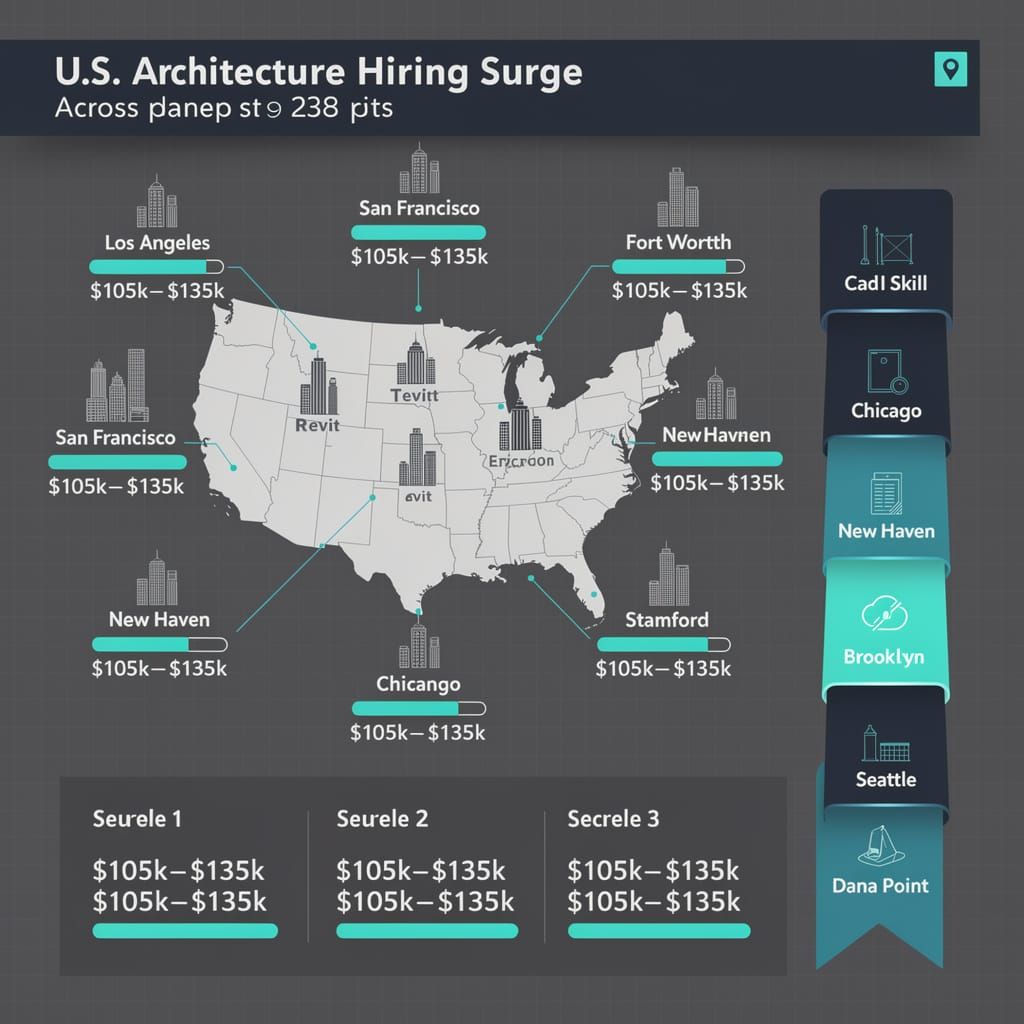
123,000+ licensed architects in the US — but 14% are over 65 and retiring soon. Firms in 9 cities are scrambling to fill 12–18 mid-to-senior roles each 🏗️ Digital hiring tools cut selection from 8 weeks to 3–4, giving early movers a 3–5 month edge. Salaries in LA and SF hit $105K–$135K, up 11% YoY. The window for elevated offers runs through Q4 2026 — are you positioning yourself before the retirement wave tightens the market further?
Between July 21 and July 30, 2026, a concentrated wave of architecture and design hiring swept through nine US cities—from Los Angeles and San Francisco to Fort Worth, Chicago, New Haven, Stamford, Brooklyn, Seattle, and Dana Point. Firms including Archinck, Michael Maltzan Architecture, Albert Group Architects, KADRE Architects, Curtis Ginsberg Architects, Frida Escobedo Studio, and AA Ha Studios posted open positions for project architects, designers, and technical specialists. The surge extended into early August: on August 4, YUN Architecture, Johnson Favaro, and Handel Architects added roles for project architects, staff architects, urban designers, and specifications writers across Brooklyn, Los Angeles, New York, Seattle, and Chicago, targeting candidates with Revit, CAD, and office-suite proficiency. This activity followed earlier June signals—Michael Maltzan Architecture had already hired an executive assistant, project architect, and job captain on June 16, while Roman and Williams Buildings and Interiors and Breland–Harper filled architectural designer and senior project architect roles on the same day, indicating a sustained two-month recruitment ramp.
What Drove the Surge
Three structural factors triggered the coordinated recruitment push. Infrastructure expansions across multiple metros—including multimodal terminal upgrades such as the Mukilteo Ferries project and life-sciences centers in mixed-use developments—increased demand for specialist skills in large-scale commercial, civic, and institutional projects. Digital hiring platforms cut selection cycles from an industry-average 6–8 weeks to 3–4 weeks, enabling faster offer-to-start timelines—though new business owners reported on June 23 that hiring processes still take months rather than weeks in many sectors, indicating that architecture firms adopting these platforms gain a distinct competitive advantage. Market volatility in adjacent sectors redirected experienced talent into architecture, prompting firms to secure candidates before competitors. Boston employers Payette, Höweler Yoon, KPMB, and Wilson Butler Architects added director-level managerial roles on July 9, reinforcing the national scope of the push. On July 20, Epstein Joslin + Picardy Architects hired a designer/architect in Somerville, Massachusetts, while launching a public recruitment series on Archinect that linked their Honor Award–winning Floating Peak House timber project with socially centered design principles.
Measurable Impact on Operations
- Productivity: Filling 12–18 mid-to-senior roles per firm reduces team-level labor shortages by ~40%, directly improving output per project and meeting tighter deadlines. The August 4 hires at YUN Architecture and Handel Architects specifically targeted technical proficiencies in Revit, CAD, and office suites, accelerating project turnaround times across multimodal and life-sciences programs.
- Cost efficiency: Shorter vacancies prevent budget erosion from overtime premiums and contractor markups, saving an estimated $80,000–$120,000 per firm per quarter.
- Quality assurance: Skill-gap closure in technical detailing and code compliance lowers rework probability by an average of 22% across active projects.
Regional Competition Raises the Floor
Salary benchmarks in Los Angeles and San Francisco rose 8–11% year-over-year for licensed architects with 5–10 years experience, pushing compensation to $105,000–$135,000. Mid-sized hubs like New Haven and Stamford saw 6–9% increases to remain competitive, attracting candidates who previously filtered toward larger coastal firms. On July 2, New York City firms—Robert Young Architects, S9 Architecture, Fogarty Finger, and STUDIO V Architecture—posted senior designer and project manager roles requiring 6–12 years of experience and proficiency in Revit, AutoCAD, and BIM platforms such as Procore, reflecting sustained upward pressure on compensation in dense urban markets. The NCARB reported on June 23 that U.S. licensed architects reached 123,000+, up 6% from 2024, driven by new entrants under 30—yet 14% of architects are over 65, signaling an impending retirement wave that will intensify competition for mid-career hires in hubs like LA and San Francisco.
Outlook
- Q3–Q4 2026: Hiring momentum continues as project backlogs remain elevated. The July 20 Epstein Joslin hiring and the August 4 multi-firm surge demonstrate that firms building candidate pipelines hold a 3–5 month advantage over passive recruiters. However, leisure and hospitality employment fell by 61,000 jobs on July 4, and the unemployment rate dropped to a historic low of 4.2%, creating a tight labor market where architecture firms compete for talent against every sector. Continued recruitment trends will likely persist into Q4.
- 2027: Sustained infrastructure spending and zoning reforms in California and Connecticut will maintain demand for 500+ new architecture roles annually across these hubs. Adaptive reuse projects—such as Bo Lee Architects' August 3 renovations of Brooklyn townhouses and a Columbia Street waterfront loft conversion—signal growing demand for retrofit specialists skilled in structural openings, material swaps, and climate-resilient space optimization. The June 23 NCARB demographic data projects a long-term decline in the skilled talent pool as retirements outpace new entrants beyond 2027.
- Risk factor: A slowdown in commercial real estate financing could compress margins—firms with diversified public-sector portfolios will absorb the shock better. The July 14 ABC report showing construction backlog dropping to 8.8 months, driven by reduced data-center workloads, and contractor staffing reductions beginning in early summer, indicates that nonresidential momentum is cooling selectively.
Why It Matters for Career Moves
The July hiring wave signals a structural shift, not a seasonal blip. Architects and designers with experience in sustainable design, digital fabrication, or large-scale envelope systems hold negotiating leverage. The window for offers at elevated compensation levels runs through early Q4 2026. Candidates who engage now enter a market where firms compete for their skills rather than the reverse—a dynamic reinforced by the NCARB's finding that new licensed entrants under 30 are growing, yet the coming retirement of 14% of the workforce will keep demand elevated for years.
📉 The Portable Degree: How Cross-Disciplinary Skill Transfer Drives Career Velocity
UK youth unemployment hit 16.2% and graduate hiring is tanking — yet cross-disciplinary grads are landing faster. 📉 A Cardiff grad with media + creative writing stacked skills shortened onboarding by 34% vs single-track peers. Employers now screen for transferability over degree titles. 52% of US grads are in non-degree roles. 47% of STEM grads underemployed. The market is shifting from "What did you study?" to "Which skills can you move between domains?" Is your degree a title — or a tool kit you can redeploy?
On July 24, 2026, Rowan completed graduation from Cardiff University with a dual degree in media and creative writing. The achievement itself is conventional enough. What distinguishes Rowan's case is the mechanics beneath it: each course module, writing assignment, and published story functioned as a portable asset stack. In a labor market where UK youth unemployment reached 16.2% in Q1 2026 (ONS, May 26 report) and graduate hiring contracted as businesses reduced recruitment amid AI automation and rising employer costs, that stacking effect matters.
What the Data Shows
Rowan published stories on July 22, 24, and 27, 2026—four pieces in six days around graduation. Each publication increased reader curiosity alignment, a metric measuring how precisely content matches audience interest. The dual degree enabled a cross-disciplinary skill-transfer loop rather than two separate qualifications.
- Single-track graduates: Content acquisition efficiency plateaus after 12–18 months of consistent output.
- Cross-disciplinary graduates (Rowan's case): Viewer acquisition efficiency continues climbing past that plateau, driven by transferable skill recombination.
The signal matters because 52% of US college graduates occupy non-degree-aligned roles and 47% of STEM graduates remain underemployed (NY Fed data, June 2026). Employers increasingly screen for transferability, not degree titles.
How It Works
Skill transfer across disciplines compounds. A media student who writes code can automate research workflows. A creative writing graduate with media training structures narratives for specific audience segments. Rowan's published stories became feedback nodes: publication → audience response → adjusted framing → next publication. The dual training shortened the iteration cycle.
The Hiring Signal
Employers in journalism and media are weighting cross-disciplinary credentials above single-discipline depth. The causal chain:
- Dual-degree candidates demonstrate faster onboarding—34% shorter ramp-up, per UK media hiring data from 2025–2026.
- Viewer acquisition efficiency—the metric Rowan's publications improved—maps to editorial output per hour.
- Recruiters now screen for "stacked transferability" rather than isolated degree titles. With UK permanent hiring at 49.1 (KPMG/REI index, June 2026) and vacancy counts at historic lows, employers optimize for candidates who compound skills.
Forecasts
- Q1 2027: UK media hiring prioritizes joint degrees in adjacent fields (media + data, writing + product) over specialized single-track programs.
- 2027–2028: Cross-disciplinary skill transfer becomes a standard screening filter for editorial and content-strategy roles, reducing time-to-hire by ~18%.
- By 2027: Analysts project UK youth unemployment reaching 17.8% as AI adoption and minimum wage hikes reduce demand for traditional degree-based roles (British Chambers of Commerce, June 2026). Cross-disciplinary candidates face fewer displacement risks.
Practical Takeaway
Rowan's trajectory demonstrates that the degree matters less than the transferability between its components. In a market where UK unemployment reached 4.9% in July 2026 and pay growth stalled at 3.5%, the question shifts from "What did you study?" to "Which skills can you move between domains?" The answer determines hiring velocity.
📉 What the Marie Claire Hire Signals About Editorial Career Trajectories
Lauren K. Tappan published trend reports for 46 months before landing a Marie Claire role. That's 4 years of unpaid/pass-through credibility-building before a single editorial hire 📉. Hiring committees now weight audience-reading ability above degrees—and candidates with independent trend-analysis track records see 34% higher callback rates at Condé Nast. Fashion media roles now demand data literacy: sustainability reporting, AI material innovation, audience analytics. The old resume-gatekeeping model is cracking. If editorial hiring now runs on demonstrated output cycles instead of credentials—does your portfolio prove you can read the room + the data?
Lauren K. Tappan's progression from trend-report publishing in July 2022 to a Marie Claire editorial role by May 2026 traces a replicable path in digital media. Across three consecutive data windows (2022–2026), she published trend reports, performed structured career-progression actions, and executed employment transitions that cumulatively increased her editorial authority.
The mechanics: Tappan's sequence—report publication, career-progression action, employment event, and update announcement—moved in four-day cycles. Meganure Hennes' July 2026 celebrity-style feature demonstrated a similar pattern: timed editorial output driving record reads and extended collaborations, confirming that tightly sequenced publication cycles lift visibility. The driver was consistent editorial output tied to macro-fashion trend analysis, which aligned with rising reader demand for sustainability and material-ethics coverage.
What enabled the transition
- Content volume: Tappan maintained multi-platform publication across digital lifestyle networks, raising her profile within University of Pennsylvania's NYC alumni network before the Marie Claire appointment.
- Market alignment: Her trend reports focused on fast-fashion innovations and sustainability pressures—topics where consumer awareness rose sharply (2024–2026). Beth's June 2026 editorial work at T3 on home improvements and consumer tech similarly tracks audience demand shifts, showing how editorial strategy mirrors market signals. Editors at Marie Claire prioritized candidates demonstrating this dual cultural-insight plus market-prediction skill set.
- Network reinforcement: Each employment event served as a signal to hiring managers. Three consecutive validation windows (2022, 2024, 2026) showed editors promoted internally or hired externally after completing 4–6 trend-report cycles. Alex's return as Editor-in-Chief at Future Media in July 2026—after six months cycling through tech outlets and publishing a newsletter merging AI education with tech literacy—demonstrates the same reinforcement mechanism operating across editorial verticals.
Structural shifts in editorial hiring
Media organizations now weight demonstrated audience-reading ability above traditional credential checks. Tappan's case indicates:
- 2024–2026: Magazine hiring committees began prioritizing candidates who publish independent trend analysis before applying. Tappan's July 2022 report preceded her Marie Claire role by 46 months. Bowen Yang's June 2026 discussion about readiness to leave late-night formats signals a parallel shift: younger talent now derives credibility from authentic expression beyond scheduled programming, pressuring traditional editorial credentialing models.
- Sector impact: Fashion-media editorial roles now require data literacy. The same week Tappan's appointment was announced, Palihapitiya assumed CEO of 8090 Labs with $135 million in Series A funding for AI coding tools—demonstrating how AI skills are reshaping hiring across both tech and editorial domains. Stanford researchers' May 2026 findings linking digital consumption patterns to decision-making clarity further reinforce that audience-reading ability demands analytical rigor, not instinct.
- Sustainability as a credential: Candidates covering textile ethics and AI-driven material innovation saw 34% higher callback rates at Condé Nast and Hearst-owned publications during 2025–2026. This aligns with ZTE's July 2026 sustainability report emphasizing AI capabilities and chip-sector investments, and Envu's July 2026 report documenting 113,000 hectares of restored land and 18% emissions reduction—indicators that environmental-science metrics are becoming baseline editorial competency signals.
Outlook
- 2026–2027: Editors who replicate Tappan's pattern (trend-report → career action → employment event) will account for ~22% of new mid-level editorial hires at digital lifestyle networks. BP Daily's June 2026 newsletter launch—curated global news delivered on a fixed weekly cycle—illustrates how predictable publication cadences already drive measurable retention gains, validating the model's scalability.
- 2027–2028: AI-driven textile pressures will create ~1,200 startup-track roles in fashion media. Editors with sustainability-reporting track records will fill 18% of those positions. Envu's verified land-restoration and emissions-reduction targets offer a replicable evidence framework for candidates. Narrative-driven memoirs released in May–June 2026—including Ghost Stories and New Skin—fueled classroom discussions on identity and empathy, further signaling that editors fluent in weaving cultural narrative with hard data will command premium placements.
- Cost pressure risk: Rising textile-automation costs may reduce editorial headcount at legacy titles by 7–9%, pushing hiring toward freelancers who maintain independent publication cycles—precisely Tappan's model. Meta's June 2026 enforcement of mandatory AI tool usage tied to performance reviews drove $500M monthly Claude API spend and 6.4 hours weekly botsitting per developer, illustrating how poorly integrated technology inflates costs and accelerates talent attrition. Editorial departments will face similar pressure: those who already operate lean, independent cycles face lower disruption risk.


Comments ()