Trump approves first U.S. military execution in six decades
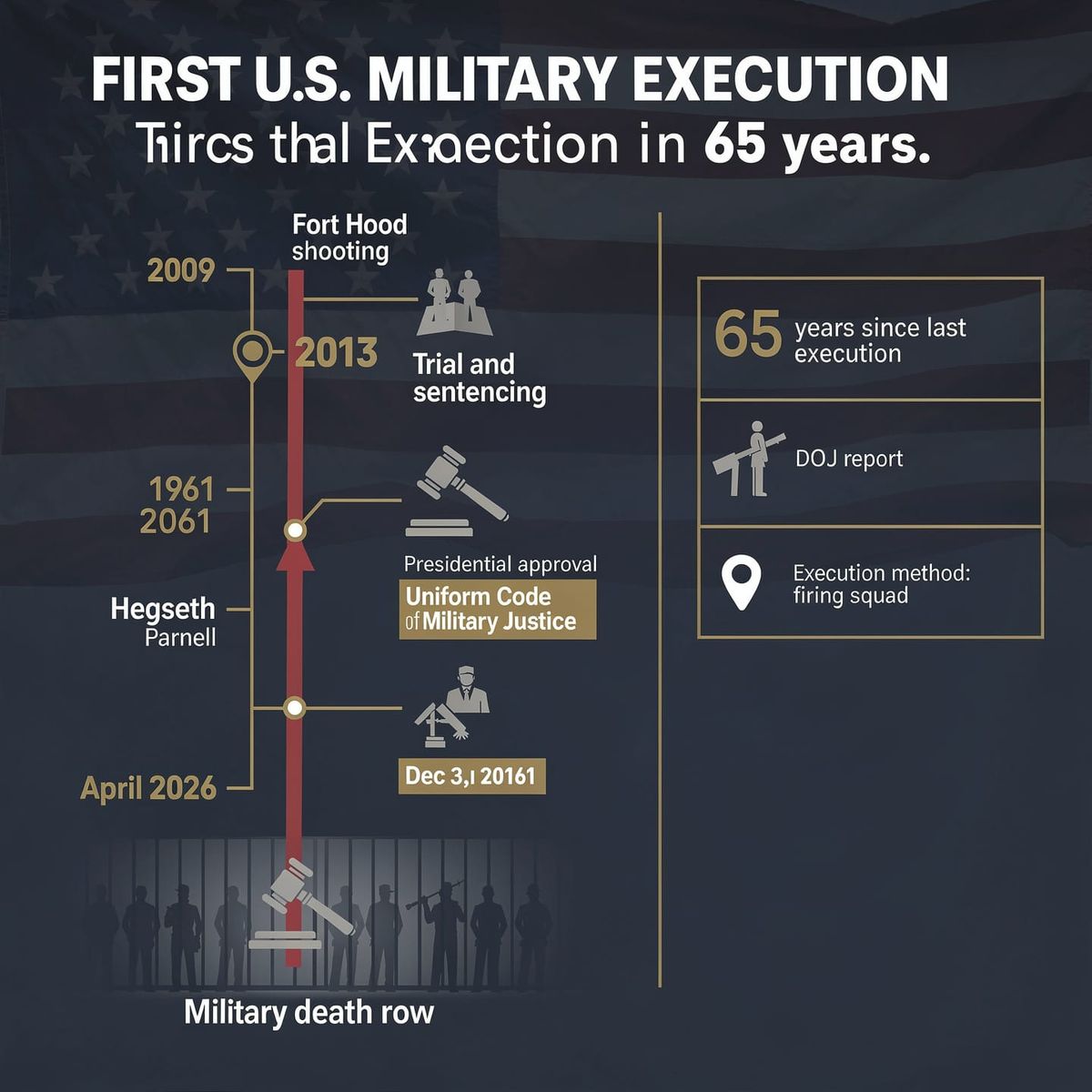
President Donald Trump approved the execution by firing squad of former Army Maj. Nidal Malik Hasan, convicted of killing 13 people and wounding 32 in the Nov. 5, 2009, shooting at Fort Hood, Texas. Pentagon spokesperson Sean Parnell confirmed the order, which followed a recommendation from Defense Secretary Pete Hegseth. The scheduled execution date is Dec. 3, 2026, at Fort Hood, by the Army's firing squad.
How the decision path works
The military justice system operates under the Uniform Code of Military Justice, which requires presidential approval before a military death sentence can be carried out. Hasan, an Army psychiatrist, was convicted in 2013 by a military court-martial for 13 counts of premeditated murder and 32 counts of attempted premeditated murder, and a military jury unanimously sentenced him to death.
What changed with Trump's order is the exercise of presidential discretion, not the conviction. That approval power had not been exercised since the last military execution—Pvt. John A. Bennett, hanged at Fort Leavenworth in April 1961, in the longest such gap in the system's history. Hegseth recommended the Army's firing squad as the method, and the Secretary of the Army is to set the time and place.
Hasan has been confined at Fort Leavenworth, Kansas, since his 2013 conviction. The scheduled execution at Fort Hood comes more than six years before the earliest point at which a firing squad could have been considered under standard federal practice; the decision steps outside routine protocol and reactivates a dormant mechanism.
What the numbers show
The 2009 attack remains one of the deadliest violence events on a U.S. military installation. Twelve service members and one civilian died in the attack. Hasan's own testimony at trial connected his ideology to the late imam Anwar al-Awlaki, an Al Qaeda-linked figure; investigators and prosecutors described the attack as an act of extremism directed at fellow soldiers.
The execution follows an April 2026 Justice Department report that noted five states allow firing squads and recommended including the method in federal protocol. A 1878 U.S. Supreme Court ruling first upheld execution by firing squad.
Read on the system, with limits
The significance extends beyond one case. Since 1961, no commander-in-chief has signed a military execution order, which means no modern administration has had to interpret the approval provisions of the Uniform Code of Military Justice in practice or defend the choice of method in court. The order reactivates a legal mechanism that had lain dormant—and it does so with the Army's firing squad designated as the method.
Hasan remains on military death row alongside three other soldiers. The order is a rare exception, reflecting both the severity of the crimes and the administration's broader embrace of the death penalty, as observers such as Eugene Fidell of Yale Law School have noted.
But causation should not be overstated. The approval establishes that the presidential mechanism is operable, not that it has broader meaning for the wider military-justice system.
The decisive unknown
The practical question is whether legal challenges run on a timeline compatible with the Dec. 3 execution date. Hasan could file a habeas corpus appeal that could delay the execution by years. As of the approval, no court has issued a stay. Whether the execution proceeds depends on those challenges, which are the decisive unknown in the case.
Comments ()