ATO ends credit-card tax payments on Nov 30
The ATO will stop accepting credit-card payments for tax bills on November 30, following the RBA's card surcharge ban. Cards made up just 2.3% of tax payments in 2024–25, but the change hits small businesses hardest, with some advisers warning of cashflow pressure.
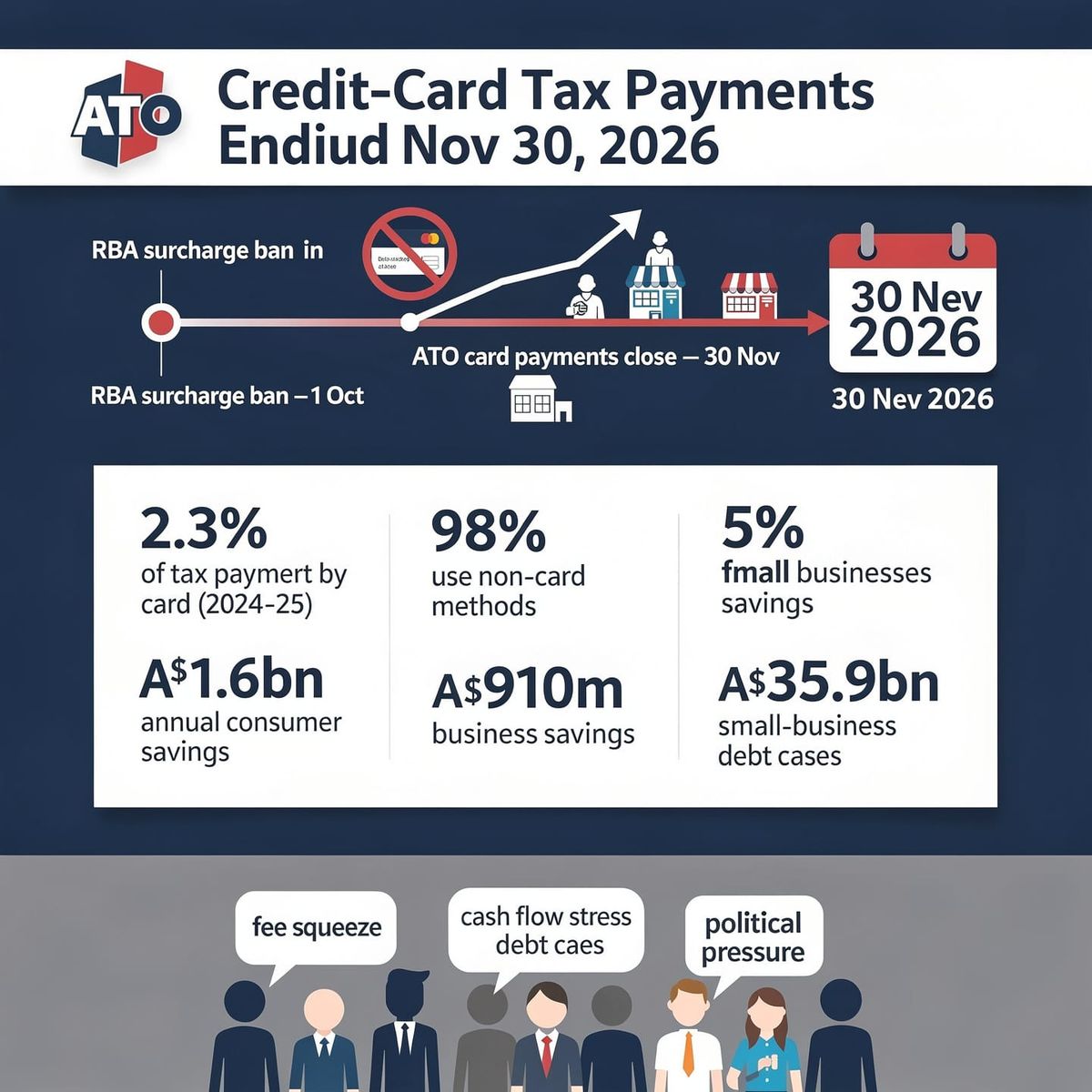
The Australian Taxation Office is ending credit-card payments for settling tax obligations, a ban scheduled to take effect November 30, 2026. The restriction closes a settlement channel that let taxpayers defer the cash outlay to a card issuer rather than paying up front.
What the payment ban changes
The ATO's change removes credit cards as an accepted method for settling tax bills. It follows the Reserve Bank of Australia's ban on card surcharges, which took effect October 1. The two moves are connected: the ATO has said it cannot absorb the cost of processing card payments under the surcharge ban, so it is withdrawing the channel rather than passing the fee on.
For taxpayers, the practical effect is that settling a bill with a card is no longer an option, and the cash has to be available at the point of payment or routed through a formal ATO payment plan. The change does not alter what is owed; it narrows the accepted settlement method.
How the change reaches its effects
The channel's use is smaller than the attention around it might suggest. Credit cards accounted for 2.3% of tax payments in the 2024–25 financial year, and 98% of taxpayers use non-credit-card methods. Among small businesses, roughly 5% used credit cards for tax payments in 2024–25 — a group the ATO has said represents about 250,000 small businesses.
The government has framed the ban as a cost-of-living measure, citing estimated consumer savings of about A$1.6 billion a year once both the RBA's surcharge ban and the ATO's payment closure take effect. Treasurer Jim Chalmers has also cited savings of about A$910 million annually for businesses.
The change is contentious rather than merely administrative. Housing Minister Clare O'Neil and Small Business Minister Anne Aly have voiced concern, and Opposition Leader Angus Taylor has called on the ATO to reverse the ban, describing the handling as "completely out of their depths." The Australian Chamber of Commerce and Industry, led by Andrew McKellar, has joined the pushback, along with the Council of Small Business Organisations Australia. Assistant Minister Andrew Charlton has defended the ban, while Shadow Treasurer Tim Wilson has leveled a double-standard criticism over how the ATO treats fees.
Pressure and an early meeting
The announcement came October 1, the same day the RBA's surcharge ban took effect — an overlap business groups say left little time to adapt. Payment plan holders were flagged as particularly affected. A meeting was held Wednesday after the outcry, which the ATO called "out of session." The consensus among business lobby groups that attended was that the ATO should reverse the ban, and some participants said a reversal appears likely given the strength of the pressure.
What the change does and does not do
The ban does not eliminate the underlying tax debt, does not alter amounts owed, and does not change the ATO's enforcement powers. What changes is the settlement path: a previously accepted method closes, and the alternatives are cash at payment time or a formal payment plan.
For some taxpayers, the switch creates a particular dynamic: paying by credit card extinguished the ATO debt but created a new debt with the card issuer. That transfer option disappears, and some advisers and tax clinic operators say the pressure falls hardest on small businesses that lack an alternative. Financial counselling reports cited a 21% increase in small-business debt cases in 2025, and small-business tax debt stood at A$35.9 billion in 2024–25 — context for why the change landed heavily in that sector.
The open question
The decisive unknown is whether political pressure reverses or adjusts the ban before November 30. O'Neil has called for consultation with the business sector, and Shadow Treasurer Wilson is demanding a reversal. The ATO and government defend the change as a cost-saving measure, and the Reserve Bank backs the removal of card fees. Whether the resistance produces a reversal, a softening, or an unchanged effective date is unresolved as of early October.
What is observable now is the direction of change: a payment flexibility that some individuals and small businesses used to manage cashflow is being withdrawn, and the burden of adjusting falls on the taxpayer at the point of settlement.

Comments ()