A Stablecoin's Hidden Banking Spine Faces a Forfeiture Test
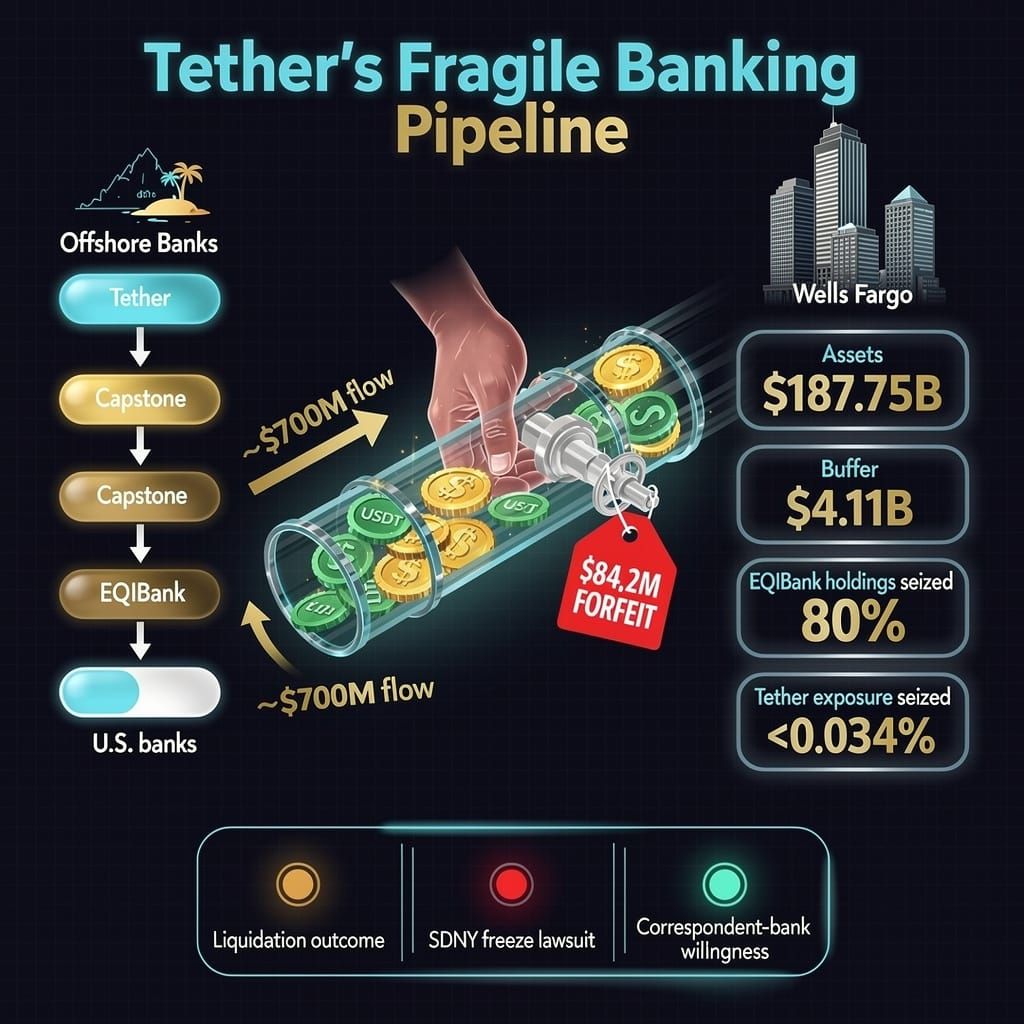
$84.2M in seized funds — but that's not the real story. The DOJ civil forfeiture case against Capstone Ltd. exposes the fragile, lightly regulated banking corridor that Tether's $187.75B stablecoin depends on to move dollars in and out of the U.S. system. ⚖️ Capstone allegedly moved ~$700M through Wells Fargo and JPMorgan on behalf of the issuer. EQIBank says the affected amount is ~$89M — about 80% of its holdings — and faces possible liquidation. The systemic risk isn't the dollar figure: it's that redemption liquidity rests on banking partners that can lose 80% of their assets to a single forfeiture action. A judge has already denied EQIBank's motion to recover the property — signaling recovery won't happen at the administrative stage. Could one seizures rewrite who holds the leverage in stablecoin corridors — your funds included? 💭
When the U.S. Department of Justice filed a civil forfeiture complaint on July 15 seeking $84.2 million tied to Tether's payment processing, the immediate headline was about a single seizure. But the case against Capstone Ltd., a Montana payment processor, exposes something more consequential: the fragile, lightly regulated banking corridor that stablecoin issuers depend on to move dollars in and out of the U.S. system.
The mechanism behind the seizure
The prosecution's theory runs through a chain of intermediaries. Capstone allegedly operated as an unlicensed money transmitter while posing as an IT firm, holding U.S. bank accounts at Wells Fargo and JPMorgan Chase. Prosecutors allege EQIBank, a Dominica-licensed digital bank, directed Capstone to lend those banking services to Tether and Bitfinex. According to the complaint, Capstone moved roughly $700 million through U.S. banks on behalf of those entities.
The scale of the flow is documented in the complaint's own accounting. Between March and December 2025, Capstone's primary Wells Fargo account disbursed an estimated $337 million, with roughly two-thirds of that going to recipients outside the U.S. Separate seizures totaled $79.1 million from a Wells Fargo Securities account, $1.86 million from a Wells Fargo Bank account, $2.06 million from JPMorgan Chase, and about 1.18 million USDT from two crypto wallets.
Prosecutors also allege Capstone converted proceeds from elder-fraud schemes — including scammers impersonating FBI agents who pressured victims into USDT payments — into stablecoin. Tether confirms it handled the USDT transfers in question but denies knowledge of Capstone's alleged conduct.
EQIBank says the affected amount is close to $89 million — about 80% of its holdings — and has warned of possible institutional liquidation. A federal judge has already denied EQIBank's Rule 41(g) motion to return the property after the forfeiture complaint was filed, signaling that recovery is not proceeding at the administrative stage.
Who controls the pipe
The structural tension is that the world's largest stablecoin, Tether, runs on a fiat on/off-ramp infrastructure controlled by non-U.S. licensed banks using U.S. correspondent channels. EQIBank operates under a Dominica license but needed U.S. bank accounts to move customer funds. Capstone, per prosecutors, provided the bridge.
The numbers framing the risk are instructive. Tether reports $187.75 billion in total assets against $183.64 billion in liabilities, a buffer near $4.11 billion, and an August 25, 2025 KPMG audit shows $6.814 billion in reserves exceeding token liabilities. Its stated direct EQIBank exposure is below 0.034% of group assets — under $64 million, a figure EQIBank disputes at roughly $89 million. By either measure, the direct balance-sheet impact on Tether is marginal. The systemic vulnerability is not the dollar amount; it is that redemption liquidity depends on banking partners that can lose 80% of their holdings to a single forfeiture action.
The case also sits inside a pattern of counterparty strain, and the regulatory clock is narrowing the corridor. The MiCA framework in Europe requires stablecoin issuers to hold 30% of reserves in EU-authorized institutions, and the GENIUS Act in the U.S. imposes custody standards on issuers — both of which constrain where Tether can park dollar reserves and deepen its reliance on offshore partners like EQIBank for access.
The seizure rewrites who holds leverage. A payment processor that thought it was a neutral utility becomes a point of regulatory pressure. A Dominica bank that thought it was offshore finds its dollar channels governed by U.S. enforcement. And a stablecoin issuer that publicly diversifies its reserves discovers that diversification is only as real as the access its counterparties retain.
The unresolved questions
The case carries genuine uncertainty. Capstone and EQIBank may pursue "innocent owner" defenses, arguing the seized funds included legitimate customer money rather than proceeds of illegal transfer activity. Tether's own position — that it processed transfers but had no knowledge of Capstone's alleged license violations — will be tested against the extent to which it relied on EQIBank's instruction.
A parallel dispute complicates the precedent. In the Southern District of New York, two Thai businessmen are suing Tether over its freeze of $42.4 million of USDT after an informal October request from a Homeland Security Investigations agent, challenging a private issuer's authority to blacklist tokens before any court order. A North Carolina magistrate judge later issued a seizure warrant authorizing token destruction, and a related $61 million DHS/HSI seizure in a pig-butchering network supports the government side — but the litigation itself tests whether stablecoin issuers can act as private enforcers without judicial oversight.
A counter-signal warrants attention: if the affected funds unwind as legitimate custodied balances rather than tainted proceeds, EQIBank's liquidation threat recedes, and the "80% of assets" figure becomes a temporary freeze rather than a permanent loss.
Monitoring indicators
Three data points will tell whether this episode remains an isolated enforcement action or signals a structural shift in stablecoin banking corridors:
- The disposition of EQIBank's liquidation proceeding, and whether "innocent owner" claims return any meaningful share of the ~$89 million.
- The outcome of the Southern District of New York challenge to Tether's unilateral freeze power, which could set precedent for issuer authority over blacklisted tokens.
- The willingness of U.S. correspondent banks to maintain clearing relationships with Dominica-licensed or similar offshore digital banks as MiCA and GENIUS Act custody rules tighten.
This is reporting and analysis, not a recommendation on any investment, trading, or other action.

Comments ()