Quant's QNT Token Soars ~300% on Clearing House Pick
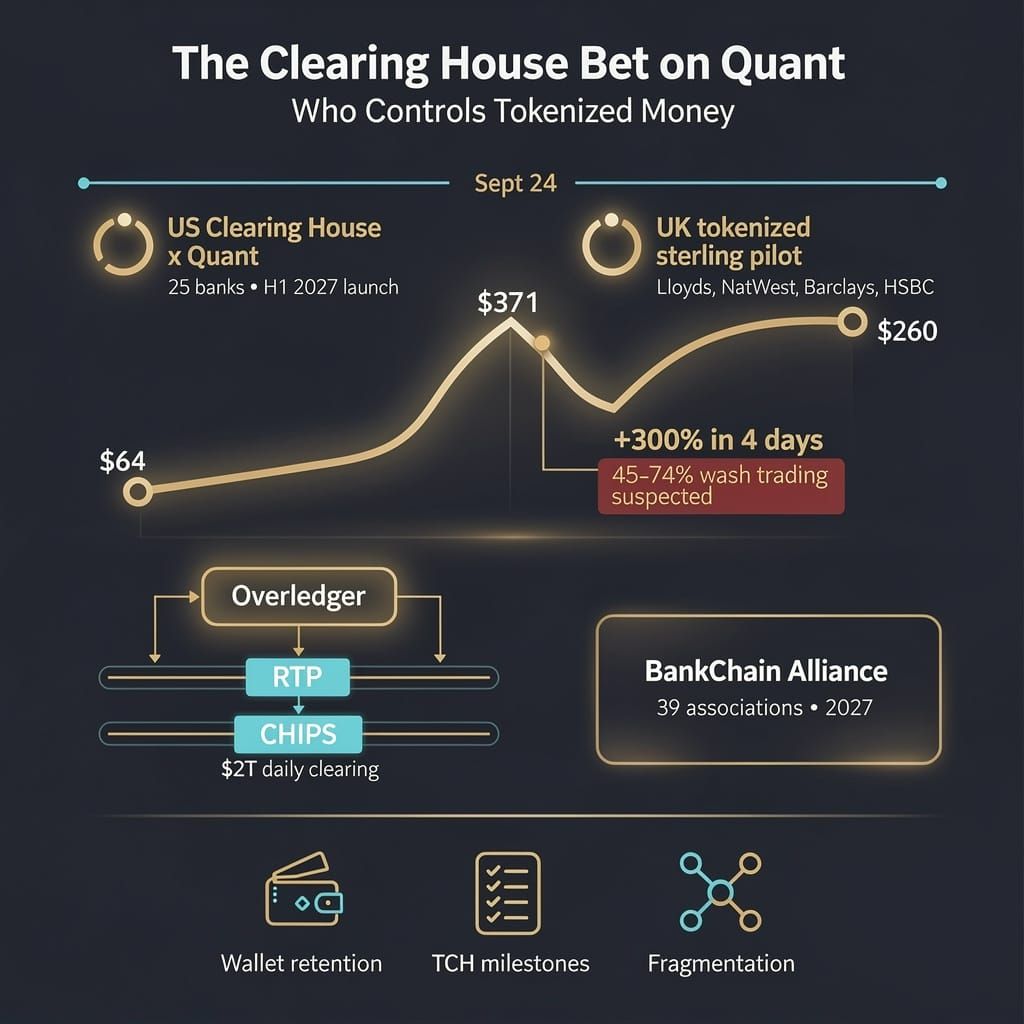
QNT jumped from $64 to a $371 peak before settling near $260 — a ~300% swing in 4 days 📈 The catalyst: The Clearing House picked London-based Quant for its On-Chain Money Initiative, a tokenized deposit network covering 25 U.S. banks, launching H1 2027. The same day, UK banks (Lloyds, NatWest, Barclays) ran the first live interbank tokenized sterling transactions. But on-chain analysis attributes 45–74% of reported volumes to wash trading. Which raises the question — did this rally price a use case or a headline? Where do you land: institutional breakthrough or speculative squeeze?
On September 24, two announcements landed within hours of each other. The Clearing House — the U.S. bank-owned payments and settlement network — selected London-based Quant to build the interoperability layer for its On-Chain Money Initiative, a shared tokenized deposit clearing network covering 25 U.S. banks, with a system launch targeted for the first half of 2027. The same day, a group of U.K. banks executed the first live interbank transactions in tokenized sterling deposits on Quant's platform — actual remortgages through Lloyds, NatWest, and Barclays, not a demonstration. Bank of England backing of the U.K. pilot, framed as a safer alternative to stablecoins, gave the settlement mechanism a regulatory anchor from the outset.
The market's read was immediate and literal: QNT, the token that gates access to Quant's Overledger software, rallied from roughly $64 to an intraday peak near $371 before settling around $260. That is an approximate 300% swing in four days. The move compresses an entire thesis about institutional adoption into a single token price — and the gap between those two things is where the real story sits.
The mechanism, traced
Quant's business model ties its software utility to its token. Overledger is a cross-blockchain connectivity layer that lets regulated institutions move tokenized deposits and payments across different ledgers without building native integrations. Under this design, banks and enterprises purchase and hold QNT to access Overledger's API network — meaning the token functions less like a speculative asset and more like a usage credential tied to a specific infrastructure vendor.
The Clearing House partnership is the load-bearing event. TCH clears roughly $2 trillion in daily payments across the U.S., and its network integrates with established rails (RTP, CHIPS) rather than replacing them — a design that routes a portion of that volume through Quant's layer. The U.K. outcome is the proof-of-mechanism: on September 24, four major UK banks (Lloyds, NatWest, Barclays, and HSBC) moved remortgage funds between institutions via two live remortgage payments and one simulated online purchase under the Great British Tokenised Deposit project. That these were genuine commercial-bank interbank transfers — not a demonstration — while keeping the legal status of ordinary current-account deposits is what distinguishes this pilot from earlier proofs-of-concept.
Where the leverage sits
The sharpest signal is who kept control. The Clearing House chose an external interoperability provider rather than building internally — an admission that cross-ledger routing is hard, and that a specialized vendor holds the relevant capability. That gives Quant structural leverage across two major markets simultaneously; no other vendor powers tokenized deposit settlement infrastructure in both the U.S. and U.K., raising its own question about single-vendor concentration risk.
Yet competition is materializing on Quant's flank. A newly formed BankChain Alliance — 39 state bankers associations building a bank-owned blockchain network with a 2027 launch target — explicitly positions itself against the dominant core-software oligopoly (Fiserv, FIS, Jack Henry) and 7-10 year vendor contracts that lock smaller banks out of owned infrastructure. The alliance names The Clearing House projects among the networks it competes with, signaling that U.S. bank-owned interoperability is not a single-firm outcome but a contested field. That is a counter-signal to any assumption that Quant's selection confers durable monopoly pricing power.
The token is where leverage cuts the other way. On-chain analysis of the September rally contradicts the headline. Independent tracking pegs QNT's legitimate exchange turnover at roughly $25 million to $36.5 million against reported volumes of $670 million to $1.45 billion, with on-chain analysts attributing between 45% and 74% of that reported activity to wash trading. Exchange net inflows of roughly 14,400 tokens on September 27 point to distribution — accumulator wallets routing holdings to exchange hot wallets — rather than accumulation. The RSI rose to its highest level in five years, north of 86, a statistically stretched reading.
The unresolved question
The critical unknown is whether the $260 price reflects capitalized future clearing volume or a one-time liquidity squeeze. Quant's revenue from the TCH contract is not tied to the token's spot price in any disclosed, contractual way — the utility fee structure and the economics of the Clearing House deal remain opaque. Valuing QNT on projected settlement volume would require visibility into pricing, minimum holdings per institution, and volume thresholds that have not been made public.
Attribution matters: price projections circulating from Finbold's AI tool ($107.62 by October 1), Gemini ($115.50), and DeepSeek ($104.85) are model outputs, not market commitments, and the token overshot most of them. A mintable contract structure and a retail float estimated near 0.1% concentrate price-setting power in a small number of holders. And the BankChain Alliance's 2027 launch — coinciding with the TCH target timeline — leaves open whether U.S. interoperability ultimately consolidates on one provider or fragments across competing bank-owned networks.
What to watch
Three indicators would test the institutional-adoption thesis against the price:
- Retained deposits on non-exchange wallets: whether the increase in QNT holders persists after late September, or reverses into further exchange inflows.
- Disclosed TCH milestones: concrete progress reports (not announcements) toward the H1 2027 launch, including participating member banks beyond the 25, pilot volumes routed through RTP and CHIPS, and how the contract's utility-fee structure is priced.
- U.S. interoperability fragmentation: whether BankChain Alliance member banks (39 associations) opt for shared ownership over vendor dependencies, which would directly test Quant's structural leverage.
None of these are a call on direction. They are the observable tests of whether this rally priced a use case or a headline.
This is reporting and market analysis, not investment, trading, or financial advice. No statement above is a recommendation to buy or sell any asset.

Comments ()