Poland's mobbing definition takes effect 5 November; employer rules due May 2027
Poland's amended mobbing definition and six-times-minimum-wage compensation floor take effect 5 November 2026, but employers with 10 or more staff have until 5 May 2027 to implement anti-mobbing rules, leaving a transition period where the obligations' content is not yet fixed.
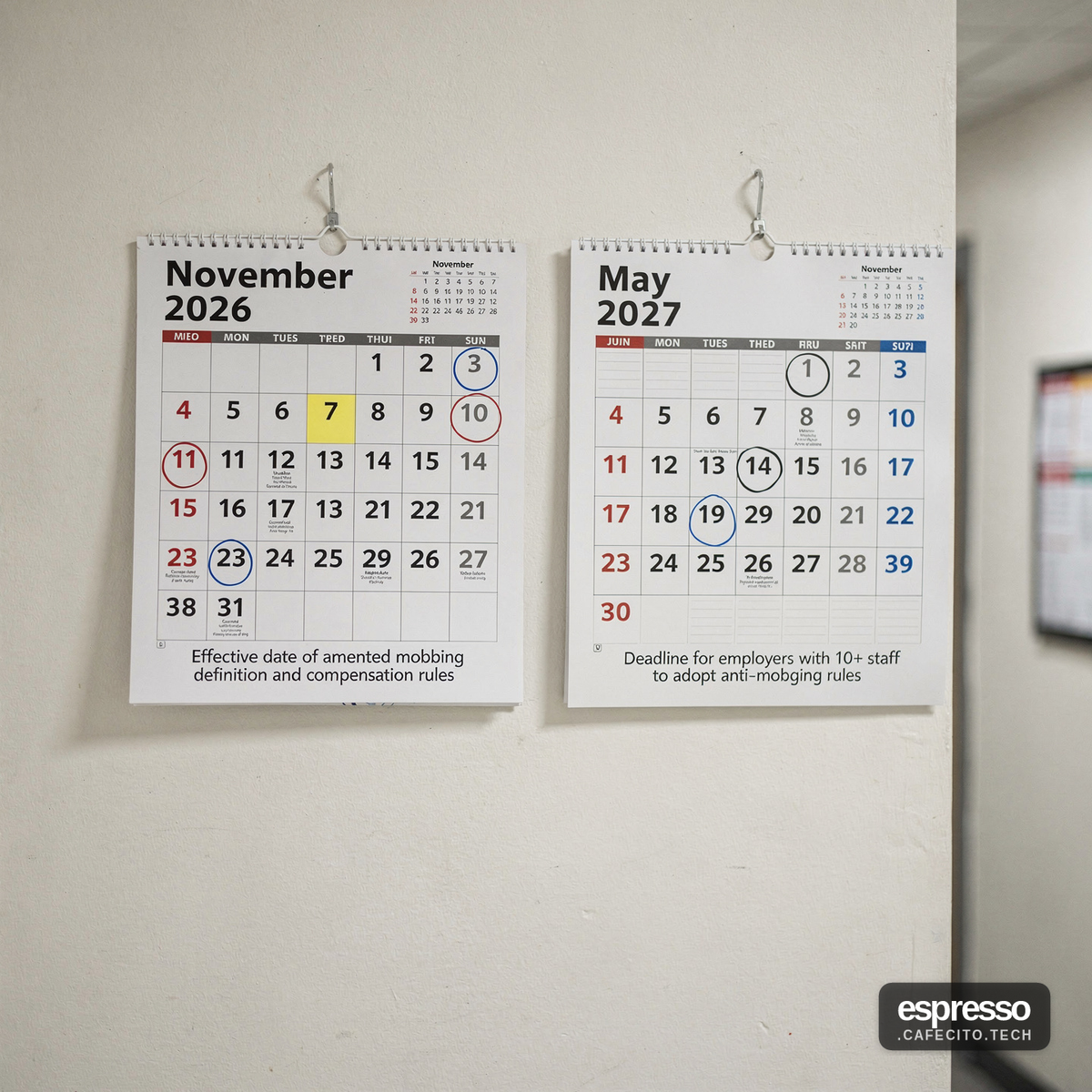
Poland's amended mobbing definition takes effect on 5 November 2026, under a law dated 19 June 2026 amending the Labor Code and Civil Procedure Code. Employers with at least 10 employees must have anti-mobbing rules in place by 5 May 2027, per the reported terms. Schools are among the affected employers, with reporting routed through the employer or, where directed by the principal, to the school authority.
The analytical problem is sequencing. The definition governs conduct from 5 November, but the workplace rules meant to operationalize prevention, detection and reporting are not required until 5 May 2027. Between those dates, per the reported terms, employees hold a new legal test and a compensation floor while employers hold obligations whose content is not fixed. One source account describes the simplified definition as centered on repeated verbal abuse rather than job performance issues and says clear behavioral thresholds are meant to limit false claims — an intended effect, not an observed outcome.
What the definition requires
Mobbing is defined as persistent harassment of an employee, requiring repeated, recurring or constant behavior patterns. Reported examples include humiliation, intimidation, belittling performance evaluation, unjustified criticism, demotion, hindering job duties, communication barriers, isolation and dismissal. An isolated single incident does not qualify even where it violates personal dignity. Whether recurrence thresholds will be measured by incident count, duration or assessor judgment is not established in the supplied evidence.
The June 2026 amendment is also reported to extend pervasiveness beyond direct supervisors to peers, subordinates, other employees and contractors, and to add discrimination provisions covering association-based and assumption-based discrimination. Labor Inspectorate guidance is reported to address mobbing determination without requiring intent. Those characterizations come from the source accounts, not independent findings.
Compensation, enforcement and the transition gap
The financial floor is the concrete change. Zadośćuczynienie for an employee who experienced mobbing must be no lower than six times the minimum wage — 28,836 PLN brutto in 2026 and 29,700 PLN brutto in 2027, per the reported figures. A separate compensatory damages minimum is put at 4,806 PLN brutto for 2026, with no minimum threshold applying to the odszkodowanie claim after 5 November 2026. Another reported provision sets zadośćuczynienie at no less than three times the minimum wage under Art. 18(3)d — 14,418 PLN brutto in 2026, 14,850 PLN from 2027.
- 4 August 2026: new Anti-Mobbing Act published, effective five days later per one account
- 5 November 2026: amended definition and compensation terms take effect
- 5 May 2027: deadline for employers with 10+ staff to implement anti-mobbing rules
Those figures are statutory minimums, not observed award patterns. The evidence contains no case count, no claim volume, no employer non-compliance figure and no sector-level exposure estimate, so the six-times minimum wage cannot be read as a population-wide pay signal. One source describes the Polish figure of 28,836 PLN as roughly €28,836; no conversion rate or currency basis is supplied to reconcile that equivalence, and another account puts the minimum fine at roughly €9,000, so both are left as reported.
A change not present in the draft deserves flagging: transitional rules are reported to make pre-existing mobbing cases eligible where the conduct continues after 5 November 2026. The supplied accounts do not specify which earlier cases meet that test or how continuing conduct is established.
What the deadline will show
Two timelines are reported and not reconciled here: publication on 4 August 2026, described in one account as effective five days later, against the 5 November 2026 implementation date in another. A second thread is reported: an employer right of recourse against the mobbing perpetrator, disciplinary actions against managers who fail to comply, and a shift described as moving from reactive to proactive management. Those are source claims about intended effect.
The observable milestone is 5 May 2027: what employers with 10 or more staff actually adopt, whether pre-November cases are carried into the new framework, and whether complaints travel the employer route or the school-authority route.


Comments ()