Poland cracks down on illegal household waste burning
Polish authorities are cracking down on households burning waste—plastic, tyres, furniture panels—in domestic furnaces across Poznań and Katowice. The practice volatilizes chemicals into nearby air without filtration, adding an unquantified increment to Poland's pollution burden, which already…
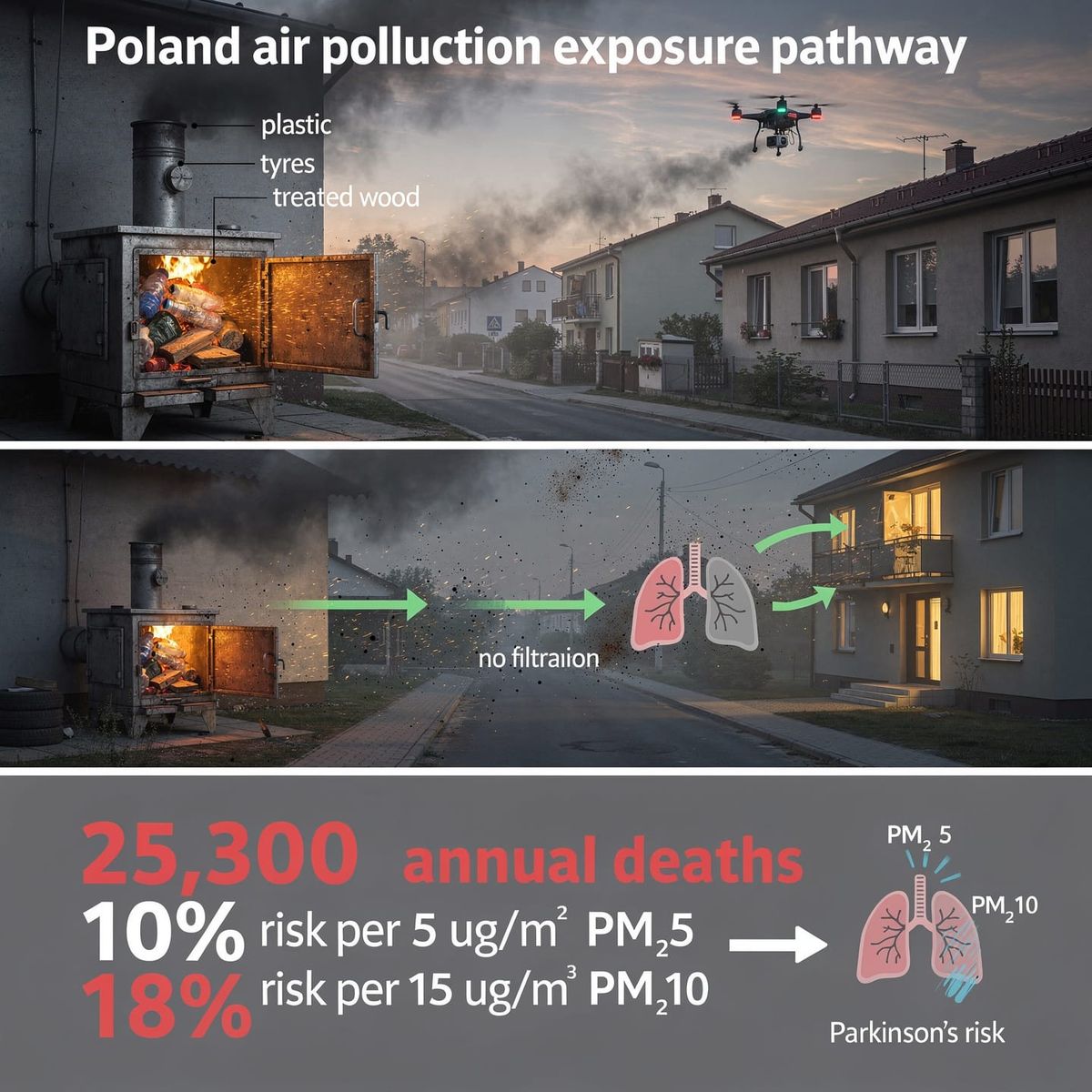
Polish authorities are stepping up enforcement against a practice documented in Poznań, Katowice, and elsewhere this month: burning household waste—plastic bottles, diapers, old clothing, tyres, furniture panels, and packaging—inside domestic furnaces. The activity is illegal under Polish law, and the combustion produces atmospheric contaminants linked to respiratory illness and other population-level health effects, according to regional air-quality agencies and the Polish fire service.
How the exposure pathway works
The mechanism runs from the household heating unit inward. When non-combustible items like PVC packaging, printed materials, and treated wood panels are fed into a private stove or furnace, they combust at temperatures far below those of licensed incinerators and typically without certified exhaust filtration. That shortfall means the furnace does not destroy the chemicals in the waste—it volatilizes them and sends them directly into nearby air. In dense urban and suburban districts, where individual furnaces sit close to residences, the resulting pollutants reach people's homes as both outdoor and indoor exposure without passing through any scrubbing or monitoring before contact.
This is the point where the chain fails. There is no evidence in the reported cases that the contamination originates from commercial or municipal sources; the driver identified is individual households. The absence of certified filtration on private furnaces means there is no engineering control between the combustion chamber and the breathing air of occupants and neighbors, leaving the population as the sole receptor.
What the health evidence supports
Reported impacts tied to the contaminant class include onset of respiratory disease and cardiovascular pathology. Regional air-quality agencies have cited effects in those categories; attribution of specific developmental and gestational outcomes to illegal burning specifically is not established in the reported material. One relevant background figure, reported in September, estimates that long-term indoor air pollution kills roughly 25,300 Poles each year through PM₂·₅ concentrations exceeding World Health Organization limits. That estimate describes chronic exposure across the population, not deaths attributable solely to illegal burning; it is a background measure against which waste-burning emissions add an unquantified increment.
The broader air-pollution health literature points the same direction. A Cambridge-led systematic review and meta-analysis published this October linked long-term PM₂·₅ and PM₁₀ exposure to increased Parkinson's disease risk—each 5 µg/m³ rise in PM₂·₅ associated with about a 10% relative risk increase, and each 15 µg/m³ rise in PM₁₀ with roughly an 18% increase, across 26 Parkinson's studies. The review's authors stressed it strengthens evidence for an environmental contribution but does not prove direct causation. London roadside reference levels help put those increments in context: average PM₂·₅ of 10 µg/m³ and PM₁₀ of 17 µg/m³ in 2023.
A separate September observation notes that illegal stove use and waste burning produce a mortality pattern similar to general air-pollution exposure, and that authorities have begun using drones to track hotspots. The drone deployment is a surveillance response, not a health measurement, so it documents where burning occurs rather than the concentration of pollutants reaching people.
What the evidence does not establish is the proportional contribution of household waste burning to overall PM₂·₅ exposure in Poland, the exact dose experienced by affected households, or a direct causal link between a specific burning event and a particular case of disease. The public-health claims are supported links between the contaminant class and outcomes; the attribution of any individual illness to this practice remains unverified.
Enforcement and its limits
The legal response defined in the reported material centers on verification: state fire service and regional environmental inspection authorities are conducting checks, and the reported outlook indicates those protocols will remain mandatory, with statutory proceedings expected to contain offending parties. The penalty structure is one component of that regime, but the reported material does not specify current monetary or custodial figures.
That enforcement chain has limits. Verification depends on detection, which is why drone surveillance and community reporting have become part of the response. Detection catches active burning; it cannot reverse the exposure already delivered into nearby air. The public-health consequence, if the practice persists at scale, is continued population-level contact with pollutants that the enforcement regime is designed—but only intermittently able—to prevent.
The unsettled question
The decisive unknown is mass. Authorities can indicate where illegal burning occurs, but the available data do not quantify how much waste is combusted, over what period, or what fraction of the country's fine-particulate burden it represents. That measurement gap is what separates the confirmed illegality of the practice from a public-health impact that is real but not yet precisely sized.
Comments ()