Manipur Hill Attacks: Toll Disputed as Violence Reaches Myanmar Border
Armed attacks in Manipur's eastern hill districts have killed an unverified number of civilians since October 9, with Naga and Kuki civil bodies offering conflicting accounts of the toll and perpetrators. The violence has spread toward the India–Myanmar border despite IRB deployments and BSF…
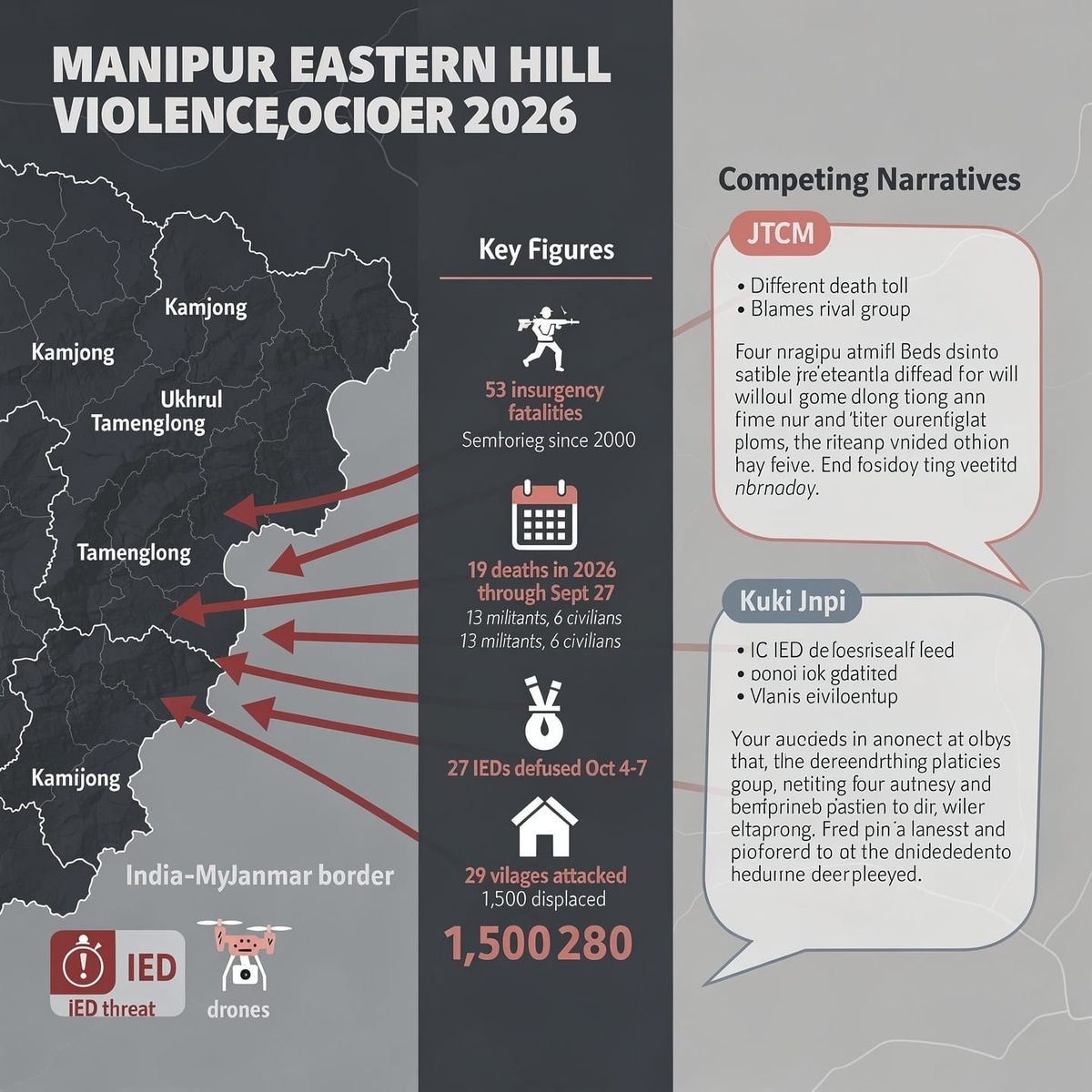
Armed attacks across Manipur's hill districts have killed a disputed, unverified number of civilians since October 9, with Naga and Kuki civil-society bodies offering sharply different accounts of who is responsible and who is dead. What is confirmed is that the violence has moved east toward the India–Myanmar border, into areas where the state's administrative reach is already thin, and that neither an India Reserve Battalion (IRB) deployment nor Border Security Force (BSF) patrols appear to have stopped it from reaching civilian villages.
Two Competing Tellings of the Same Week
The Joint Tribes Council Manipur (JTCM), an umbrella body representing multiple tribal communities, says that since October 9 armed groups have killed a significant number of Naga civilians in Kamjong, Ukhrul, and Tamenglong districts. On October 11 the council's working committee condemned four civilian killings and two injuries at Makui and Tapon villages, naming the dead as Machungamang Daimai, a Naga village guard, and three residents aged 48, 52, and 53. It demanded the return of a beheaded victim's missing head for burial. None of these figures has been independently verified.
Kuki organizations tell the opposite story. The Kuki Inpi Manipur, an apex Kuki civil body, accused the NSCN-IM and NSCN-East Flank of attacking Kuki-Zo civilians in collusion with state security forces, and claimed 29 Kuki-Zo civilians killed and 29 villages attacked, damaged, or burned, with more than 1,500 displaced. The Thadou Inpi Manipur separately lodged complaints about the October 10 deaths of 42-year-old Domkhonei Touthang, identified as a woman from Chahsat village—a figure that does not line up with the Kuki Inpi's earlier naming of her among its casualties—and of Ajinpou Ringkangmai, whose alleged beheading in Makui mirrors the JTCM's demand.
The two accounts overlap only in confirming three things: that civilians are dying across multiple districts, that settlements are being burned, and that cell and road access in the affected hill areas is intermittent, making verification impossible in the near term. Former chief minister Nongthombam Biren Singh separately told reporters that seven people had died in the preceding 24 hours.
The Security Structure, and Its Limits
The area is staffed, not secure. An IRB unit has been deployed to the affected districts, and the BSF patrols the international boundary with Myanmar. A security operation between October 4 and 7 reportedly detected and defused 27 IEDs along an 8-kilometer border stretch in Kamjong. Yet within days of that operation, police stations were set ablaze and villages attacked.
The context matters. The Ministry of Home Affairs extended the Armed Forces (Special Powers) Act in Manipur, Nagaland, and Arunachal Pradesh for six months from October 1, a notification issued September 24 under a "disturbed area" declaration that excludes 13 police-station zones in and around Imphal and Bishnupur. According to the South Asia Terrorism Portal, Kamjong District has logged 53 insurgency-related fatalities since 2000, but the conflict has recently picked up the pace: 19 deaths in 2026 through September 27 (13 militants, 6 civilians), against none in 2024, alongside use of drones and recovery of military-grade weapons near Border Pillar 115 in April. The state has not issued a verified accounting of the October killings. Manipur's chief minister, Nemcha Kipgen, condemned the killings and called for an investigation—a response measured in statements, not yet in published results.
The Watch Question Nobody Can Answer
The decisive unknown is attribution. Civil-society bodies on both sides accuse the other community's armed groups, and Kuki bodies additionally allege collusion between Naga insurgents and state forces. The JTCM's account implicates the Kuki National Front and the Kuki National Army in the Tamenglong attacks. The NSCN-IM, the main Naga insurgent group under a long-running ceasefire with New Delhi, operates in parts of these districts—both sides cite its presence, one as perpetrator, the other as protector. No faction has formally claimed responsibility for the October killings, and no independent body has confirmed a chain of command.
That gap determines what can be concluded. The available evidence supports the narrow finding that the existing security architecture—IRB deployment, BSF border patrols, an extended AFSPA regime, and ceasefire arrangements—has not prevented armed groups from operating inside civilian villages with lethal effect, and that both communities now believe the state is unwilling or unable to protect them. The competing casualty claims, with each side naming its own dead and accusing the other, are themselves a symptom: two populations have stopped waiting for an official narrative and are constructing their own verified truths.
Until an independent authority publishes a casualty accounting and names a responsible actor, the death count itself is contested ground—and for the families organizing burials without heads, that is not an abstract problem, but the immediate consequence of a state that is present in the hills and not in control of them.


Comments ()