Pfizer Zurich's AI scheduling backfires amid burnout
After a returning employee's burnout and stroke risk, Pfizer's Zurich site backfired on its home-office ban and AI scheduling system, which removed flexibility and failed to flag accumulating stress. The reporting ties departures to those decisions, though precise exit counts and attribution to…
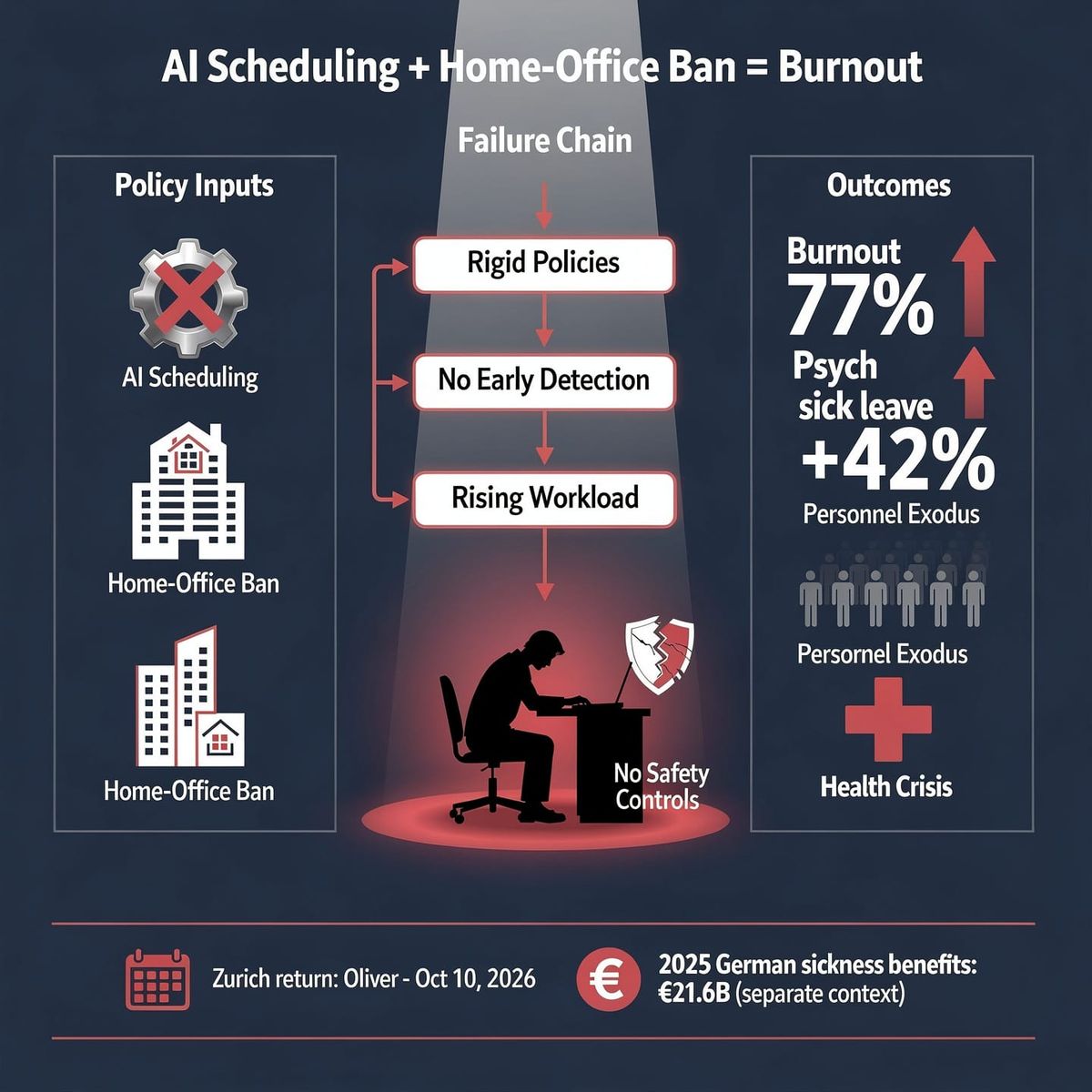
On October 10, 2026, a Pfizer employee named Oliver Dürr returned to work at the company's Zurich site after a burnout-related absence that included a stroke risk. Reported accounts tie the return to the site's home-office ban and an AI-driven scheduling system, both described as pushing staff to leave.
What the reporting establishes is a specific failure chain rather than a broad claim about Pfizer-wide policy. The mechanisms at play are the scheduling system, the home-office restriction, and the absence of controls to catch the fallout before it turned into lost staff and a returning employee with a serious health condition. The observed outcomes—personnel shortage, rising stress-related absenteeism, and staff turnover—follow a plausible path from the two workplace decisions, though the reporting does not provide company-confirmed figures on how many employees actually left the Zurich site or the precise share attributable to each policy.
The wider context gives the Zurich case a scale beyond one facility, though the two have to be kept separate. German data from the statistical office and an AOK-WIdO report dated October 9 point to rising absence rates driven by psychological conditions. That report found psychically related sick leave among AOK-insured workers rose 42% over a decade, from 284 to 403 absence days per 100 members, and burnout cases climbed 77%, from 11.0 to 19.5 days per 100 insured. The average sick leave for psychiatric conditions was 28.5 days, versus 5.7 days for respiratory illness.
But the numbers need to be held separately from the Zurich incident. The €21.6 billion figure in general circulation is 2025 Krankengeld (sickness-benefit) spending across the statutory health insurance system—6.1% of total outlays—not a measurement of Pfizer's Zurich operation or its scheduling system. The rising German absence rates come from a different employer population than a single Swiss pharmaceutical site. What they do together is show the environment in which a burnout-driven return reads as an escalatory sign rather than an isolated event.
What the October 10 development establishes beyond the announcement itself is that the workplace controls designed around AI scheduling did not absorb the human cost they generated. The AI system was intended to manage work—its role in the reported sequence was to enforce a working pattern, not to detect when that pattern was causing harm. That detection gap, combined with a home-office ban that removed a flexible buffer, is where the failure sits. Neither the AI's information nor the policy's incentive structure flagged the accumulating strain on Dürr or his departing colleagues before the burnout and stroke risk emerged.
The decisive unknown is attribution. The reporting ties Dürr's burnout to the site's conditions, and it ties the conditions to the scheduling system and office mandate, but it does not isolate how much of the psychological distress came from the AI scheduling, the home-office ban, or the broader personnel shortage each policy helped create. Those are separate mechanisms that could be compounding one another.
What is measurable is the observable consequence: a staff exodus, a returning employee under serious medical strain, and a workplace that has priced its scheduling decisions in lost personnel. Precise departure counts and the share of absences linked to the AI system are not published, so the case rests on the reported sequence rather than quantified staffing data. Until Pfizer or the site publishes those figures, the Zurich outcome stands as the operational result: enforcement-driven scheduling that removed flexibility and failed to catch the stress it produced, with workers carrying the cost.
Comments ()