Deno Runtime Winds Down as Cloudflare Absorbs Its Team
Cloudflare is folding Deno Land's engineering team into its platform as Ryan Dahl's runtime enters a 12-month support wind-down. Deno Deploy closes in roughly six months, pushing hosted customers to migrate while the celld technology behind self-hosted Workers is integrated.
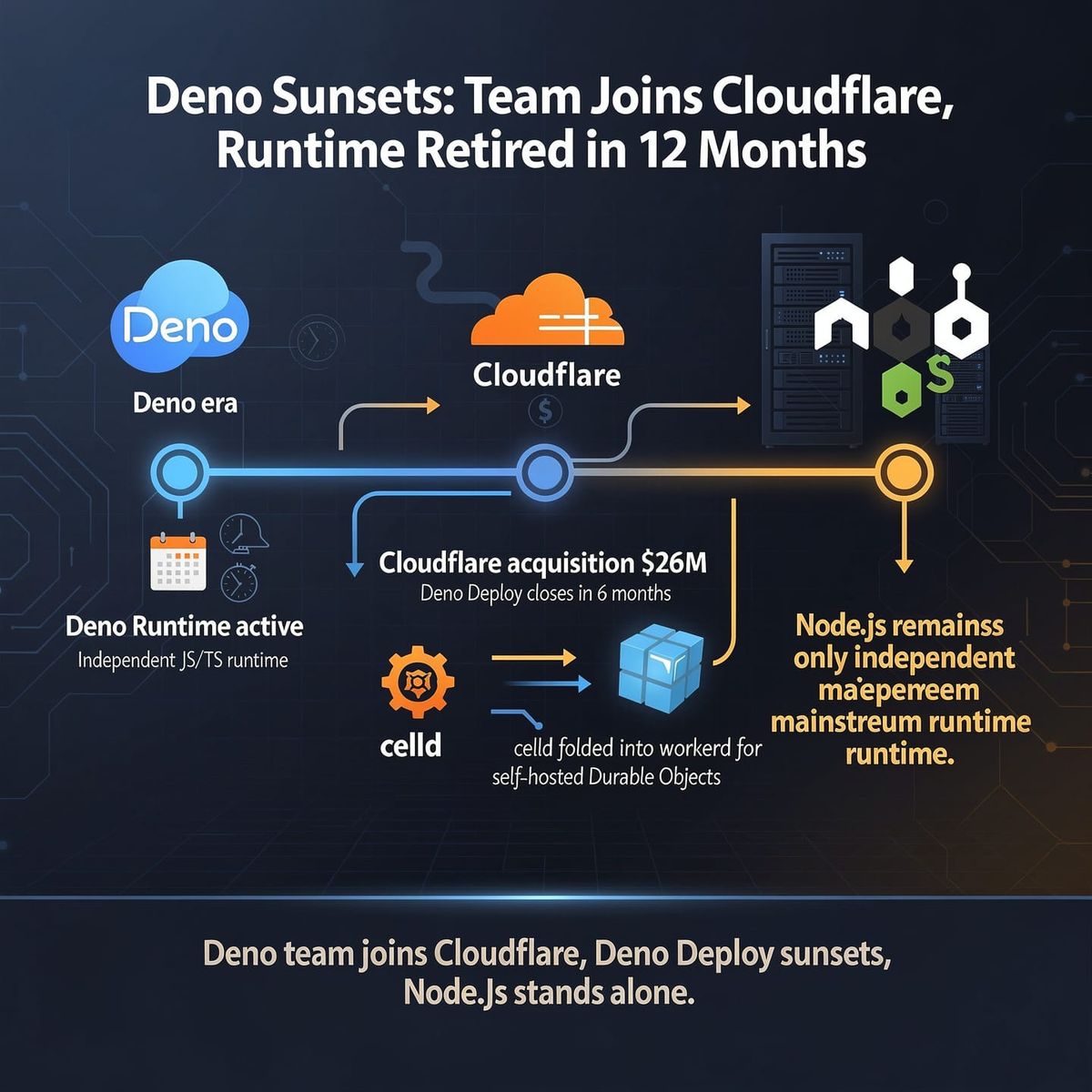
On October 9, Cloudflare announced that Deno Land Inc.—the startup founded by Node.js creator Ryan Dahl—will join the company, with the Deno runtime supported for only another year before feature development stops. The Deno Deploy hosting service will close in approximately six months. Reports put the acquisition at $26 million in total funding.
The acquisition folds Deno's engineering team into Cloudflare to advance the celld project and its integration into workerd, the open-source runtime behind Cloudflare Workers. The JSR package registry will continue operating, with its infrastructure moving to Cloudflare. Node.js, governed by the OpenJS Foundation, remains the only independent mainstream runtime.
What the Runtime Actually Did
Deno was a standalone JavaScript and TypeScript runtime—essentially the program that executes code outside a browser. It competed directly with Node.js, the dominant runtime that Dahl created in 2009 and later left. Deno's pitch was built-in security (no arbitrary network or file access by default), native TypeScript support, and a simpler module system. Its commercial bet was Deno Deploy, a hosted edge service where developers ran code without managing servers.
The problem was distribution. Cloudflare Workers already solved "run my code at the edge without managing servers," with a far larger installed base. Deno was technically respected but never turned that into durable commercial traction. The runtime stayed a strong niche product; the business around it did not reach escape velocity against an entrenched platform with deeper reach.
The Dependency That Broke
The core issue was access to customers, not engineering quality. Developers who wanted edge-hosted compute already had Workers and its ecosystem. Deno Deploy asked them to migrate workloads onto a smaller platform whose commercial future depended on competing with a company that also ran much of the infrastructure the internet's traffic flows through.
What the acquisition signals is that Cloudflare valued something narrower than the runtime. Dahl reportedly believes celld is more valuable than the Deno runtime itself. Celld is an open-source Rust binary that enables running Cloudflare Durable Objects—the stateful storage layer inside Workers—on self-hosted hardware. The strategy: let enterprises run Workers code on their own servers, an alternative to AWS Lambda's lock-in, especially for regulated industries that need data on private infrastructure.
That reframes the shutdown. Deno isn't being preserved as a service; its technology is being folded into a platform where the point is self-hosting, not a managed runtime.
What the Timeline Actually Means
The announcements separate into distinct windows:
- Deno Deploy: closes in roughly six months. Current customers have a narrow window to migrate hosted workloads to Cloudflare Workers.
- Deno runtime: one more year of monthly bug-fix and security releases, then official development ends. The code stays open-source, leaving the door open for a community fork. Deno-compatible platforms like Supabase Edge Functions and Netlify Edge Functions face their own migration planning.
- celld: integrated into workerd, with progress reports so far uncertain.
The meaningful line is the 12-month runtime cutoff. Deno was never a mass-market runtime—Node.js remained dominant—but it had a genuine developer following. That community now faces a clock on when its tooling stops receiving support and must decide whether to migrate to Workers, Node.js, or a community fork.
The Insight Underneath
The acquisition is less a triumph of one platform over another and more an admission about commercial structure. Cloudflare didn't buy Deno to keep Deno going; it bought the celld technology and the team to fold into Workers. The startup's user-facing product—the runtime people actually ran—is being retired.
What remains genuinely uncertain is how many Deno Deploy customers migrate to Workers versus leaving for another runtime entirely, and whether the open-sourced runtime gets a lasting community fork. The registry survives, but celld's integration progress is still unproven, and Deno's hosted users face a concrete migration deadline with no stated successor path beyond the platform that just absorbed them.
The decisive count isn't the acquisition price—it's how many developers actually move to Workers in the next two quarters. The support clock is set; the migration behavior isn't.

Comments ()