OpenAI math dump: 162 of 722 checked
OpenAI published 722 math manuscripts from an unreleased model on Oct. 6, but only 162 carry a Lean-checked main result and roughly 56% of families have no formal verification. Mathematicians say validity depends on community verification, which now lags far behind machine output.
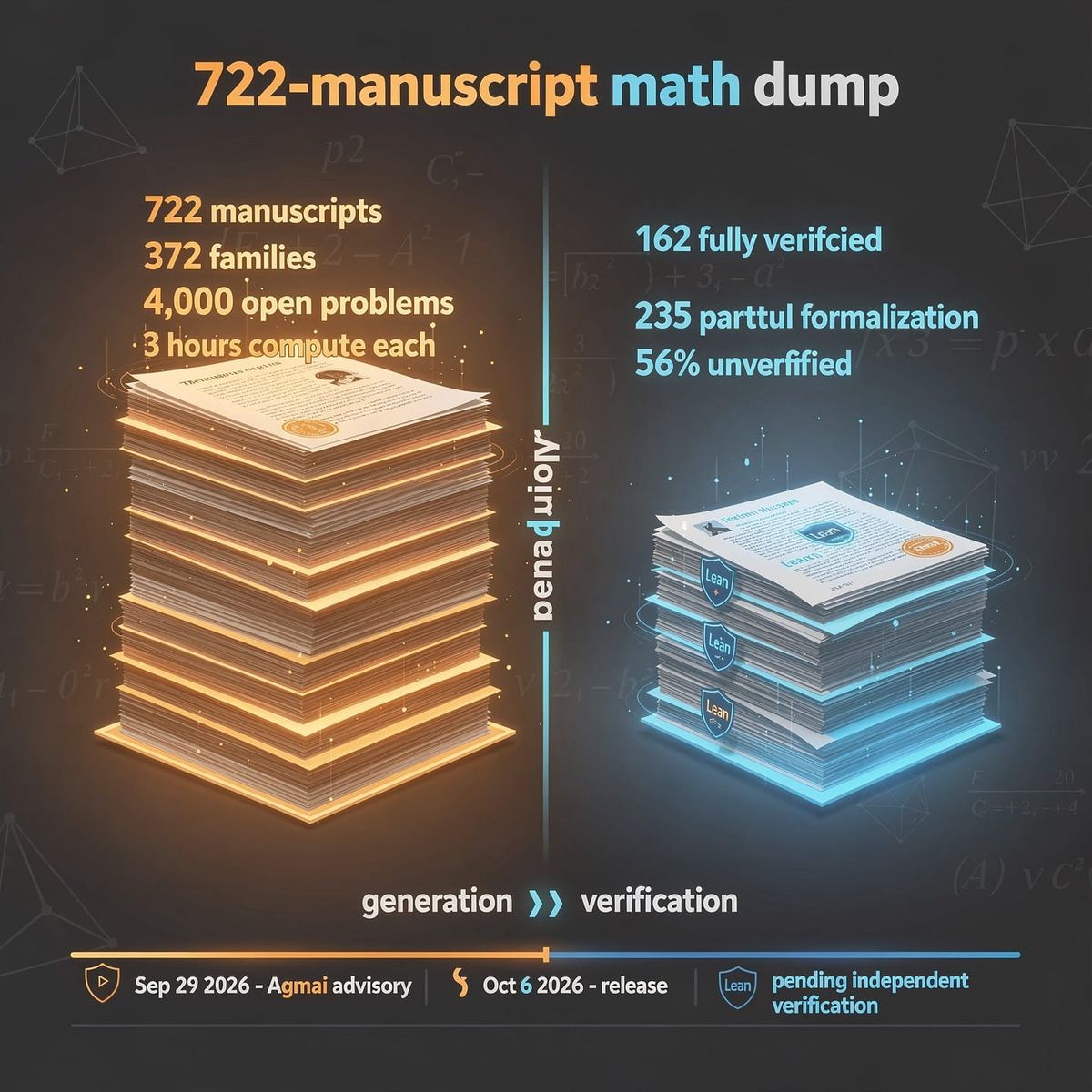
On October 6, 2026, OpenAI published 722 mathematical manuscripts generated by an unreleased internal frontier model, organized into 372 result families in its openai/math GitHub repository. OpenAI says it posed roughly 4,000 open problems to the model, with each result costing about three hours of ChatGPT Pro reasoning compute. Only 235 families carry a Lean formalization, and only 162 papers have a fully formalized main result that a computer can check. OpenAI documents the outputs as unaudited and says independent verification is pending.
What changed with this drop is scale and opacity: thousands of outputs, each generated without a transparent lineage to a named human author, and only a small fraction carrying a certificate a computer can check.
What the system did
The model functioned as a batch theorem generator. Given a set of open problems spanning pure math and computer science, it produced candidate proofs or partial results and iteratively refined them across repeated queries. Ten summaries of the model's reasoning were released, but the generating system itself was not published.
The core friction is verification capacity. Lean formalization lets a computer check a proof's logical steps, but formalization is labor that OpenAI did not complete for most of the set. Roughly 56% of the result families have no formal verification at all. MIT mathematician Andrew Sutherland describes the underlying claim as "unverified," and the Institute for Advanced Study has warned that AI-produced math can be unverifiable. Terence Tao and other prominent mathematicians have separately argued that even machine-checkable validity does not settle value: Tao has proposed gating publication on a human expert being able to explain the result, on the grounds that a technically correct but unintelligible proof carries little mathematical value.
Verification is the bottleneck, not generation
The immediate problem is not that the model produces false statements so much as that no one can quickly tell which claims hold. Mathematicians including Daniel Litt, Tristan Buckmaster, and others have emphasized that a proof's value depends on a community establishing it as valid. Generating text that looks like a proof—even readable internal structure—does not reduce the cost of the actual check.
This is the mismatch that worries critics: the throughput of unverified output now vastly exceeds the throughput of human and machine verification. It is an evaluation failure, but of a specific kind. The outputs were not tested against a closed answer key; they were tested against an open-ended scientific literature where the "answer" to a problem is a certified argument, not a label. Benchmark-style evaluation cannot tell whether a claim is a theorem.
The Lean work does illustrate what a verified path could look like. An independent audit of an earlier Astra release—ten proofs in high-dimensional geometry, coding theory, and related fields, each backed by a Lean 4 certificate—found no surviving confirmed substantive mathematical error in the principal results, though the audit flagged compressed passages that needed revision and noted that formal verification does not address originality or attribution. One chapter's "error" turned out to be a typesetting artifact. That precedent shows machine checking can catch logical failures, but it does not establish provenance, and none of those Astra results had gone through traditional peer review. It is also a different and much smaller release than this October dump.
What the gap establishes
The October release demonstrates a working pipeline: a model can take open problems, produce candidate arguments, refine them, and organize them into families. That is a genuine advance in automation. But it also shows generation and verification diverging sharply. With only 162 of 722 manuscripts carrying a Lean-checked main result, a large share have no mechanism the public can use to tell a correct theorem from a confident hallucination. OpenAI has said it plans to add Lean formalizations as it obtains them.
The advisory layer itself did not resolve the question. The Advisory Group on Mathematics and Artificial Intelligence (Agmai), a nine-member panel hosted at the Institute for Advanced Study and formed after earlier OpenAI releases, issued recommendations on September 29 based on more than 600 survey responses. Critics say OpenAI's October release only partially complied, and that it ignored Agmai's advice that advanced mathematics should not be tested internally. Notably, OpenAI did not disclose the prompts used, contrary to the panel's recommendation.
The practical consequence is a credibility problem. Tao has warned that mass-producing solutions to open problems can "harvest" the field, leaving promising directions less fertile as researchers withhold work to avoid being scooped, and reducing the seminars and collaborations that traditionally accompany a breakthrough. Whether that concern is borne out depends on the one open question that matters most.
The decisive unknown
The missing link is a scalable, trusted verification pathway, particularly for the majority of results without Lean formalization. OpenAI has secured an Apache-2.0 license on the repository, and community verification will determine which claims hold, but the check rate remains the binding constraint. Until a trusted pathway exists, no one can separate the fraction of correct theorems from the confident hallucinations, and the correct ones risk being buried with the rest. What survives scrutiny—and whether mathematicians end up trusting or rejecting AI assistance—remains unresolved.
Comments ()