Citrix patches 2 exploited NetScaler zero-days as fallout widens
Citrix has shipped fixes for two actively exploited NetScaler ADC/Gateway zero-days (both CVSS 9.5) that allow pre-auth code execution and DTLS denial of service. Reports describe webshells dropped on customer-managed appliances and credentialless access. Patch rollout is complicated by a SAML-…
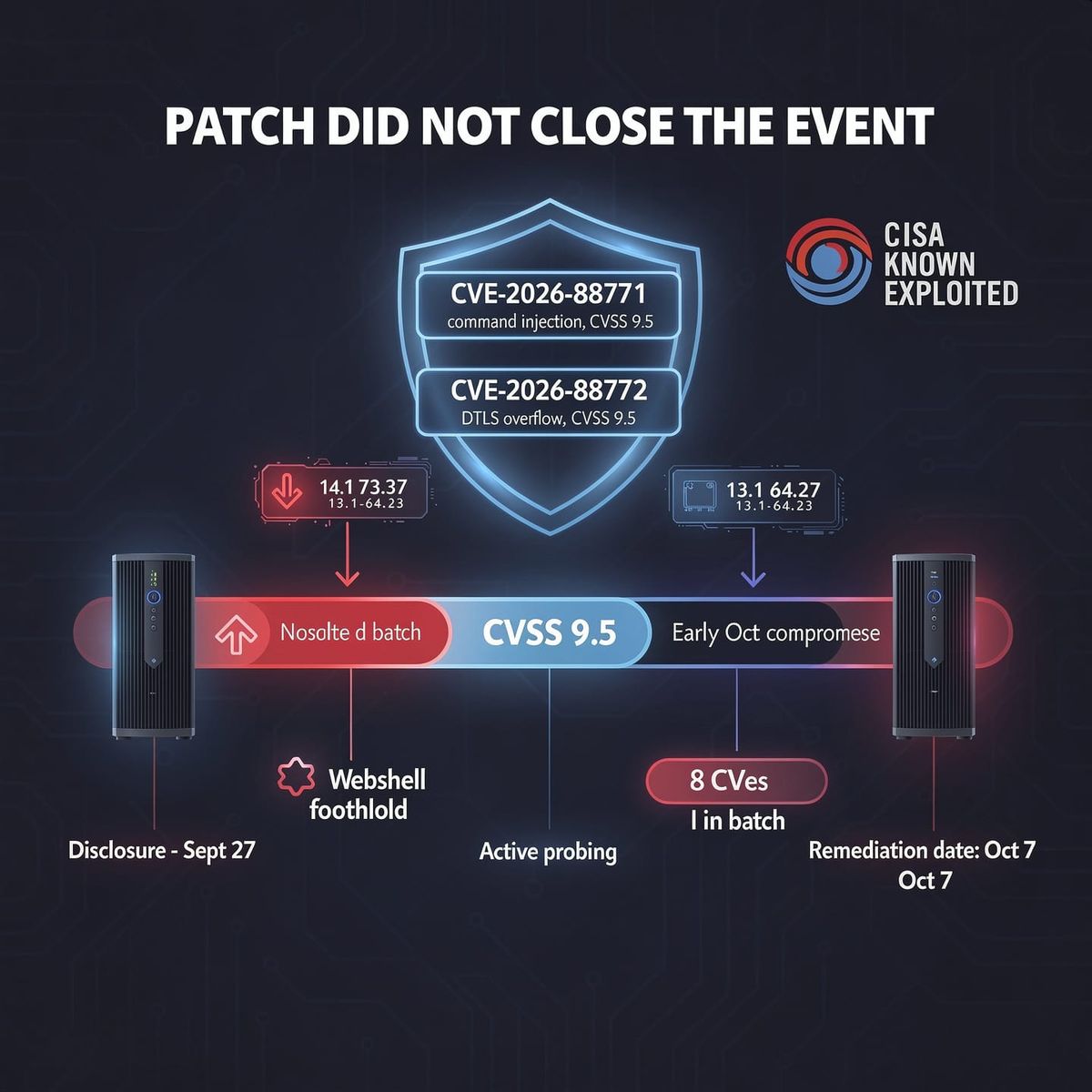
Citrix on Sept. 27 disclosed a pair of critical zero-days in NetScaler ADC and NetScaler Gateway, each scoring CVSS 9.5, with active production exploitation confirmed before a fix shipped. CVE-2026-88771 is a pre-authentication command-injection / remote code execution flaw; CVE-2026-88772 is a DTLS memory overflow that can be triggered remotely for a denial of service or RCE when DTLS is enabled. Fixed builds shipped in the same window, in the 14.1-73.37 and 13.1-64.23 lines, and CISA added both to its Known Exploited Vulnerabilities catalog on Sept. 27. By early October the story had moved from exposure warning to confirmed compromise, with reporting describing credentialless access and webshells dropped on customer-managed appliances, plus denial-of-service crashes from the memory overflow.
What the flaws actually give an attacker
NetScaler ADC and Gateway sit in front of internal networks as the VPN, load-balancing, and authentication entry point for remote users. The two flaws hit that trust boundary from opposite ends.
CVE-2026-88771 is the code-execution path. Improper input validation lets an unauthenticated attacker run arbitrary commands on the appliance itself—taking control of the device that authenticates remote workers. From there the reported progression is a webshell dropped onto the appliance, turning it into a foothold for lateral movement or for pulling configuration data routed through it; a Sept. 30 intelligence briefing noted data-exfiltration risk via webshells and flagged hiring anti-forensics measures in some cases.
CVE-2026-88772 is the memory overflow in the DTLS packet processor. With DTLS enabled, it can be exercised to force a denial of service, crashing the appliance and knocking offline whatever load-balanced services or VPN access run through it.
The two flaws share a prerequisite: the attacker needs a network path to the appliance, and the appliance needs to still be running a vulnerable build. That exploitation status was what separated this advisory from a routine patch cycle.
The patch and the fallout it didn't stop
Citrix shipped fixed builds the same week it disclosed the flaws. The build designation matters because it survives a common misreading: the advisory batch covered eight NetScaler vulnerabilities total (CVE-2026-88771 through CVE-2026-88778), including HTTP request smuggling, feature-policy bypasses, and a TCP ISN prediction flaw, but only the two zero-days with confirmed in-the-wild exploitation are the emergency drivers in this patch.
The follow-on trouble is that patching alone didn't fully close the event. One live complication reported in early October: after upgrading to 14.1-73.37, some NetScaler ADC and Gateway deployments running SAML with Gateway/AAA authentication saw the nsaad authentication daemon crash on crafted SAML traffic, tripping an internal watchdog that force-restarts the appliance. Citrix acknowledged the issue and provided mitigation rulesets through its Active Defense service, while continuing to recommend the patch pending a corrected build. Denial-of-service potential remains under certain repeated deployment conditions, and Citrix has reported no confirmed impact on customer data integrity.
A second wrinkle: CVE-2026-88779, a separate authenticated-command-injection / denial-of-service flaw in the same product family, was added to CISA's Known Exploited Vulnerabilities catalog in early October, with a CISA remediation recommendation for Oct. 7.
Separating exposed from compromised
The early picture was an exposure number, not a breach count. Thousands of NetScaler appliances were reachable from the internet when the advisory went out, and researchers at Grey Noise and others observed continuous external probing of unpatched devices. CVSS scores describe severity, not how many units were actually hit. Patch-to-observation timing doesn't identify which customers had already updated either—the flaws were disclosed and exploited in the same window, so there was no clean stretch of exposure separating victims from patched operators.
By early October that picture shifted. Some reporting framed it as thousands of compromised ADCs and gateways across the affected regions, and threat-intelligence reports described successful authentication-bypass operations and credentialless access in targeted North American firms. What remains genuinely unknown is confirmation at the data level: none of the public reporting establishes a verified figure for stolen records.
What the mechanism establishes
The functional consequence runs past "patch a NetScaler appliance." For organizations running customer-managed NetScaler ADC and Gateway boxes—as opposed to Citrix's cloud-managed services—the code-execution flaw, when used successfully, does not respect the normal perimeter: the vulnerable device is the perimeter for remote access, authentication, and load balancing. A webshell there operates inside the trust boundary, which is why lateral movement and credential-adjacent access appear in the reporting rather than just defacement.
The DTLS memory overflow converts a single crash into a broader outage because a NetScaler appliance is a recovery-and-reboot proposition measured in tens of minutes, and repeated crash/reboot cycling gives an attacker repeated seats at the reconnect handshake. That's an operational disruption for every load-balanced service or VPN session hanging off the device.
The decisive unknown remains the true scale of downstream compromise. The verifiable picture as of this writing: two critical remote-exploitable flaws in the NetScaler access plane with confirmed in-the-wild exploitation, a large exposed install base, active webshell and crash-loop activity, and a fixed build that arrived inside the same week but is still being walked into place alongside a fresh SAML crash problem and an additional CISA-listed CVE in the same product line.



Comments ()