NSE's ₹22,562-Crore IPO Opens for Trading on BSE
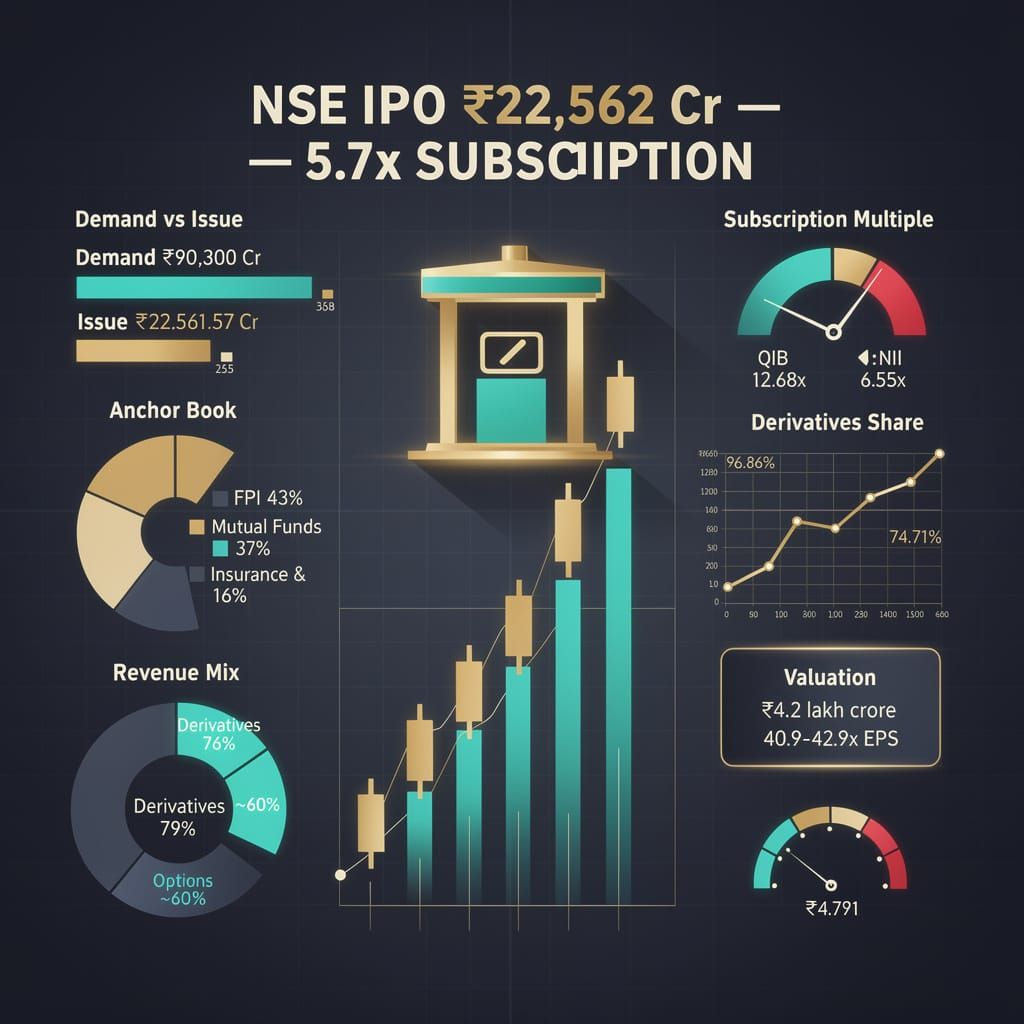
NSE's IPO drew ₹90,300 crore in bids against a ₹22,562-crore issue—a 5.7x oversubscription, the 2nd-largest in Indian market history. 📈 Only ~5% of equity floats, so early price discovery may be thin. Professional money took most of it; retail stayed muted. Since Aug 4, NSE's closing auction has reshaped how index giants like Infosys and TCS trade. Will the scarcity premium hold in the first two weeks? 🏛️
On September 21, 2026, the National Stock Exchange of India closed its initial public offering with total demand of roughly ₹90,300 crore against an issue size of ₹22,561.57 crore—a 5.7x subscription that ranks as the second-largest public offering in Indian capital-markets history, trailing only Hyundai Motor India's 2024 listing. The ₹6,746.18 crore raised from 189 anchor investors on the final day confirmed that the world's largest derivatives exchange by contract count can price scarcity.
What changed
The offering was entirely an Offer for Sale (OFS)—12.64 crore equity shares, about 5.11% of NSE's paid-up capital, sold by existing shareholders with no fresh capital raised. Proceeds flow to selling investors, not to the exchange's balance sheet. NSE shares will trade exclusively on the Bombay Stock Exchange beginning September 24, because SEBI Chairman Tuhin Kanta Pandey ruled out allowing NSE to trade on its own platform as "too early." The valuation implied by the upper band of ₹1,785 per share is roughly ₹4.2 lakh crore, pricing NSE at 40.9x–42.9x FY26 diluted EPS on a base of ₹16,601 crore revenue and ₹10,302 crore profit after tax.
The listing also resets the comp set. Analysts flagged a likely correction in BSE's valuation—BSE settled at ₹3,384 (up ₹78) on September 14, at a 54.28x multiple, a premium analysts expect to compress once the larger, more profitable NSE trades as a comparable. BSE's ₹1.38-lakh-crore market cap now faces a live reference point of a monopoly-priced peer.
How the mechanism works
NSE is, in effect, a toll booth on Indian capital markets—earning roughly 79% of revenue from derivatives, with options alone about 60% of that base, while bearing near-zero credit risk. That structure explains the demand mix. Qualified institutional buyers subscribed at 12.68x their allotment, non-institutional investors at 6.55x, employees at roughly 2.04–2.39x, and retail at 1.01–1.39x. Professional money chased the scarcity; retail stayed muted against a minimum 35% retail reservation.
Anchor allocation reveals who now controls the float. Foreign portfolio investors took the largest single share at roughly 43% of the anchor book. Domestic institutions put in more than ₹3,588 crore across over 25 mutual funds and 11 insurance and pension firms—domestic mutual funds allocating ₹2,495 crore (37% of the anchor portion), insurance and pension funds ₹1,082 crore (16.04%). LIC, a pre-IPO holder at 10.72% alongside SBI and CPPIB, was the largest single anchor at 5.93%. GIC, ADIA, Norges Bank, Fidelity, and GSAM rounded out the book.
Distribution of value, risk, and leverage
The structure concentrates a peculiar risk: only about 5% of NSE's equity floats. Post-IPO liquidity will be thin relative to the ₹4.2-lakh-crore valuation, so the initial trading session could see price discovery dominated by the few holders willing to sell. That thin float is a leverage point—not for NSE's operations, which are fully funded, but for any seller with a large block.
The second-order tension is competitive—and it sits atop an unresolved operational flaw that predates the listing. On August 4, when NSE's permanent Closing Auction Session (CAS) launched, Sensex fell 0.27% and Nifty fell 0.64%, with the steeper Nifty drop attributed to auction-heavy holdings like Infosys and TCS. The structural shift from continuous trading to a closing auction, with a shortened post-CAS derivatives window, forced some F&O position closures and skewed activity toward NSE. SEBI responded on September 12 with proposed CAS timing revisions—cutting the transition window between the continuous trading session and the auction from five minutes to as little as one minute (Option A: CTS to 3:30 p.m., CAS 3:31–3:40 p.m., derivatives until 3:45 p.m.; Option B: CTS to 3:15 p.m., CAS 3:15–3:25 p.m., derivatives until 3:30 p.m.), plus full disclosure of pending iceberg orders. The comment period runs to October 3, so the rule that will govern NSE's post-IPO price discovery remains unsettled.
The other lever is NSE's own derivative market share, which fell from 96.86% in FY24 to 74.71% in FY26, eroded by SEBI's larger contract lots, rationalized weekly expiries, and retail-derivatives curbs. The IPO now publicly discloses that decline under a listed-company disclosure regime—and presses the exchange to defend its moat against BSE, which controls the listing venue and captures trading fees NSE concentrates in its own options complex.
Unresolved uncertainty and monitoring indicators
- Float dynamics: Watch realized trading volumes and price range in the first two weeks. A sustained spread between NSE's quoted price and its ₹1,700–1,785 issue band measures how much of the scarcity premium persists.
- Options market share: Track NSE's index-options share vs. BSE in monthly trading statistics. A decline below 70% would indicate structural territory loss, not cyclical.
- CAS rule-stage: Monitor whether SEBI adopts Option A or B by the October 3 comment deadline, and how the shortened transition window affects auction-driven index volatility, particularly in Nifty-weighted names like Infosys and TCS.
The listing turns a decade of regulatory stalling into a market test—just as the exchange's own microstructural rules remain in motion. The ₹22,562 crore raised from 189 anchors measures the price professional capital puts on owning a piece of the infrastructure it has to trade through either way.
Comments ()