Microsoft's Xbox reset: 3,200 roles cut after a $76.5B buying spree
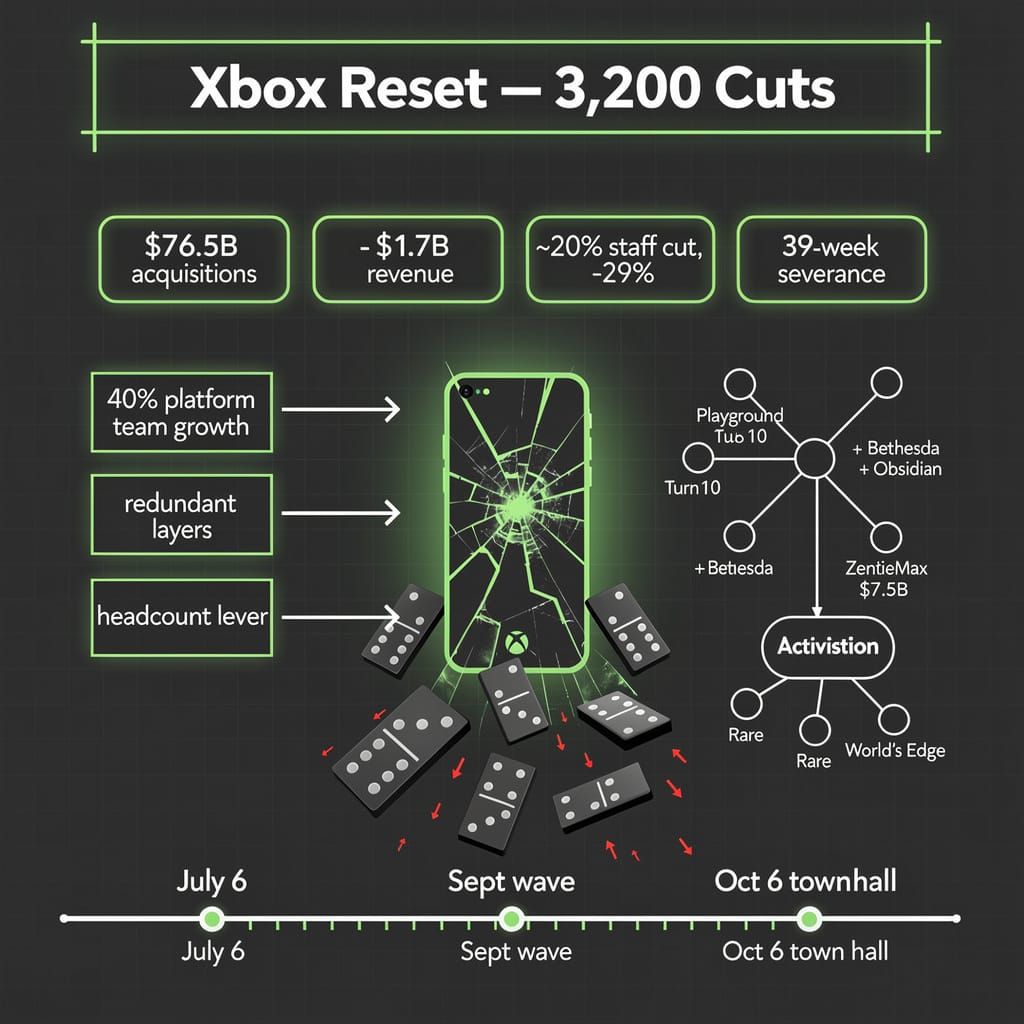
~1,600 more Xbox roles cut this week—nearly 14% of Xbox staff—after Microsoft spent $76.5B buying Activision and ZeniMax. 🎮 CEO Asha Sharma's diagnosis: the business was "unhealthy" and the company "spread ourselves too thin." The math: Xbox hardware revenue is down 29% year over year, with ~75% of layoffs for the fiscal year now complete. Left behind are teams (Playground/Turn 10, Bethesda/Obsidian) told to make consolidation work—just as top talent like a VP departed for an AI startup. Is cutting the studios you paid billions to acquire actually fixing the problem, or just resizing it? What does Xbox's "reset" look like for the developers who stay? 💭
On September third week, Halo Studios staff, first-party developers, and Xbox Game Studios management got the second wave of bad news this year. Microsoft cut roughly 268 roles in Xbox gaming (plus a smaller number in cloud+AI), bringing the division's 2026 total to about 3,200 by most counts. The stated reason, per Xbox CEO Asha Sharma: the business was "unhealthy" and management had "simply spread ourselves too thin."
The numbers behind that confession are worth sitting with. Microsoft spent roughly $69 billion on Activision Blizzard and $7.5 billion on ZeniMax Media to build its studio portfolio. A spokesperson confirmed the July wave cut about 2.1% of Microsoft's global workforce (~4,800 people on July 6), with the gaming division bearing the brunt—closing and spinning out studios including Compulsion Games, Double Fine, Ninja Theory, and Undead Labs. The current "Xbox Reset" plan targets cutting ~20% of Xbox staff by fiscal year-end—roughly 3,200 people, of which about three-quarters are now gone, per Matt Booty. US employees let go receive severance up to 39 weeks of base pay, which signals a retention investment being poured into people being shown the door.
The organization spent a decade acquiring talent, then, in under 100 days, decided that talent was the problem. Ninja Theory faces closure after two rescue deals fell through—its fate confirmed nine days after Microsoft announced the studio's next Senua game at the June Xbox Games Showcase. Double Fine and Compulsion Games regain independence. Obsidian folds under Bethesda. Playground and Turn 10 merge into one Forza/Fable studio. Activision—fresh off the Halo IP being handed to a "purpose-built team"—also absorbs Rare (Sea of Thieves) and World's Edge (Age of Empires). King picks up Microsoft Casual Games.
The incentives never rewarded consolidation. Every acquisition added a studio that had to justify its own existence with its own project pipeline. Each studio built its own management, tools, and overhead. As Sharma conceded, platform teams grew 40% since the current hardware generation launched—while player base and total play time declined. More studios meant more competing internal factions and more "redundant layers of management complexity," as one internal developer put it. When revenue growth stalled, the only lever visible from the top was headcount and studio count themselves. That stalled growth is concrete: on July 30 the division posted a $1.7B revenue decline, Xbox hardware revenue down 29% and console units off 29% year over year, with content/services down 10%—roughly $4.9B lost in products and people. Sharma attributed the slide to "rising console prices and reduced unit sales," driven by semiconductor cost inflation that pushed $100-plus device uplifts and, per one analyst, "business recovery expected FY2027." The enterprise side—Azure income plus a $3.2B Anthropic contribution—kept Microsoft's overall profit rising, which is exactly why the gaming unit's cuts read as collateral, not strategy.
The double blow is what matters for trust. The first round told employees the problem was structures. The second round told them the problem was, in part, the people inside those structures. Behavioral trust—speaking up with hard project truths, sharing cross-studio context, judging decisions fair—requires believing the decision-makers have accurate information about what teams actually do. When a Halo team is told their next game moves to Activision, or a studio is told to re-independently negotiate its own sale, the message employees absorb is that the real evaluation of their work happens at the divestiture stage, not at review time. The senior-level signal compounds it: Xbox VP Jared Palmer departed for Cognition AI three months after joining, leaving Project Helios development exposed just as the division stabilizes post-layoffs.
Some spinouts are legitimate reversals, not failures. Compulsion and Double Fine going independent arguably re-opens creative freedom. And Microsoft's gaming business still reports strong financials ($90B revenue, $36B profit; fiscally, $133.7B net income and $182.9B operating cash flow underpin a dividend raise to $0.98, its 23rd consecutive increase). The risk is treating a restructuring that's 75% complete as a completed success, when the hardest casualties—retention of who's left, and whether remaining teams trust that "consolidation" won't be repeated in 18 months—aren't tracked in any earnings statement. Analysts already flag "operational fragmentation" from 3,200 job cuts targeting studio staff.
Things to Think About:
- Do developers at merged studios (Playground/Turn 10, Bethesda/Obsidian) report clearer decision authority, or competing oversight?
- After the July 6 buyouts and 39-week severance packages, do remaining staff judge the process fair, or do they read it as the price of being next?
- With the next update scheduled for an October 6 town hall, does the c-suite signal whether "reset" has an end state—and does the departing-engineer pattern recur before then?
Comments ()