CMF becomes majority Indian-owned, targets 100 million phones a year
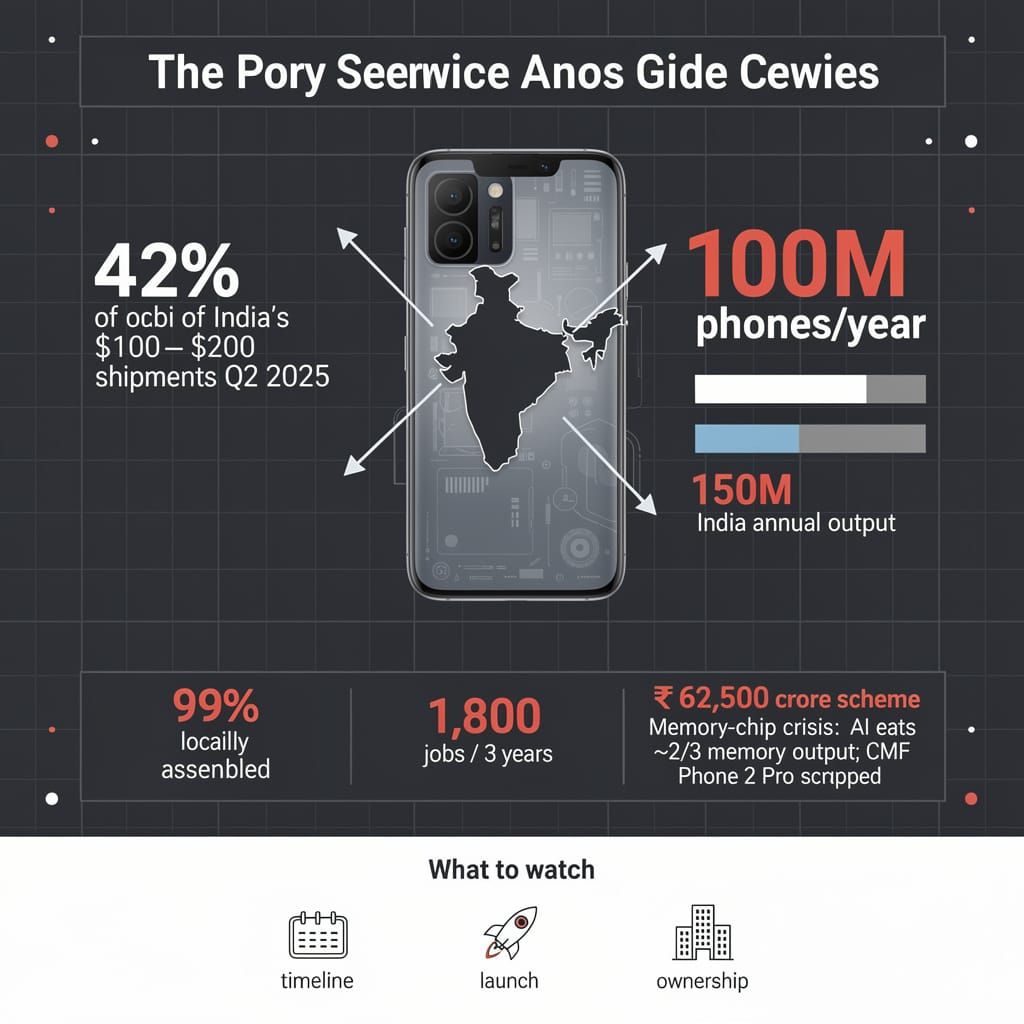
📱 CMF's spin-off targets 100 million phones a year—roughly two-thirds of India's entire annual domestic market. The brand already grabbed over 42% of India's $100–$200 phone shipments in Q2 2025. Now it's betting on local ownership plus local engineering, with a plan to create ~1,800 jobs. It's a pivot from "Make in India" to "Invent in India." Can a budget brand built on hype really hit that scale? 👀
Here's the thing nobody expected from a brand built on edgy transparent back panels and hype: its most-grown market wasn't a cool Western city. It was India. And on September 21, Carl Pei did something genuinely unusual—he gave the brand away.
Well, kind of. CMF, the budget arm of Nothing, is officially spinning off into its own standalone company. But not just "own company." It's becoming majority Indian-owned and headquartered in India, with its own team, its own R&D, and its own destiny. Nothing stays on as a shareholder and tech partner, handing over the OS, the engineering crew, supplier relationships, and brand ops.
Why does this matter?
Because it's not a typical corporate carve-out designed to juice a balance sheet. This is a brand walking toward the fire. India is the only place on earth where 99% of phones sold are assembled locally, and where the sub-$200 segment is a battlefield littered with Samsung and a dozen scrappy locals. CMF already proved it can win there—it grabbed over 42% of India's $100–$200 shipments in Q2 2025 and posted the fastest expansion rate of any smartphone sub-brand in the country during 2025.
So the spin-off isn't retreat. It's a pivot into deeper water.
The big number
Pei's stated ambition: 100 million phones a year. To put that in perspective, that's roughly two-thirds of India's entire annual domestic market—and India already cranks out over 150 million smartphones a year on its own factory floors. You don't hit 100 million by bolting off-the-shelf parts together and calling it a day.
The plan is to make suppliers sweat: local chassis architecture, camera systems, antenna design, and software optimization—engineering IP developed in India, not imported. That's a shift from "Make in India" to "Invent in India." The joint venture with Optiemus Infracom is already wired to create around 1,800 local jobs over three years, with India's ₹62,500 crore Mobile Phone Manufacturing Scheme greasing the rails to make the country a global export hub for electronics.
The messy backdrop
This didn't come out of nowhere, and it wasn't entirely voluntary either. The memory-chip crisis has been brutal. In June, co-founder Akis Evangelidis confirmed the CMF Phone 2 Pro was scrapped—he cited runaway RAM and SSD costs swallowing more than half the hardware budget on a cheap handset. And it's not just CMF feeling it: AI compute clusters are devouring nearly two-thirds of global memory output, a crunch brutal enough that it pushed even flagship phones past $1,300. The very reason a planned budget model for 2026 got shelved is the storm any spin-off now inherits.
What to watch
- The timeline. No legal separation date has been announced yet. "Standalone company" and "actually standalone" are different things.
- The next launch. With a canceled 2026 model already on the record, the product cadence is the real test.
- The ownership math. Majority Indian shareholders, Nothing as partner—how much say does London (or wherever Nothing calls home) actually keep?
The spin-off is a bet that localizing ownership plus localizing engineering is the only way to survive the budget trenches. Whether 100 million is a dream or a plan? Time—and the next phone—will tell.
Comments ()