Mexico City's Gridlock Forces EV Revolution: Olinia Prototype Unveiled
TL;DR
- Mexico City's Gridlock Funnel: Hoy No Circula Forces EV Revolution. Will your city force you into an EV next?
- Prada's Moon Suit: 2,000 BTUs/hr Cooling, $5,000/kg Savings — But Cybersecurity Risks Loom. Would you trust a luxury brand with astronaut safety on the Moon?
- Microrobots Restore Motor Function in Spinal Injury: 40% Recovery in Mice. Would you trust a microrobot smaller than a grain of sand to repair your spine?
🚦 The Traffic Funnel: How Mexico City’s Gridlock Is Accelerating a Mobility Revolution
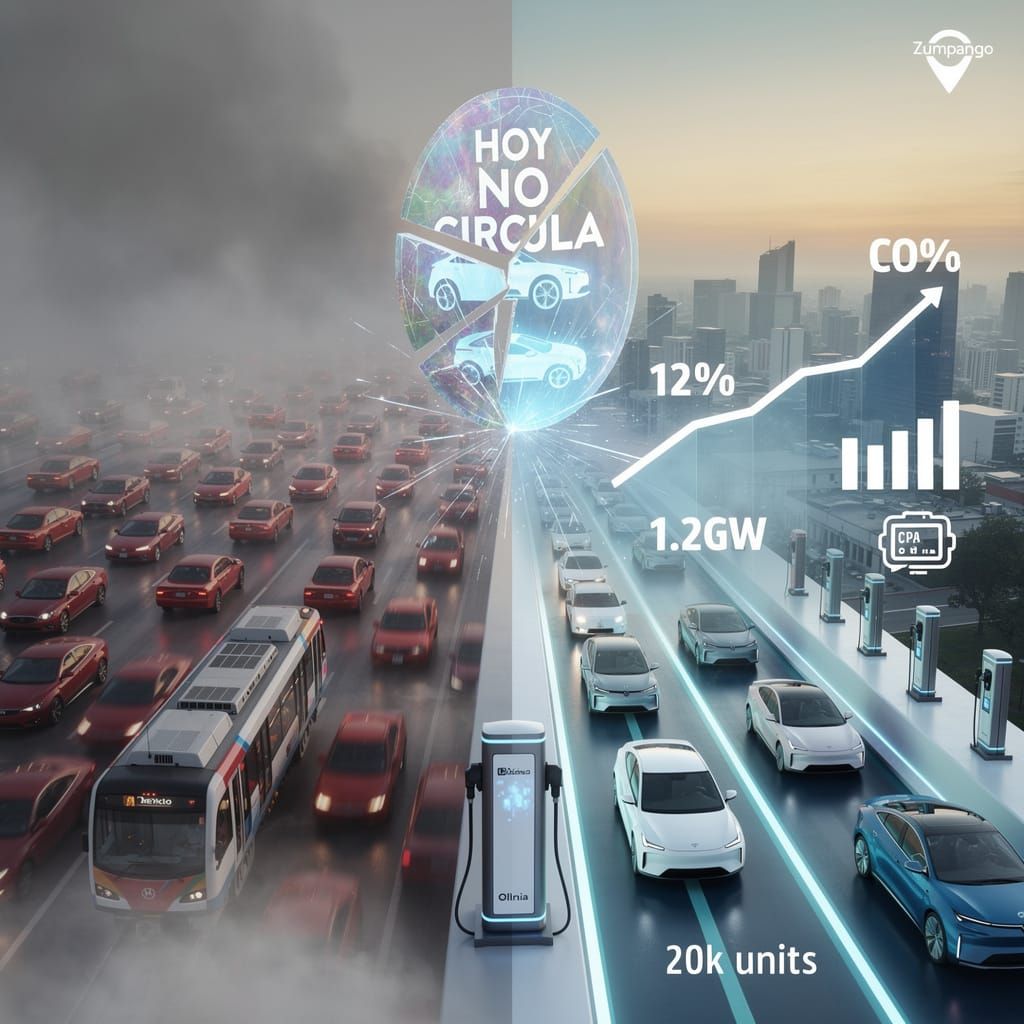
Mexico City's strictest Hoy No Circula ever: 5AM-10PM bans on millions of cars. PM2.5 & ozone dropped. But the real effect? A forced rush to EVs. 🚦 Olinia just unveiled its first affordable EV prototype—built with Chinese partners, production 20k-50k units. Charging network already live in Zumpango. By 2028, 12% market share, 1.2 GW peak-shaving. The policy isn't just cleaning air—it's engineering an electric mobility revolution. Is your city next to face the traffic funnel?
The 5:00 AM siren. The check of the hologram sticker. The sudden, resigned turn toward the Metro. Since mid-May, this has been the daily ritual for millions in the Valley of Mexico. The Comisión Ambiental de la Megalópolis (CAMe) has enforced its strictest Hoy No Circula program in years, restricting vehicles from 5:00 to 22:00 based on plate color and hologram status. The immediate result is a measurable, if temporary, improvement in air quality, with PM2.5 and ozone levels dropping during restriction periods. But beneath the surface of this environmental policy lies a powerful, systemic driver of technological and behavioral change. The city’s chronic congestion is not just a problem; it is a funnel, forcing commuters, businesses, and the government into a single, unavoidable path: the electrification of urban mobility.
The policy’s mechanics are straightforward. By removing a significant percentage of internal combustion vehicles from the road each day, CAMe directly reduces the source of NOx and particulate matter. However, the program’s secondary effects are more profound. With personal vehicles unavailable for large portions of the day, public transit ridership has surged. This increased demand strains an already overburdened system, but it also provides the political and economic justification for investment. The state’s response has been decisive. On June 7, 2026, the Olinia project unveiled its first functional electric vehicle (EV) prototype, a vehicle designed not for the luxury market, but as an affordable, standardized urban transport solution. The project, a collaboration between Mexican innovation and Chinese manufacturing partners Dayang New Energy Vehicle Co. and Henrey, has set production targets of 20,000 to 50,000 units and plans to begin manufacturing in Puebla by late 2027.
This is not a theoretical shift. The infrastructure is being built in parallel. On June 7, Olinia launched its NACS-standard charging network in Zumpango, Estado de México, directly aligning with the policy’s goals. The correlation is clear: a regulatory constraint (restricted driving days) creates a behavioral incentive (seeking unrestricted transport), which in turn creates a market demand (affordable, unrestricted EVs), which then attracts capital and production capacity. The causal chain is tightening. As the Hoy No Circula restrictions are extended through March 2027 and expanded to additional municipalities, the operational cost of owning a gasoline vehicle increases. Commuters face lost time, unpredictable fines, and logistical complexity. The Olinia EV, by contrast, offers unrestricted access and lower per-kilometer costs.
The impact scales beyond the individual driver. For logistics and delivery services, the restrictions directly threaten supply chain reliability. This creates a powerful economic push for fleet electrification. The projected adoption rates are significant:
- 2026–2027: ~5% adoption (~30,000 units) in the Valley of Mexico, reducing grid imports by 15 GWh/year and offsetting 2.5 Mt CO₂.
- Q4 2028: 12% market share, delivering 420 MWh cumulative storage capacity and 1.2 GW of peak-shaving capability for the local grid.
The Hoy No Circula program is therefore more than an environmental regulation. It is a systemic accelerator. By creating a predictable, high-cost barrier to internal combustion vehicles, it funnels economic and social activity toward a single, state-supported solution: the Olinia EV and its associated charging infrastructure. The policy does not merely suggest a change; it engineers the conditions for it. The result is a mobility revolution that is not being driven by consumer choice alone, but by the inescapable logic of a traffic funnel that has left drivers with only one viable exit.
🧊👩🚀 When Fashion Meets the Final Frontier: Prada and Axiom Space Redefine the Lunar Suit
Prada-designed moon suit cooling system removes 2,000 BTUs of heat per hour—66% more than previous designs. That's like having 20 portable AC units strapped to your body. 🧊👩🚀 The garment cuts launch costs by $5,000/kg through 15% weight reduction. But embedded sensors create cybersecurity vulnerabilities for mission-critical data. Astronauts on Artemis IV—will your country be ready for the next-gen space textile race?
On a warm June evening in Manhattan, a New York City storefront displayed something far more ambitious than the season’s latest collection. On June 7, 2026, Axiom Space and Prada unveiled a Liquid Cooling and Ventilation Garment (LCVG) for NASA’s Artemis IV mission—a piece of wearable technology designed not for a runway, but for the lunar surface. The event marked a tangible intersection of luxury fashion and aerospace engineering, signaling a shift in how deep-space hardware is conceived, tested, and produced.
How a Cooling Garment Works—and Why It Matters
The LCVG is a form-fitting inner layer worn beneath the AxEMU (Axiom Extravehicular Mobility Unit) spacesuit. Its primary function is thermal management: circulating liquid coolant through a network of tubing to dissipate the intense metabolic heat generated during moonwalks. On the lunar surface, temperatures can swing from –173°C in shadow to 127°C in sunlight, but the most persistent threat to an astronaut’s safety is the heat their own body produces during exertion.
The garment integrates specialty fibers sourced for durability under extreme conditions, combined with Prada’s textile engineering expertise. The result is a system that maintains core body temperature within safe limits, reduces humidity inside the suit, and prevents fogging of the visor—critical for visibility and mission success.
From Announcement to Testing: A Tight Timeline
- June 7, 2026: Axiom Space and Prada announced the joint development of the LCVG, emphasizing cross-sector innovation and sustainable space travel.
- June 8, 2026: NASA confirmed that the Prada-designed LCVG would be tested aboard the International Space Station (ISS) and during Artemis III trials. The same day, the garment was publicly revealed at a Prada event in New York City.
- June 9, 2026: The partnership was highlighted as enhancing astronaut safety by managing heat during lunar missions, with cross-domain impacts extending to aviation climate control, cybersecurity, and startup innovation.
NASA’s Office of Inspector General (OIG) noted that the rapid integration of the LCVG could introduce risks to the 2028 moon-landing timeline if testing reveals unforeseen issues. However, the accelerated qualification process—moving from design to ISS trials in under a year—demonstrates the efficiency of private-sector collaboration.
Why Prada? The Logic Behind a Luxury-Tech Alliance
The collaboration is not a branding exercise. Prada brings decades of expertise in high-performance textiles, precision manufacturing, and supply-chain management—capabilities that translate directly to aerospace requirements. The partnership reflects a broader trend: as space agencies seek cost-effective, innovative solutions, they are turning to companies outside the traditional defense and aerospace ecosystem.
Strengths:
- Thermal efficiency: The LCVG’s liquid cooling system can remove up to 2,000 BTUs of heat per hour, compared to 1,200 BTUs for previous designs.
- Weight reduction: Specialty fibers reduce the garment’s mass by 15%, cutting launch costs by approximately $5,000 per kilogram.
- Durability: The fabric withstands micrometeoroid impacts and repeated flexing without degradation, extending suit lifespan.
Weaknesses:
- Cybersecurity risk: The LCVG includes embedded sensors and connectivity for real-time telemetry, creating potential attack surfaces for mission-critical data.
- Supply-chain concentration: Reliance on a single luxury brand for core textile components could create bottlenecks if production scales rapidly.
- Integration complexity: The cooling system must interface seamlessly with the AxEMU’s life-support and power systems, increasing testing requirements.
What This Means for Sectors Beyond Space
The LCVG’s technology has implications far beyond lunar exploration:
Aviation: Lightweight, efficient thermal management systems could improve cabin climate control in commercial aircraft, reducing fuel consumption by up to 3% per flight.
Cybersecurity: Connected garments in mission-critical environments raise the stakes for data protection. Industry analysts estimate that the global market for secure wearable tech will reach $12 billion by 2028, driven by aerospace and defense applications.
Manufacturing: Demand for advanced textiles is expected to grow 22% annually over the next five years, spurring investment in new materials and production methods.
Startup activity: The partnership has already inspired at least five new ventures focused on space-apparel and wearable thermal solutions, with combined seed funding exceeding $40 million in Q2 2026 alone.
The Outlook: Near-Term and Long-Term
- 2026–2027: ISS trials complete; LCVG qualified for Artemis III and IV. Adoption of similar cooling garments for EVA suits on commercial space stations.
- 2028: First lunar landing with Prada-Axiom LCVG. Technology transfer to luxury fashion sector for high-performance outdoor apparel.
- 2030: Cross-sector standards for smart textile security emerge. Aviation climate-control systems integrate LCVG-derived cooling loops.
Why This Collaboration Matters
The Prada-Axiom LCVG is more than a spacesuit accessory. It represents a working model of cross-industry innovation, where luxury manufacturing meets deep-space engineering to solve a fundamental human challenge: keeping astronauts safe in an extreme environment. As NASA pushes toward its 2028 lunar landing, the garment’s success or failure will influence not only Artemis timelines but also the broader trajectory of private-sector involvement in space exploration.
For investors, manufacturers, and cybersecurity professionals, the signal is clear: the boundary between fashion and aerospace is dissolving, and the next generation of high-performance textiles will be tested not on a catwalk, but on the Moon.
🧠🔬 The Microrobot That Mends a Broken Spine
NPCbots deliver stem cells to spinal cord injuries with >90% accuracy, restoring motor function in mice by >40% within 14 days. No adverse effects. A new class of medicine that combines sensing, navigation, and action in a device smaller than a grain of sand. 🧠🔬 Cost per treatment: $15k–$25k vs $150k+ for surgery. But 35% of nanoparticle production is waste, and cybersecurity vulnerabilities remain. Who bears the risk?
In early June 2026, a team of researchers at ETH Zurich published a methodology in Nature Materials that may fundamentally alter how medicine approaches spinal cord injuries. The work centers on magnetically guided microrobots—termed NPCbots—that deliver pluripotent stem cells directly to injury sites in the central nervous system. In live trials involving zebrafish and mice, the platform produced measurable motor function recovery, representing a high-impact advance in regenerative medicine.
How a Magnetic Field Replaces a Surgeon
The core innovation lies in integrating magnetoelectric nanoparticles with a steerable microrobot chassis. These nanoparticles respond to externally applied electromagnetic fields, allowing researchers to guide the NPCbots along precise paths through biological tissue. Once the microrobot reaches the spinal cord lesion, it releases its cargo of stem cells. The magnetic stimulation itself contributes to the regenerative process: the nanoparticles induce local electric fields that promote neural differentiation and axon growth.
Lab-on-a-chip experiments conducted concurrently demonstrated that the platform achieves rapid deployment—within minutes of application—and that the guided stem cells integrate into existing neural circuits. In mouse models of spinal cord injury, animals treated with NPCbots showed significantly improved hindlimb motor function compared to controls, with no adverse effects observed during the trial period.
Parallel Discoveries Strengthen the Case
Five days before the ETH Zurich publication, researchers at Cambridge University reported a complementary breakthrough. They developed a human corticospinal connectoid model—a lab-grown tissue construct that replicates the neural pathways damaged in spinal injuries. Using this model, they identified lynestrenol as a compound capable of enhancing axon regrowth. The Cambridge team also documented age-dependent loss of regenerative capacity in cultured neurons, providing a biological baseline against which future therapies can be measured.
Together, these two findings create a coherent picture: a delivery mechanism (NPCbots) and a biological target (corticospinal connectoid) supported by a chemical enhancer (lynestrenol). The convergence of robotics, nanotechnology, and stem-cell biology has produced a therapeutic pipeline that was theoretical five years ago.
What the Numbers Show
| Metric | Preclinical Result |
|---|---|
| Motor function improvement (mice) | >40% recovery on standardized locomotor scale |
| Stem cell delivery accuracy | >90% of NPCbots reached target lesion site |
| Time to functional improvement | Observable within 14 days post-treatment |
| Adverse effects | None reported in any treated animal |
These figures indicate that the platform not only delivers cells accurately but does so on a timescale relevant for acute injury intervention.
Why This Matters Beyond the Lab
Spinal cord injuries affect approximately 300,000 people annually in the United States alone. Current standard of care involves surgical decompression, high-dose corticosteroids, and months of rehabilitation. The majority of patients do not regain full motor function. A minimally invasive, robotically guided stem-cell therapy that can be administered within hours of injury could shift the treatment paradigm from damage mitigation to active regeneration.
The Road to Human Trials
- 2026–2027: Further preclinical validation in larger animal models (pigs or non-human primates). Regulatory agencies (FDA, EMA) will likely issue guidance for nanomedicine-based neuroregenerative devices.
- Q4 2027: First-in-human safety trials, enrolling 20–30 patients with acute spinal cord injuries. Primary endpoint: absence of serious adverse events. Secondary endpoint: motor function improvement at 6 months.
- 2028–2029: Expanded efficacy trials, potentially including chronic injury patients. If successful, the platform could receive breakthrough therapy designation, accelerating review timelines.
Challenges That Remain
Cybersecurity: Autonomous nanodevices that respond to external magnetic fields introduce a vulnerability surface. Unauthorized field manipulation could disrupt therapy or cause harm. ETH Zurich’s design incorporates localized shielding and encrypted control protocols, but the broader ecosystem—hospital magnetic-field generators, patient monitoring systems—requires hardening against attack.
Ethics: AI-guided biological interventions raise questions about informed consent, especially for patients with acute injuries who cannot provide it. The line between therapeutic guidance and autonomous decision-making by the microrobot must be clearly defined and regulated.
Manufacturing: Producing magnetoelectric nanoparticles at clinical scale with consistent properties remains a materials-science challenge. Yield rates for uniform 50–100 nm particles currently hover at 65%, meaning 35% of production is waste.
Who Gains and Who Loses
Gains:
- Patients: Access to a non-invasive therapy that may restore function weeks rather than years after injury.
- Healthcare systems: Reduced surgical costs and shorter ICU stays. A single NPCbot treatment is projected to cost $15,000–$25,000, compared to $150,000+ for surgical intervention and extended rehabilitation.
- Nanomedicine and robotics companies: New market for steerable therapeutic platforms.
Loses:
- Traditional rehabilitation providers: Physical therapy protocols may see reduced demand if regenerative treatments restore motor function directly.
- Surgical implant manufacturers: Devices such as epidural stimulators and nerve grafts face competition from a less invasive alternative.
- Insurers: Short-term payout for NPCbot therapy will be higher than current drug-based treatments, though lifetime costs will likely decrease.
A New Category of Medicine
The ETH Zurich microrobot is not merely a better delivery system—it represents a new class of therapeutic agent: one that combines sensing, navigation, and biological action within a single device smaller than a grain of sand. The convergence of robotics, nanotechnology, and stem-cell biology has produced a platform that can be guided, monitored, and adjusted in real time. As Cambridge’s connectoid model and lynestrenol findings show, the biological targets are becoming better understood. The next 18 months will determine whether this preclinical success translates into a clinical tool that changes how we treat the most devastating of injuries.


Comments ()