12 pathogens linked to ~2.3M cancer cases in 2024
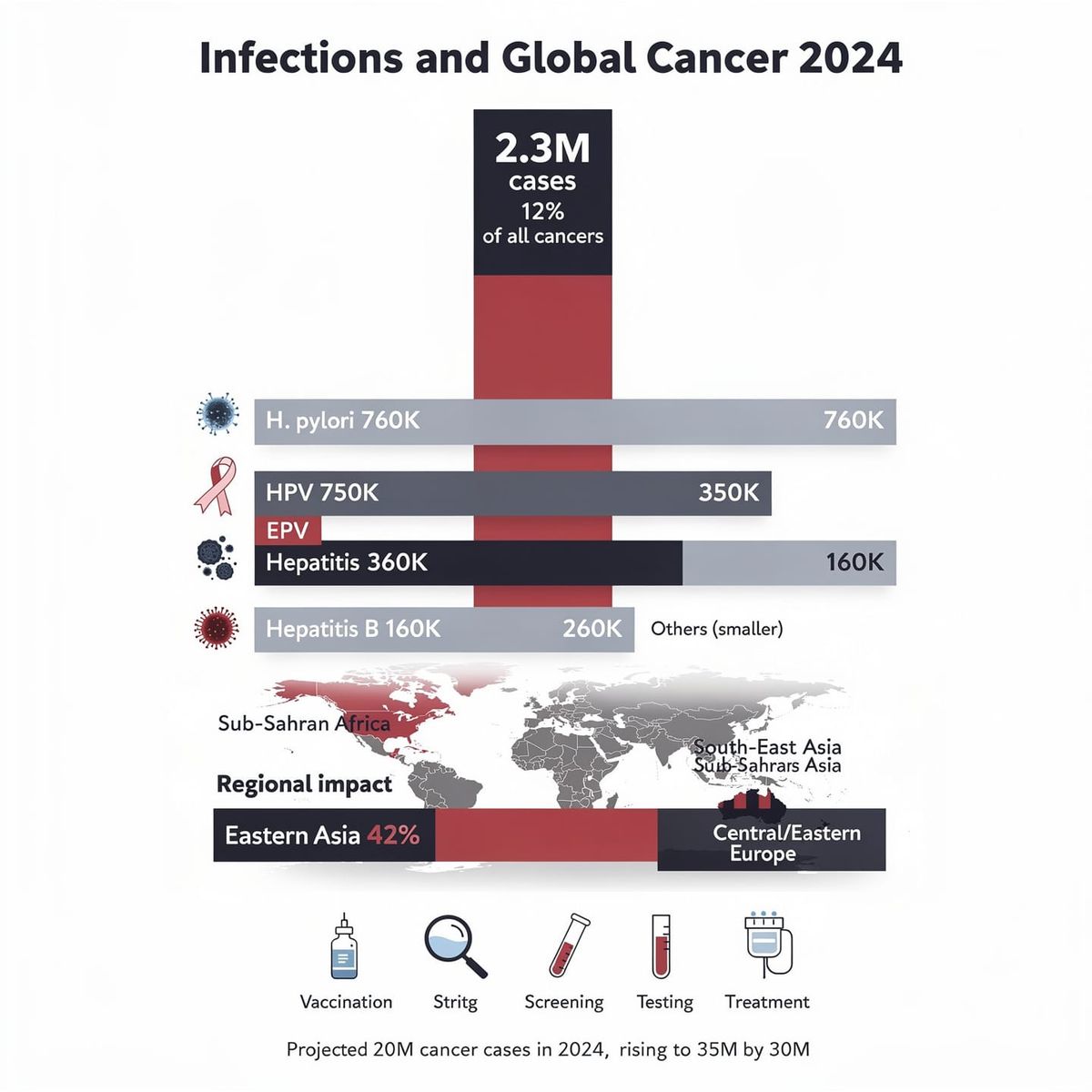
About 12% of new cancer cases in 2024—an estimated 2.3 million—trace to 12 infectious agents, per a Lancet Oncology analysis led by IARC. The top contributors are H. pylori (~760,000) and HPV (~750,000), followed by hepatitis B and EBV. The figure is a modeled estimate, not a count, and doesn't say any detected infection inevitably causes cancer. Most of this burden falls on low- and middle-income regions, and the researchers say established tools—vaccination, screening, treatment—can prevent much of it.
An analysis published in The Lancet Oncology estimates that a dozen infectious agents—bacteria, viruses, and parasites—were tied to roughly 2.3 million new cancer cases worldwide in 2024, or about 12% of all new diagnoses that year. The work was led by Harriet Rumgay and colleagues at the International Agency for Research on Cancer (IARC), the World Health Organization's cancer research branch based in Lyon, France.
The estimate is a modeled total, not a count of observed cases. It depends on prevalence data and attribution assumptions that vary by region, and it does not claim that a detected infection will inevitably cause cancer. Its core finding is scale: a meaningful share of the global cancer burden traces to pathogens that current tools can largely prevent or treat.
How the infections drive cancer
The top contributors are Helicobacter pylori (roughly 760,000 attributed cases) and human papillomavirus (HPV, about 750,000), each accounting for around 4% of all new cancers. Hepatitis B virus follows at roughly 360,000 cases (2%), Epstein-Barr virus (EBV) at about 260,000 (1%), and hepatitis C virus at roughly 160,000. The remaining agents include Kaposi sarcoma-associated herpesvirus, HIV, HTLV-1, Merkel cell polyomavirus, and several parasites.
The mechanisms differ, but most act over long periods. H. pylori infection is linked to stomach cancer, chronic hepatitis B and C drive liver cancer, and HPV causes cervical and other cancers through persistent infection that can take years to progress. The review notes EBV has emerged as the fourth-largest infectious cause of cancer globally.
Where the prevention gap sits
Eastern Asia accounts for about 42% of infection-attributable cases. Higher infection-related rates also appear in Sub-Saharan Africa, South-East Asia, and Central and Eastern Europe, with low- and middle-income countries carrying a disproportionate share. The researchers point to established control measures—vaccination, screening, testing, and treatment—as the reason much of that burden is avoidable.
HPV vaccination, for example, interrupts persistent infection before precancer forms. The review itself does not establish new effectiveness data for any single intervention; it aggregates existing surveillance and modeling to quantify these pathogens' population-level impact.
What the estimate does and doesn't show
A decisive limit is attribution. For many cases, the specific infectious cause is inferred from prevalence and tumor site rather than confirmed in the individual patient. The figure also combines agents whose prevention pathways differ, and it does not distinguish the 2.3 million total's breakdown by region in the reported summary beyond the East Asia share.
What the number establishes is where the control chain is weakest. The surveillance systems behind the estimate are the same ones needed to track whether vaccination, screening, and treatment programs are closing that gap. With worldwide cancer cases projected to rise from roughly 20 million in 2024 toward 35 million by 2050 on population aging alone, the 2024 infection baseline becomes the reference against which future reductions would be judged.
Comments ()