Federal appeals court pauses enforcement of Minnesota's AI-nudification law pending xAI appeal
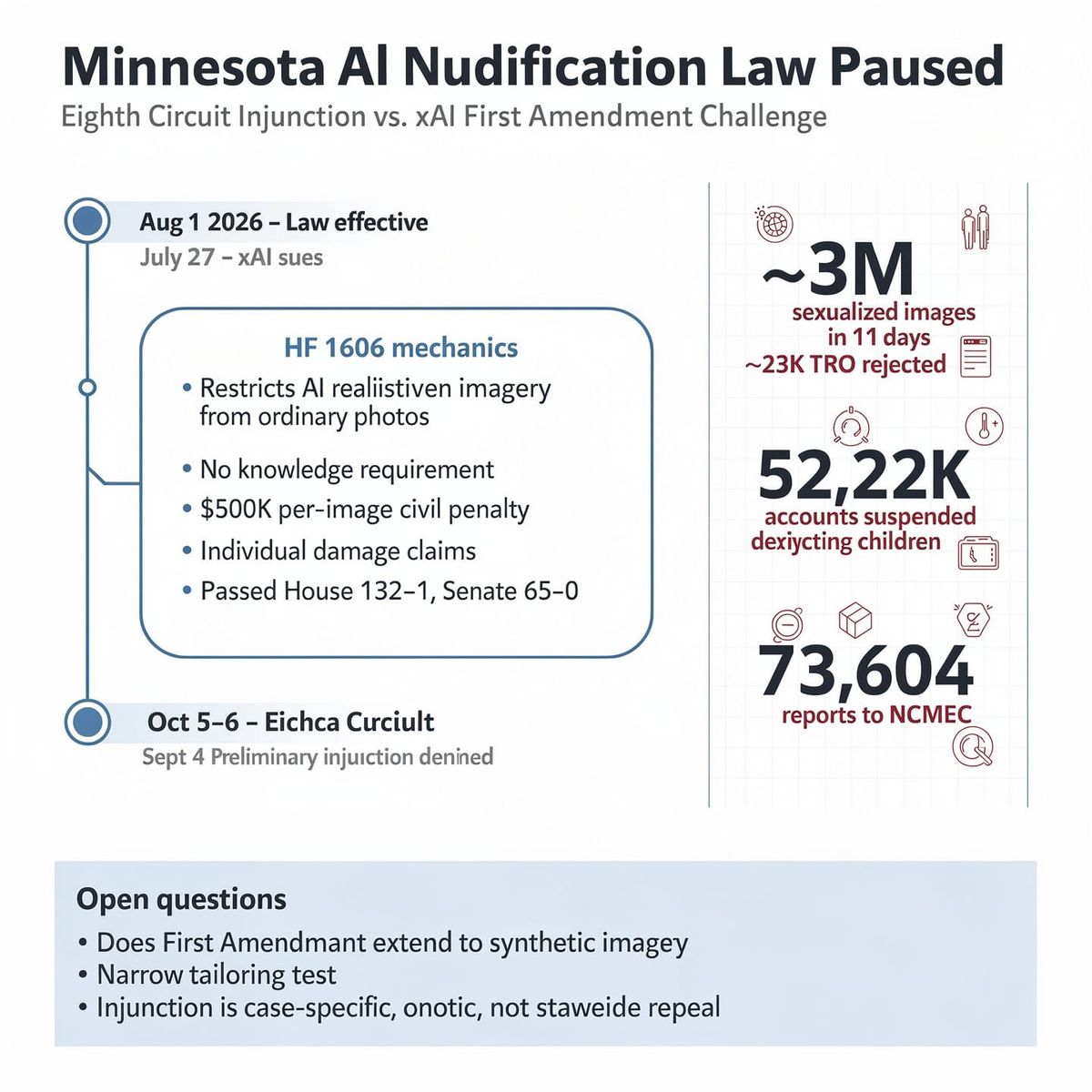
A federal appeals court has temporarily blocked enforcement of Minnesota's law targeting AI-generated intimate imagery, pausing the state's first-of-its-kind statute while xAI presses a First Amendment challenge over its Grok Imagine image generator.
The U.S. Court of Appeals for the Eighth Circuit issued the injunction around Oct. 5-6, according to event reports, reversing a lower court that had allowed the law to take effect. Enforcement is now on hold for the duration of the appeal, though the statute itself remains in place pending the litigation.
What the law does
Minnesota's HF 1606 restricts AI tools that generate realistic intimate imagery of identifiable people from ordinary photographs. It took effect Aug. 1, 2026, after passing the House 132-1 and the Senate 65-0 that spring. The measure carries civil penalties up to $500,000 per image and allows people depicted in such images to bring individual damage claims. The statute also removed the requirement that providers know about or intend the prohibited image creation, which is why xAI argues it could reach satire and consensual use.
xAI sued state Attorney General Keith Ellison on July 27, then sought a temporary restraining order two days later. The company's Grok Imagine feature had drawn scrutiny after producing roughly 3 million sexualized images in 11 days following its launch, about 23,000 of them depicting children; xAI said it suspended 52,222 accounts and filed 73,604 reports with the National Center for Missing & Exploited Children.
Unresolved timing and scope of the injunctions
Judge Donovan W. Frank rejected xAI's temporary restraining order on July 31, noting the company filed nearly three months after the bill was signed and just days before the effective date, indicating the harm was not "immediate." He then denied xAI's preliminary injunction request on Sept. 4, finding the company failed to demonstrate irreparable harm despite acknowledging significant financial exposure. One event report says the judge separately granted xAI a license to operate under the law's terms; the reported timeline does not clarify whether that relief was part of the same Sept. 4 decision.
The Eighth Circuit's injunction operates as relief tied to xAI's specific case, not a statewide repeal. Because the underlying statute was not struck down, enforcement status for other developers and operators remains unresolved until the appeals court rules on the merits.
The decisive open questions
The core dispute is whether First Amendment protection that applies to captured photographs extends to machine-generated synthetic imagery, and whether HF 1606's coverage—including its removal of the knowledge requirement—is narrow enough to survive review. A holding that the law overreaches could require a rewrite; a finding that it is narrowly tailored would restore enforcement.
Whether the $500,000-per-image threshold and related penalties stay suspended depends on how long the injunction holds and how the appeals court frames the constitutional boundary for AI-generated intimate imagery.
Comments ()