Kazakhstan Orders Military Reorganization After Fatal Caspian Drill
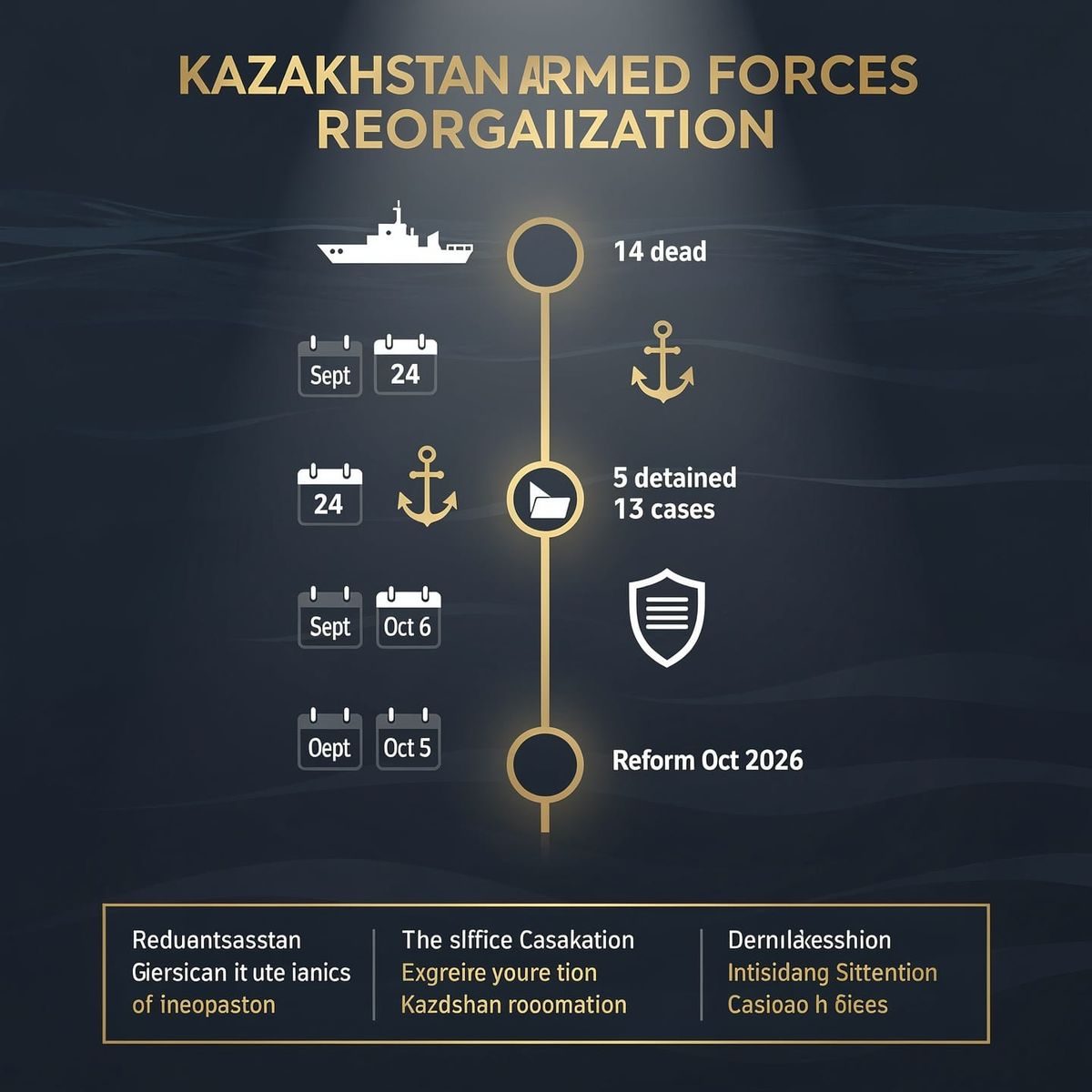
Kazakhstan's president ordered a reorganization of the Armed Forces after an inquiry into a Caspian naval exercise that killed 14 service members on September 24. The probe found shortcomings in drill planning, risk assessment, and troop deployment. Five military officials were detained, and the defense minister was replaced. The Military Reform Plan, still in draft, is expected to take effect in the second half of October, but its exact scope—tighter safety rules or a deeper command restructure—isn't yet settled.
President Kassym-Jomart Tokayev has ordered a reorganization of Kazakhstan's Armed Forces after an official inquiry into a training tragedy in the Mangystau region, Defense Ministry and presidential statements confirmed. Tokayev heard initial findings on October 5 and ordered reforms the same day.
The incident
Fourteen service members died during the Khazar Qorgany 2026 naval exercises on the Caspian Sea on September 24, 2026. Initial reports put the deaths at anywhere from 12 to 14 before official confirmation settled the toll at 14. The Defense Ministry said 17 personnel were swept into the sea, with three rescued and one hospitalized.
The deaths triggered a nationwide examination of how drills are planned and executed. A presidential committee chaired by Aida Balayeva reviewed inspection findings, and the president heard the results on October 5, one day before he ordered the reorganization.
Who was held accountable
Five military officials were detained on September 25 following a pretrial investigation by the Military Investigative Department into the deaths, confirmed by Deputy Interior Minister Sanzhar Adilov. The detentions were tied to negligence, and the ongoing probe has since grown: 13 criminal cases have been launched on suspicion of embezzlement, abuse of office, and other violations, including hazing and violence against service members.
Former navy commander Kanat Niyazbekov was detained on October 6 on suspicion of negligence.
The tragedy also triggered a broader shakeup. Defense Minister Dauren Kosanov was replaced by Aidos Myrzakhmetov on September 27. Three other officials — Kanysh Abubakirov, Almaz Dzhumakeyev, and Niyazbekov — were dismissed on October 3, before Niyazbekov's later detention. Aitkurman Omarbekov was appointed First Deputy Defense Minister and Chief of General Staff on October 5.
What the reform targets
The inquiry identified serious shortcomings in exercise preparation, planning, risk assessment, and safety measures, as well as improper troop deployment. The Military Reform Plan is meant to build a new-model army focused on modernization, discipline, and safety.
Tokayev was blunt about the diagnosis. On September 27, he said, "Our army is stuck in the last century... the command system must be completely rebuilt."
The reorganization is not yet operational. Tokayev ordered the reforms after receiving the October 5 findings, with implementation expected in the second half of October 2026, according to announced plans. Drafting of defense reform proposals to address the identified shortcomings is underway.
What's known, what isn't
While the criminal cases and detentions are documented, the formal legal status of the five initially detained officials — whether they remain held or have been formally charged — has not been confirmed. Public mourning was declared on September 25, and the government announced an 815-million-tenge ($1.5 million) public fundraiser for the families of the deceased, with a special commission led by Bekmurat Zhusipov set up for aid distribution.
The decisive unknown is whether the reform plan, still in draft, will tighten drill-safety rules and approval chains or restructure command authority itself. For now, the armed forces are running on a declared but unexecuted overhaul, with 14 service members dead and one former navy commander in custody as the standing record of what went wrong.

Comments ()