ATF ends federal suppressor registration
ATF guidance effective October 9 drops federal NFA registration and approval for suppressors and short-barreled firearms, following the Texas *Jensen v. ATF* ruling. Transfers now use the standard Form 4473 background check. State laws in 15 states still impose their own requirements, and the…
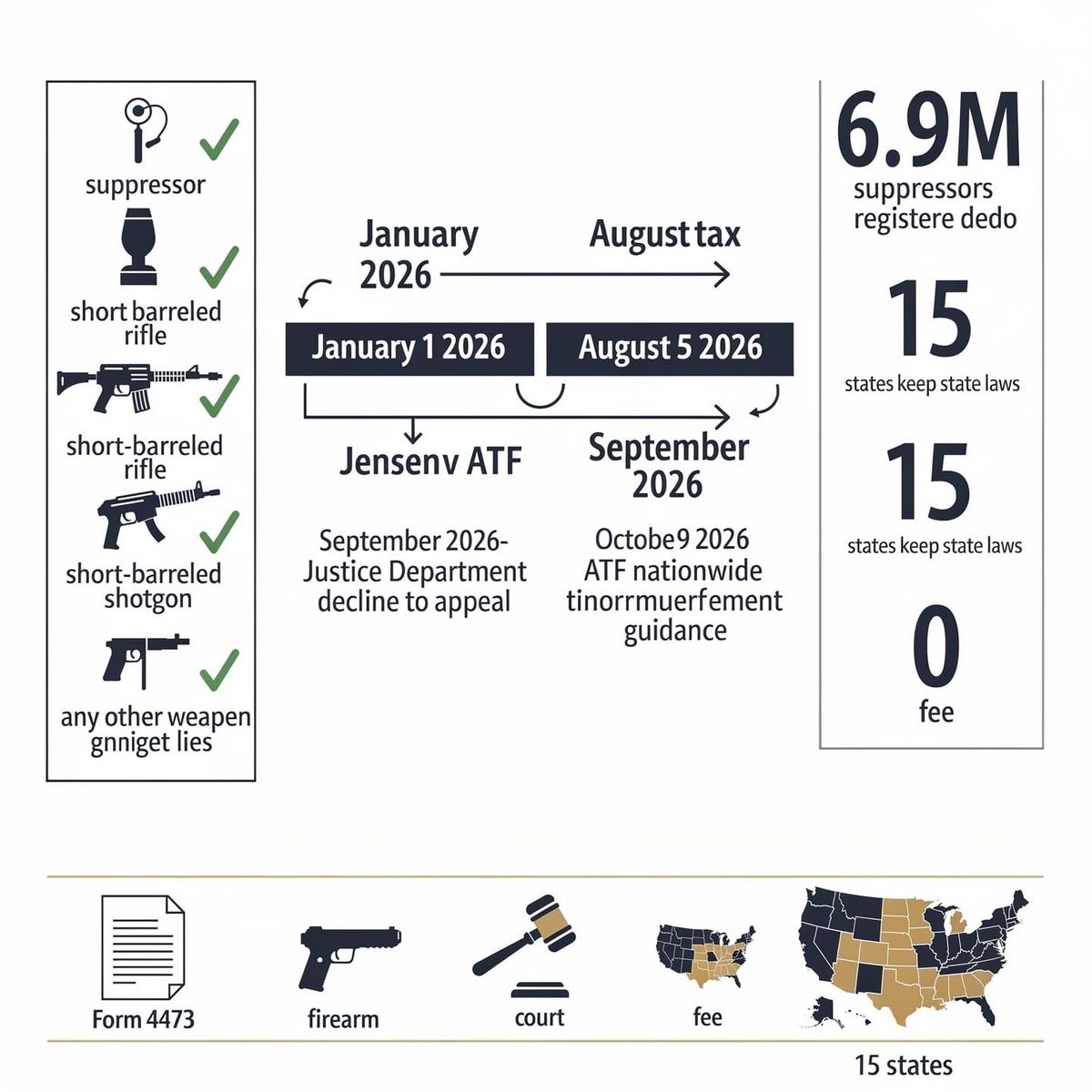
Effective October 9, 2026, the Bureau of Alcohol, Tobacco, Firearms and Explosives (ATF) issued guidance ending federal registration and approval requirements for silencers, short-barreled rifles, short-barreled shotguns, and "any other weapon" devices once covered under the National Firearms Act (NFA). Director Robert Cekada announced the change through an open letter and FAQs, and the Justice Department said it will not appeal the underlying ruling.
The practical effect: buyers transferring these items no longer need to file individual NFA registration forms, pay the associated fee, or submit to prior approval. Transfers can proceed through the standard Form 4473 background-check process used for ordinary firearms. ATF has directed its field inspectors that such transfers are not violations under the new interpretation.
The ruling behind the change
The policy shift stems from a Northern District of Texas ruling in the case known as Jensen v. ATF (Silencer Shop Foundation v. United States). Judge James Wesley Hendrix found on August 5, 2026 that the ATF had been applying four NFA categories—suppressors, short-barreled rifles, short-barreled shotguns, and "any other weapon"—as a tax and registration scheme whose taxing foundation had been eliminated. The NFA's authority rested on a $200 tax and registration regime; the court concluded that with the tax on these items set to zero, the agency lacked a fiscal basis for regulating them.
That zero came from the One Big Beautiful Bill Act (Pub. L. 119-21, 2025), signed in mid-2025, which reduced the tax on suppressors, short-barreled rifles, and short-barreled shotguns to zero effective January 1, 2026. Hendrix's August 5 injunction applied to those affected categories in the Northern District of Texas. The Justice Department declined to appeal within its September window, and ATF extended the interpretation nationwide through the October 9 enforcement-discretion guidance.
What the guidance does not do is repeal the statute or bind Congress. The change applies through ATF enforcement discretion, the underlying law remains on the books, and state law still governs possession and transportation. Machine guns and destructive devices stay under the NFA, and Special Occupational Taxes on dealers are unchanged.
What this changes for the market
The near-term signal is measurable: more than 6.9 million suppressors were registered as of early September, and the guidance removed the prior approval wait that had applied to transfers. Silencer shops and advocacy groups report expanded sales volume, and some dealers describe selling out of suppressor inventory following the announcement.
But the scope of relief is contested. Fifteen states—Alaska, Colorado, Connecticut, Georgia, Michigan, Mississippi, Montana, Nevada, North Carolina, North Dakota, Ohio, Oregon, Pennsylvania, Washington, and Wisconsin—still enforce their own NFA-style registration requirements for these untaxed arms, and some still mandate Form 1 or Form 4 filings. ATF said it accepts those voluntary submissions to allow commerce to continue in states with their own requirements. The federal injunction does not bind those state laws, so whether the federal change compels the states to fall in line, or leaves a patchwork of state-level requirements, is unresolved.
What isn't settled
Two open questions loom. First, a future attorney general could revive enforcement; Cekada has acknowledged that possibility while characterizing further litigation as unlikely. Second, the change could be reversed if Congress imposes a new tax on these items or a higher court overturns the ruling, leaving the new interpretation an executive policy rather than a statutory certainty. Related challenges—including Brown v. ATF and Roberts v. ATF—remain pending, and the Firearms Policy Coalition has proposed legislative repeal of state laws that tie ownership to federal registration.
The main consequences are concrete: reduced administrative burden for buyers and dealers, a shorter purchase process, and removal of a fee that had funded the registration system. Existing recordholders may keep devices they lawfully possessed before the ruling. The decisive unknown, for now, is whether state requirements, a new congressional tax, or future judicial action reimposes registration before the change settles into routine practice.



Comments ()