AnyPwn: unauth root on AnyDesk Linux 8.0.2
AnyDesk Linux 8.0.2 has a memory-corruption flaw letting unauthenticated attackers get root via TCP port 7070, bypassing login and session controls. AnyDesk 8.0.3 is the fix; no exploitation in the wild has been reported at disclosure.
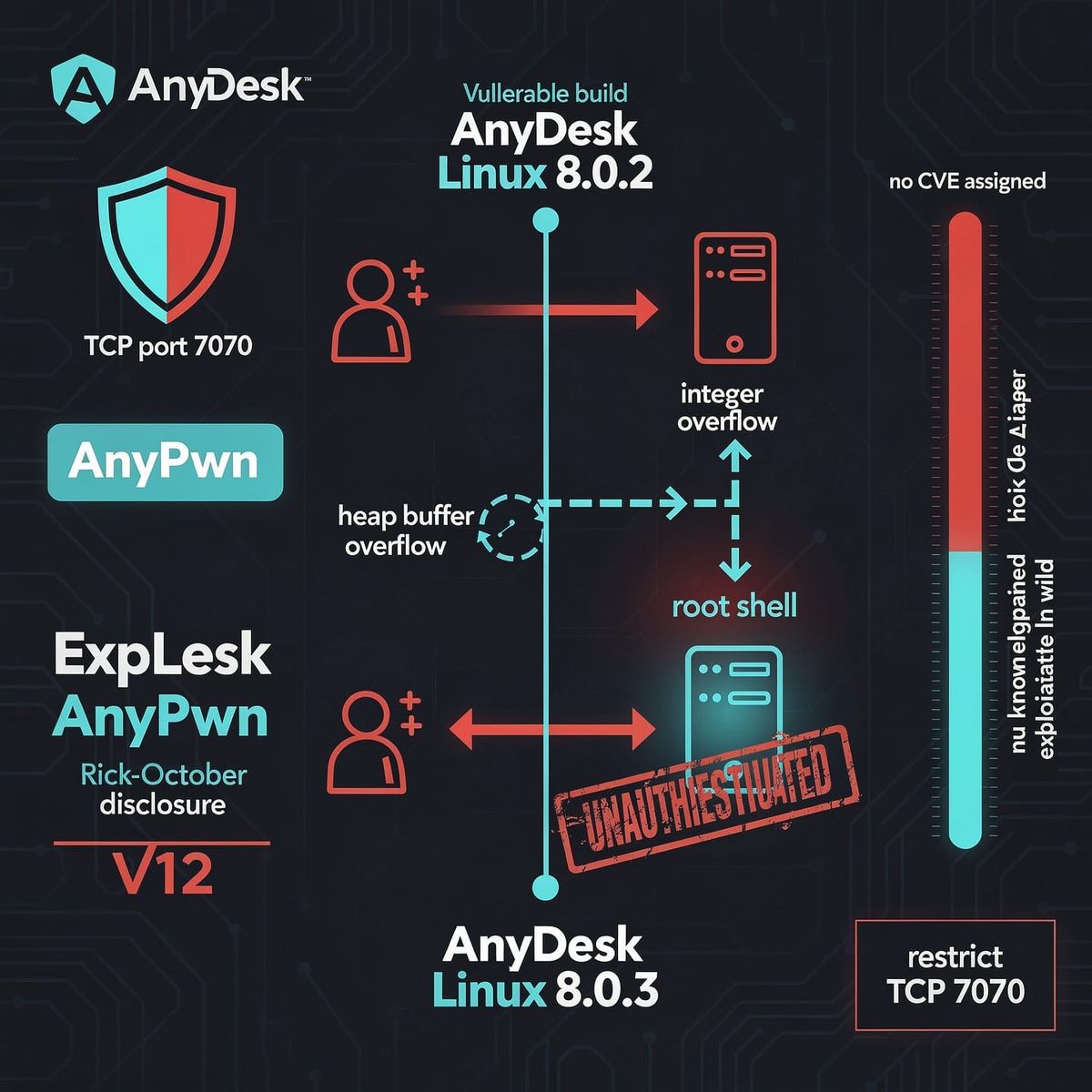
Unauthenticated remote attackers can gain full root control over AnyDesk Linux 8.0.2 by sending crafted traffic directly to TCP port 7070, bypassing login and session controls. The exploit—dubbed AnyPwn—was researched by Rick de Jager of the V12 security team, with public disclosure landing in mid-October. No CVE has been assigned as of that date.
The root cause is a memory-corruption bug in the session protocol, not a race in the handshake. The mode-5 stream packet path fails to properly handle length values during processing, triggering an integer overflow that leads to a heap buffer overflow. An attacker who can reach port 7070 can drive that overflow to achieve arbitrary command execution as root, without ever presenting credentials. A direct TCP connection is the whole attack surface: no session, password, or authenticated "DESK" permission is required.
What the memory bug actually does
AnyDesk's session protocol processes mode-5 streaming packets for live desktop traffic. The flaw sits in how that handler interprets a length field: the arithmetic overflows, and the result is an out-of-bounds write into the heap. The malformed packet then redirects execution toward attacker-controlled code. That yields a root shell because the vulnerable handler runs with the privilege of the AnyDesk process.
That also shapes the fix timeline. AnyDesk 8.0.3—the patched release—ships as the fix for the vulnerability, with the affected build being 8.0.2. Windows and macOS versions are unaffected; the exposure is specific to the Linux build. The patch's existence predates the October disclosure and does not by itself establish that 8.0.2's exposure was known or fixed in response to external reporting.
What was exposed and what changed
The affected build is specifically AnyDesk Linux 8.0.2. The vulnerability needs no user interaction on the host—no prompt acceptance, no shared password, no prior session. Any Linux machine running 8.0.2 with port 7070 reachable over the network is a candidate target. The heap overflow lands as full server takeover under the mode settings that route that streaming path, per the reported impact.
The relevant context: AnyDesk is a widely deployed remote-desktop tool, and its Linux client is used on servers and workstations precisely because administrators want unattended, low-friction access. A flaw that removes the authentication requirement undermines that core trust model. The fixed 8.0.3 release sits downstream of the affected build, so a fleet still on 8.0.2 has no intermediate step that blocks the path.
There is no report of exploitation in the wild at the time of disclosure. That is the decisive unknown: whether anyone exercised the heap overflow before the fixed 8.0.3 shipped, or in the gap before the exploit went public.
The open question
Because 8.0.3 patches the vulnerability, a user running a patched build was covered before the exploit went public. The remaining exposure is a fleet that never moved off 8.0.2. And because the flaw is a memory-corruption bug in a streaming parser rather than a logic error in a permission check, the failure is in how untrusted inbound data is validated at a trust boundary—an integer overflow in a length calculation opening a heap write that shouldn't exist.
The structural picture is straightforward: AnyDesk placed a parsing trust boundary in a code path that runs on unauthenticated inbound traffic, and the length-validation gap turned protocol input into arbitrary command execution. The temporary mitigation reported alongside the fix is restricting access to TCP port 7070. Until exploitation status is known, the safe read is that any Linux fleet still on 8.0.2 is exposed to a severe, easy-to-reach compromise with little standing between the network and a root shell.



Comments ()