Six-Flavor 3D PDF Flaw Made Adobe Reader an RCE Vector
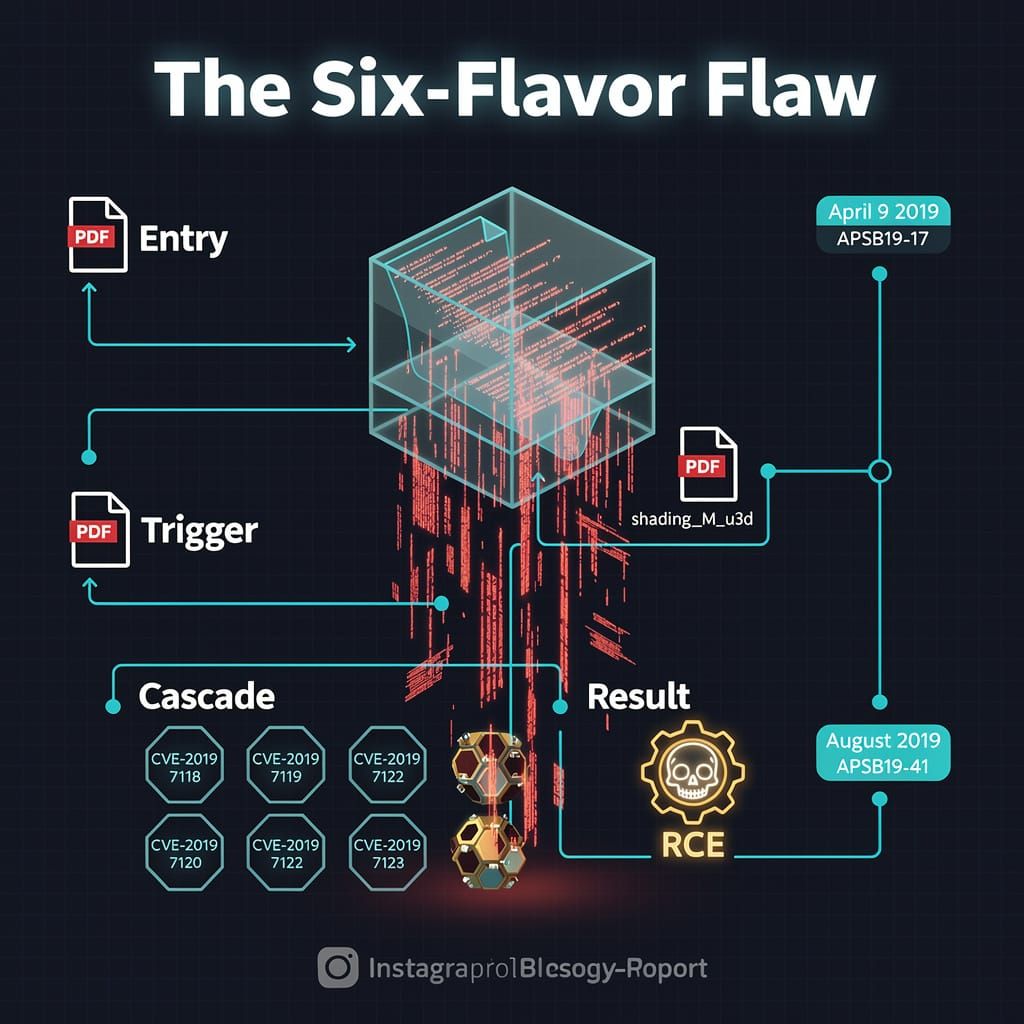
Six CVEs. One codebase. The same root cause. In April 2019, Adobe patched 6 flaws (CVE-2019-7118–7123) clustered in Acrobat Reader's 2d.x3d module—the component rendering 3D content in PDFs 📄🔓 The trigger: an external texture image (shading_M.u3d) loaded inside a crafted 3D PDF. Out-of-bounds reads and writes in TIF, TGA, and TRGB parsing helpers gave attackers multiple RCE paths. Worse: the payload runs inside Adobe's own sandbox as the logged-on user—no escape required. Who's at risk? CAD shops—engineering, architecture, manufacturing—where 3D-enabled PDFs ship daily with that feature quietly left on. The fix closed this cluster (plus APSB19-41's follow-ups), but the design pressure lingers: any feature pulling untrusted TIFF/PNG/TGA into a parser invites the same bug. A malicious PDF is still a viable system-compromise vector in 2026. Is your Reader deployment on the patched builds?
On April 9, 2019, Adobe shipped a quiet patch. It was labeled APSB19-17, and buried inside was an unusually dense batch of vulnerabilities—six distinct CVE entries, all pointing at the same attack surface and the same root cause.
In the years since, that cluster has become a case study in how a niche feature can quietly transform a trusted document reader into a remote-code-execution vector.
One Codebase, Six Ways In
The six flaws—CVE-2019-7118 through CVE-2019-7123—all live in Acrobat Reader DC's 2d.x3d module, the component that renders 3D content embedded in PDF files. The affected build was Reader DC 2019.010.20064. Adobe disclosed CVE-2019-7118 as early as January 25, 2019, and shipped the fix on April 9.
What makes this notable isn't the severity of any single bug. It's the concentration. The cluster spans both read and write corruption—out-of-bounds reads in the TIF and TGA parsing helpers, and an out-of-bounds write in TRGB::Read() that Adobe confirmed as an "arbitrary write in the sandboxed process." Together, they mean an attacker controlling a 3D PDF's external image payload had multiple independent paths to corrupt memory.
How the Attack Unfolds
The attack chain follows a predictable sequence:
- Entry: A user opens a 3D-enabled PDF, common in CAD-design workflows where files shuttle between engineers, suppliers, and contractors.
- Trigger: The 2d.x3d module loads an external texture image referenced inside the file. Published research on sibling flaws in this module confirms the named payload—
shading_M.u3d, a texture metadata file whose invalid entries drive the parsing bug. - Cascade: Processing that image runs the code at fault. In CVE-2019-7120 and CVE-2019-7121,
TIF::Read()performs an out-of-bounds read. In CVE-2019-7122,TTIFFread::TifReadChunkyRGB()does the same. CVE-2019-7123 hitsTRGB::expandrow(), while CVE-2019-7118 and CVE-2019-7119 deliver out-of-bounds writes. - Result: Memory corruption that researchers tied to remote code execution—a threat model Adobe itself acknowledged when it scored the cluster at critical impact. The payload executes inside the product's own sandbox as the logged-on user, meaning no sandbox escape is required for the initial compromise.
The cleanest explanation for the concentration of flaws is a shared oversight: improper bounds checking when the module parses texture resource declaration block sizes. The same root cause surfaced in a parallel disclosure in Foxit Reader's U3D plug-in, where CVE-2019-6982 used a malformed CLOD Mesh Declaration Block to trigger a heap overflow via a 1-byte mutation.
Why CAD Shops Were in the Crosshairs
Adobe scored the whole cluster at high impact, and the sector mapping makes sense. Industries that exchange 3D PDFs—mechanical engineering, architecture, manufacturing, product design—were the realistic targets. These shops ship heavy CAD-derived PDFs with 3D content display active during ordinary work, which is why the same surface surfaced again months later.
The August 2019 follow-up illustrated exactly that. Adobe disclosed and patched CVE-2019-8010 and CVE-2019-8011 (advisory APSB19-41) in build 2019.010.20099—again out-of-bounds reads in the 3D PDF module, again triggered by crafted shading_M.u3d metadata and TGA/TIFF image payloads. The same advisory also closed CVE-2019-8038 and CVE-2019-8039, a pair of use-after-free bugs in form-field handling that ZDI reported in June 2019, both capable of executing code inside the PDF sandbox. The pattern held: a feature that loads external, untrusted image formats into a parsing engine kept generating the same class of bug.
The Pattern Worth Watching
APSB19-17 and APSB19-41 closed these specific holes, but the underlying design pressure remains. Each time a feature loads external, potentially untrusted image formats—TIFF, PNG, TGA—into a parsing engine, the same class of bug can reappear. And document-reader RCE is not a closed chapter: in 2026, Foxit PDF Reader's CVE-2024-30326 reminded defenders that a single malicious PDF still represents a viable system-compromise vector.
Monitor your Adobe Reader deployments for the patched builds, and audit any environment that consumes 3D PDFs against this cluster. For defenders, the lesson is that an out-of-bounds read in a rendering helper can be as dangerous as a memory-corruption bug in the core parser—especially when the offending code lives behind a feature users didn't realize was on.



Comments ()