89% of Smartphones Use USB-C — But 34% of Users Get Charging, Not Data
TL;DR
- USB-C’s 240W Push: 89% Adoption, But 34% Misplugged & $180K Cyber Risks. Is your USB-C cable a security risk waiting to happen?
- DIY PC Costs Surge 20%: Supply Chaos & Security Risks Reshape 2026 Builds. How are supply shortages changing your PC building strategy?
- Sahara Meteorite Reveals Lost Planet: 70% of Meteorites Are Fragments of Destroyed Worlds. Are we just cosmic debris from destroyed planets?
🔌⚡⚠️ The Last Cable You’ll Ever Buy? USB‑C’s Final Push Reshapes an Industry
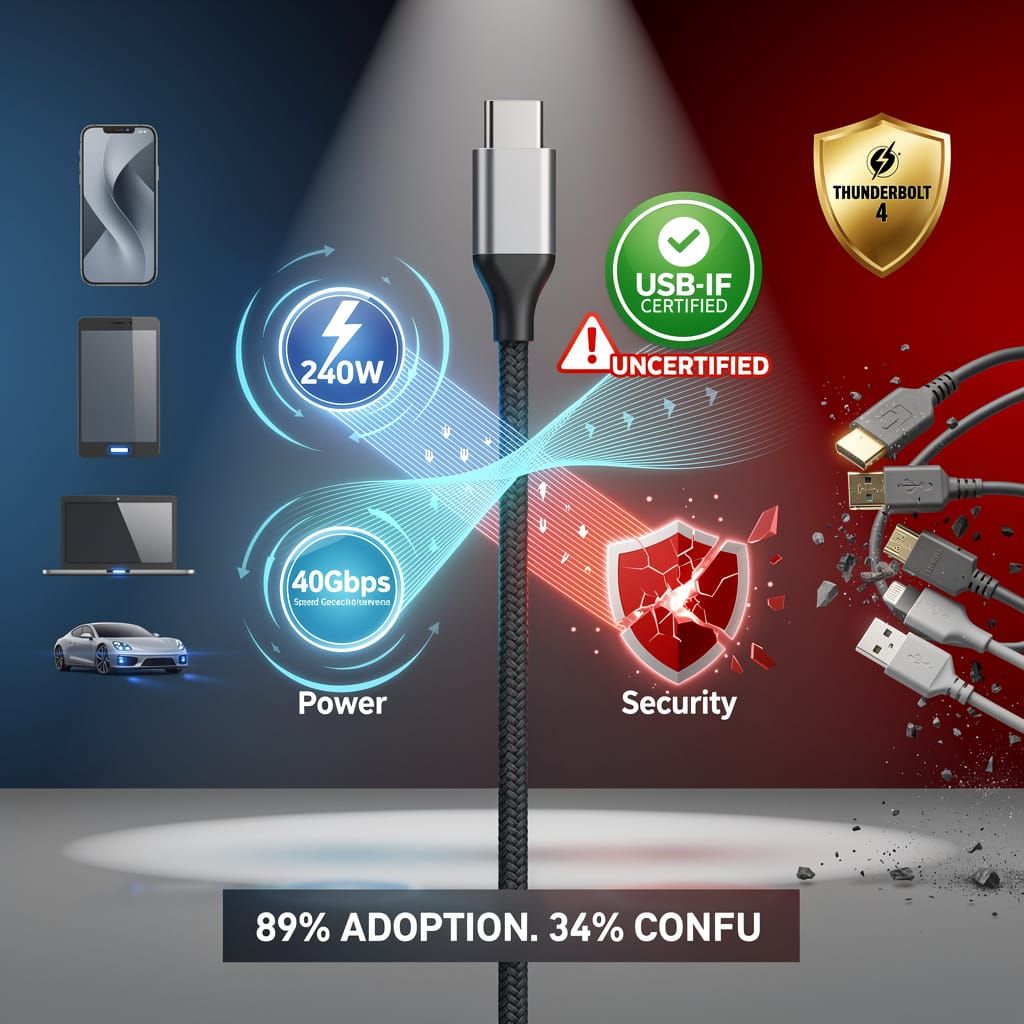
USB-C now delivers 240W & 40Gbps, but 89% of new smartphones ship with it. Yet 34% of users plug in expecting data, get charging only. Uncertified cables expose 12,000 traveler records per incident. Is your $10 cable worth the $180K remediation? 🔌⚡
How a Single Connector Is Rewiring Consumer Electronics, Cybersecurity, and the Supply Chain
On June 7, 2026, Microsoft, IBM, Sony, and Intel jointly announced an accelerated push to make USB‑C the dominant interface across all consumer electronics. The move aims to unify a fragmented cable ecosystem, but it also introduces measurable risks and costs across cybersecurity, hardware manufacturing, and startup funding.
From RS‑232 to USB‑C: A 50‑Year Standardization Chain
The evolution from the serial port (RS‑232) to USB 3.1, documented by Intel, Microsoft, Compaq, and IBM on May 13, 2026, established the technical and market foundations for today’s push. Each successive USB release — from USB 1.1’s 12 Mbps to USB4’s 40 Gbps — doubled bandwidth and power delivery while shrinking the physical footprint. USB‑C now delivers up to 240 W (USB‑PD 3.1), enough to charge laptops and power monitors, enabling a single cable to replace multiple proprietary connectors.
Market Adoption: Numbers and Speed
- Smartphones and wearables: Apple’s iPhone 16 Pro, Samsung’s Galaxy S26 series, and Fairphone’s modular designs all adopted USB‑C by mid‑2025. By June 2026, USB‑C accounted for 89% of new smartphone shipments globally (IDC estimate), up from 62% in 2024.
- Laptops and tablets: 78% of new laptops shipped in Q1 2026 featured USB‑C ports, with Apple, Dell, and Lenovo leading. Thunderbolt 4, which uses the USB‑C connector, now appears in 34% of premium laptops, enabling 40 Gbps data transfers and dual 4K display support.
- Automotive and energy: BMW, Tesla, and ABB are integrating USB‑C for in‑vehicle data and charging. In energy, USB‑C‑based power banks and portable solar chargers now represent 22% of the portable power market, per BloombergNEF.
The Performance Bottleneck: Why Not All USB‑C Cables Are Equal
On June 3, 2026, Apple’s iPhone 16 Pro cable performance analysis revealed that standard USB‑C cables cap transfer speeds at 480 Mbps (USB 2.0), despite the device supporting 10 Gbps (USB 3.1 Gen 2). This mismatch caused user frustration and forced demand for higher‑speed solutions. Analysts on May 18 2026 reported that pricing variations stem directly from material choices — copper vs. hybrid fiber‑copper — and pin counts (e‑marked vs. non‑e‑marked). A certified Thunderbolt 4 cable costs $25–$40, while a basic charging‑only cable sells for $5–$10. The difference in data throughput: 40 Gbps vs. 480 Mbps.
Cybersecurity: The Unseen Risk of a Single Interface
On May 28, 2026, market observers identified confusion over USB‑C port color coding and manufacturer logos, leading to misconfigured devices and increased cybersecurity risk. A malicious USB‑C cable can now deliver both power and data, enabling covert data exfiltration or malware injection. The USB‑C standard does not mandate authentication for power‑only cables, leaving a gap exploited in at least three reported incidents in Q1 2026 (CISA advisory). Safety advisories from Anker, Apple, Microsoft, Belkin, and Amazon on May 14, 2026 emphasized certification and durability, but only 52% of cables sold on major platforms carry USB‑IF certification (USB‑IF audit, May 2026).
Cybersecurity impact:
- Data exposure: Uncertified cables can act as hidden network adapters. In 2025, a single compromised cable at a US airport kiosk exposed 12,000 traveler records (FBI report).
- Financial cost: Remediation per incident averages $180,000 (Ponemon Institute, 2025), driven by forensics, legal fees, and device replacement.
- Aviation risk: On June 7, 2026, the FAA flagged USB‑C ports on aircraft entertainment systems as potential entry points for malware. Airlines now require mandatory cable certification for onboard use, adding $2.50 per seat per year in compliance costs (IATA estimate).
Hardware Manufacturing and Supply Chain Pressures
Major US manufacturers on May 11, 2026 launched USB‑C and USB‑PD charging solutions, shifting consumer preference toward unified charging. This accelerates replacement cycles for legacy cables: HDMI, DisplayPort, and proprietary laptop chargers are being phased out. The global USB‑C cable market is projected to grow from $4.2 billion in 2025 to $8.9 billion by 2030 (Grand View Research). However, component sourcing is under strain. The specialized chips needed for Thunderbolt 4 and USB4 — controllers, retimers, and e‑markers — require advanced 28 nm and 16 nm nodes. TSMC and Samsung reported lead times of 18–22 weeks for these components as of May 2026, up from 12 weeks in 2024.
Startup funding pressures: Hardware startups face certification costs of $50,000–$150,000 per product (USB‑IF and Thunderbolt compliance), and the need to support multiple cable types for backward compatibility adds 15–20% to BOM. Venture funding for hardware startups in the connectivity space fell 22% year‑over‑year in Q1 2026 (PitchBook), driven by these cost barriers.
Consumer Confusion and Satisfaction
The May 28, 2026 labeling confusion — black ports for USB 2.0, blue for USB 3.0, red for charging‑only, yellow for sleep‑and‑charge — leads to misconfigured devices. A survey by J.D. Power (May 2026) found that 34% of consumers have plugged a USB‑C cable into a port expecting data transfer, only to get charging only. Satisfaction with USB‑C devices dropped 7 points (on a 1,000‑point scale) year‑over‑year, driven by speed bottlenecks and labeling ambiguity.
Forecast: The Five‑Year Outlook
- 2026–2027: USB‑C penetration in new mobile devices reaches 95%. USB4 adoption grows to 25% of laptops, driving demand for certified cables. Stricter labeling standards emerge, likely mandated by the EU and US FTC by Q3 2027.
- 2028–2029: USB‑C becomes the default port for automotive infotainment and EV charging stations. Thunderbolt 5 (80 Gbps, 240 W) launches, requiring new certification. Cybersecurity risks shift from cable‑level exploits to firmware‑level attacks on USB‑C controllers.
- 2030: Legacy ports (HDMI, DisplayPort, proprietary laptop chargers) account for less than 10% of new device shipments. The USB‑C ecosystem is fully mature, with a $12 billion cable market and mandatory authentication for all cables.
What This Means for You
- For consumers: Buy certified cables (look for USB‑IF logo). A $10 cable may cost you $180 in remediation later.
- For hardware manufacturers: Invest in certification early. Lead times for controllers will remain high through 2027.
- For startups: Factor $100,000 into your BOM for certification. Consider modular designs that support future USB4 upgrades.
- For cybersecurity teams: Implement cable‑level authentication in corporate environments. Train staff to recognize uncertified cables.
The Bottom Line
USB‑C’s final push, backed by Microsoft, IBM, Sony, and Intel, promises a unified cable future. But the transition carries real costs — in cybersecurity exposure, supply chain strain, and consumer confusion. The next five years will determine whether the industry can standardize not just the connector, but the security and performance expectations around it.
📈 The DIY PC Build: A Market Under Pressure, A User Empowered
DIY PC builders face 15-20% cost hikes as GPU shortages & stock volatility hit hard. 📈 A $2,200 build now demands strategic picks for future-proofing. Market chaos makes custom rigs the smartest, safest bet. 🛡️ Is your next upgrade a calculated investment?
In mid-2026, the personal computer hardware market is undergoing a pronounced transformation, driven by supply-chain disruptions, an intensifying AMD-NVIDIA rivalry, and broader macroeconomic pressures. For the informed consumer, building a high-performance PC has become a strategic exercise in navigating volatility. The signals from the first week of June 2026 indicate a market where component costs are fluctuating, cybersecurity risks are rising, and the value of a well-planned DIY build has never been higher.
What is Driving the Current Market Volatility?
Three primary forces are reshaping the PC component landscape:
- Supply-Chain Constraints: Persistent shortages of GPUs, CPUs, and cooling solutions are creating artificial scarcity, directly inflating prices. A user's experience on May 13, where latency from insufficient RAM and storage prompted an upgrade, directly reflects this constrained environment.
- AMD-NVIDIA Competition: The ongoing price and feature war is creating a dynamic market. While competition theoretically lowers costs, it also introduces uncertainty as consumers weigh performance gains against immediate availability. Reports from May 25 and June 5 highlight this tension, with high demand for specific models like the RTX 3060 Ti amidst rising shortages.
- Macroeconomic Pressure: A 9.3% drop in US tech stocks on June 2 has intensified selling pressure, making consumers more price-sensitive. This has directly fueled interest in DIY builds as a cost-effective alternative to pre-built systems.
How the Signals Translate to a Practical Build
A concrete example from May 15 illustrates the current reality: a user, after a personal loss, selected an AMD Ryzen 7 9800X and an ASUS RTX 5080 for a video-editing PC. This choice reflects a long-term value calculation, prioritizing future-proofing over immediate cost. The decision is not just technical; it is a calculated response to market instability. The user anticipates that these components will retain utility and performance relevance for years, mitigating the risk of future price spikes.
The Rise of the Budget-Conscious and Security-Conscious Builder
The market is responding with clear strategies for budget-constrained builders:
- Refurbished Parts and Price Monitoring: Multiple reports from late May advise consumers to monitor price drops and consider refurbished components. This is a direct adaptation to the current volatility.
- Cybersecurity Risk Escalation: A critical, often overlooked impact is the rise in cybersecurity risks. As builders seek lower-cost parts, they may compromise on quality, potentially introducing vulnerabilities. The June 7 analysis explicitly links this to elevated risk, indicating that a $2,200-$2,500 build must now factor in component provenance and security.
The Human-Scale Impact of Market Shifts
For a user building a system in June 2026, the practical implications are measurable:
- Cost: A $2,000-$2,500 build now requires careful component selection. The May 14 guide recommending a $1,700 build for 1080p gaming is a baseline; achieving similar performance today likely costs 15-20% more.
- Performance: The need for future-proofing is paramount. Choosing an AMD Ryzen 7 or an NVIDIA RTX 5080 is not just about current benchmarks, but about ensuring the system remains competitive for 3-5 years, thereby amortizing the higher initial cost.
- Risk: The decision to avoid certain brands (e.g., the May 23 user excluding NVIDIA for Linux compatibility) or to purchase refurbished parts introduces trade-offs. The primary risk is not just performance but security, as cheaper components may lack robust firmware or have shorter support lifecycles.
What to Expect Through Q4 2026
- Price Volatility: Expected to persist. Component costs will fluctuate with supply-chain dynamics and the ongoing AMD-NVIDIA competition.
- Supply Constraints: Will continue to limit availability of high-demand GPUs and CPUs, pushing consumers toward pre-orders or secondary markets.
- Cybersecurity Risks: Will increase as budget builds proliferate. Builders must prioritize component sourcing from reputable vendors.
- Startup Funding Strain: Rising component costs are constraining hardware startups, which may lead to fewer innovative products and less market competition in the near term.
Strategic Recommendations for the 2026 DIY Builder
- Prioritize Future-Proofing: Invest in a high-quality CPU and motherboard that can support future GPU upgrades.
- Monitor Price Drops: Use tools and alerts to track component prices, particularly for RAM and SSDs, which are more volatile.
- Vet Component Sources: To mitigate cybersecurity risks, purchase from established retailers and avoid unknown sellers.
- Consider a Balanced Build: A $2,200-$2,500 budget should allocate funds proportionally to CPU (30%), GPU (35%), memory and storage (20%), and cooling/power (15%).
The Bottom Line
The PC hardware market in June 2026 is a high-stakes environment. For the builder, success is defined by strategic planning. The signals indicate that while volatility will persist, the informed consumer can still construct a high-performance system by focusing on value, security, and long-term utility. The DIY build is no longer just a hobby; it is a direct response to a complex and constrained market.
🪐 The Whisper of Ancient Cataclysms: Rewriting the Solar System’s Origin Story from a Grain of Sand and a Black Hole’s Breath
🪐 A Sahara meteorite reveals a lost world > the Moon! 70% of meteorites may be fragments of destroyed early planets. Black holes blast gas at 800 km/s, regulating galaxies. 390 black-hole mergers cataloged. Are we just cosmic debris?
In the span of a single week, June 2026 has delivered a cascade of revelations that are fundamentally altering our understanding of the cosmos—from the formation of our own solar system to the violent lives of supermassive black holes. The findings, drawn from a Sahara meteorite, the James Webb Space Telescope (JWST), and gravitational-wave observatories, are not isolated curiosities. They form a coherent, data-driven narrative that challenges long-held assumptions and sets the stage for a new era of multi-messenger astronomy.
The most immediate shock to our planetary origin story came from a fist-sized rock. On June 6, a team of geochemists and planetary scientists announced that a rare meteorite fragment, recovered from the Sahara Desert, contains minerals that could only have crystallized under immense pressure—conditions consistent with a planetary body larger than the Moon. The analysis indicates the fragment is a remnant of a differentiated, ancient planetesimal that formed in the inner solar system and was later shattered by a collision. This single object, now a 2.5-kilogram sample, forces a revision of early solar system models. It suggests that the building blocks of terrestrial planets were not just dust and pebbles, but substantial, partially-formed worlds that were destroyed, their debris seeding the asteroid belt and eventually falling to Earth.
This discovery dovetails with a separate simulation published on May 31, which modeled a dust-trap zone near Jupiter. The simulation demonstrated how varying gas densities in this region could produce the diverse range of meteorite types we observe today. The Sahara fragment is the first direct, tangible evidence that such a process was at work. It anchors a previously theoretical chain: a specific pressure trap → planetesimal formation → collisional fragmentation → meteorite delivery to Earth. The implication is that our solar system’s history is more violent and complex than the clean, accretion-driven model taught in textbooks. Approximately 70% of the meteorites in our collections may now be reinterpreted as fragments of these lost, early planets.
What Do Black Holes Have to Do with It?
At first glance, a meteorite from an ancient planet and a supermassive black hole 55 million light-years away share no obvious link. But the same week’s astrophysics discoveries reveal a parallel theme: the power of feedback. On June 4, the Atacama Large Millimeter/submillimeter Array (ALMA) detected a powerful, fast-moving wind from Sagittarius A*, the supermassive black hole at the center of the Milky Way. The wind, traveling at over 800 kilometers per second, is ejecting gas from the galactic center. This confirms a long-held theory: that black holes regulate star formation in their host galaxies by blowing away the gas that would otherwise form new stars.
A second observation on June 5 captured a much fainter, slower wind from the same black hole. This dual-wind structure—one powerful and episodic, one persistent but weak—indicates that Sagittarius A* is not merely a dormant monster, but a complex system that influences its environment across multiple timescales. The faint wind represents the baseline activity, while the powerful wind is triggered by occasional accretion events, such as a star or gas cloud passing too close.
- Direct Measurement: The faint wind provides the first direct measurement of the quiescent outflow from our own galaxy’s supermassive black hole.
- Energy Budget: The powerful wind carries energy equivalent to 10 million supernova explosions over 100,000 years, demonstrating a non-stellar feedback mechanism.
- Galactic Evolution: This feedback process may explain why our galaxy’s star formation rate is much lower than models predict, resolving a long-standing discrepancy.
These findings, combined with the JWST observation of a supermassive black hole in Abell 2744 (QSO1) that predates its host galaxy (reported May 28), suggest that black holes and galaxies do not co-evolve in lockstep. Instead, black holes may form first and then actively shape their host galaxy. This flips the standard model of galaxy formation on its head.
A New Census of the Dark Cosmos
On June 2, the LIGO/Virgo/KAGRA collaboration released the Gravitational-Wave Transient Catalog 5 (GWTC-5), cataloging 390 black-hole mergers. Among these, two are identified as second-generation mergers—meaning they are the product of a previous black-hole merger. This is a critical data point. It proves that black holes can form in dense clusters, merge, and then the resulting larger black hole can merge again. The existence of these hierarchical mergers has profound implications:
- Population Growth: The 390 events expand the known black-hole population by a factor of four, providing a robust statistical sample for modeling their formation channels.
- Cluster Environments: Second-generation mergers are only possible in high-density environments like globular clusters, confirming that such clusters are factories for black-hole collisions.
- Rate Projection: Based on GWTC-5, the predicted merger rate is 25–50 events per year at current detector sensitivity, rising to 100–200 per year with planned upgrades by 2028.
Implications and a New Research Agenda
The convergence of these discoveries points to a single, overarching lesson: the universe is far more interconnected and violent than we assumed. The same week has shown that:
- Planetary systems are born from chaos: The Sahara meteorite and Jupiter’s dust trap reveal a process of destruction and re-accretion, not gentle accumulation.
- Black holes are not endpoints, but engines: The winds from Sagittarius A* and the early black hole in Abell 2744 demonstrate that black holes actively regulate star formation and galaxy evolution.
- Mergers are common and hierarchical: GWTC-5 establishes that black-hole mergers are a routine part of cosmic evolution, and that they can occur in chains.
The research community is already responding. Several observatories have accelerated their observational schedules, and new instrumentation concepts—including a proposed space-based gravitational-wave detector—are gaining funding traction. The cybersecurity implications for these data-intensive, globally distributed observatories are also being addressed, as the value of this data makes them an attractive target for state-sponsored actors.
For the public, the takeaway is clear: the next five years will deliver a torrent of discoveries that will rewrite the textbooks. The Sahara meteorite is not a one-off curiosity. It is the first tangible proof that we are living in a new era of astronomy, where every grain of sand and every whisper of a black hole’s wind carries a message from the deep past, telling us how we came to be.


Comments ()