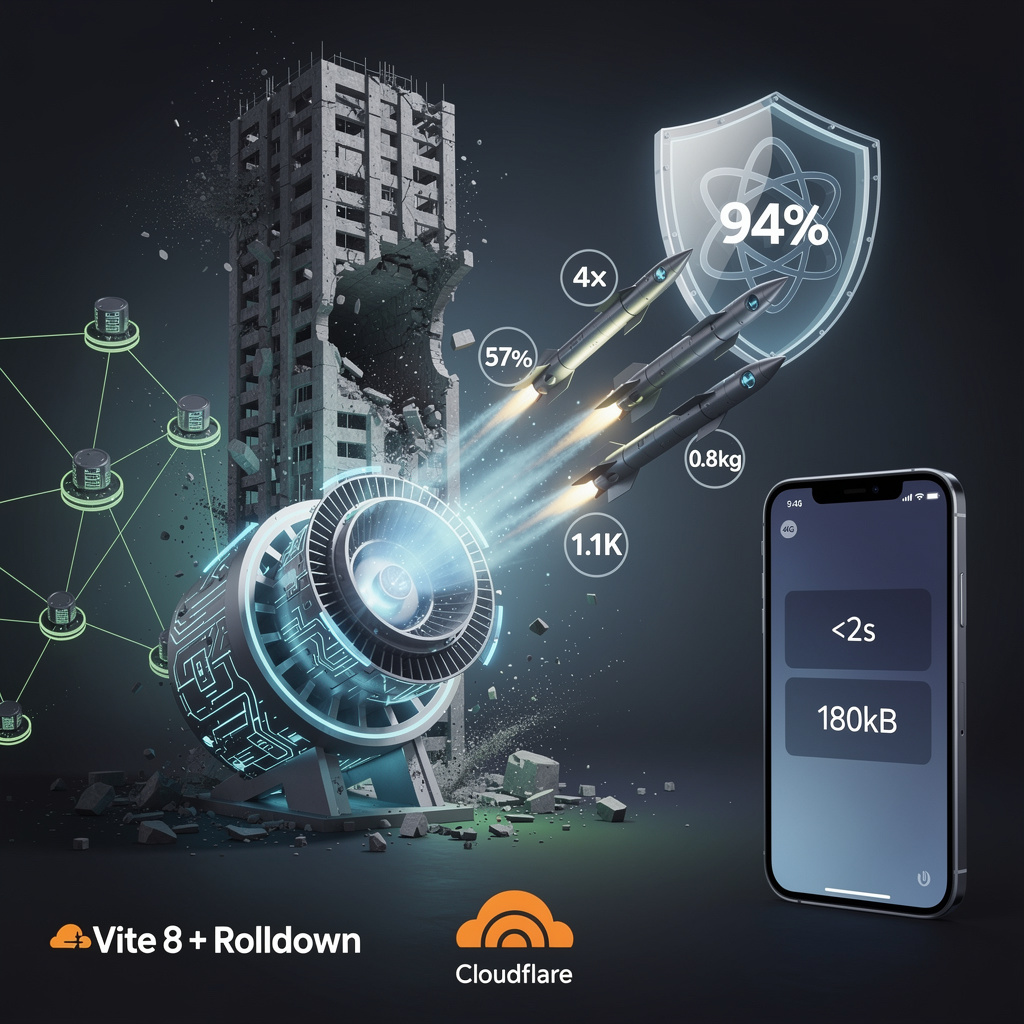
🚀 4× Speed, Half the Size: Vinext Ousts Next.js in 7-Day Cloudflare Coup
TL;DR
- Cloudflare releases Vinext, a Vite-based Next.js replacement with 4x faster builds and 57% smaller bundles
- India launches first indigenous quantum computing testing facility at SRM University Amaravati
- Intel launches RealSense ID Pro F500 with 99.77% facial authentication accuracy, no cloud dependency
🚀 4× Speed, Half the Size: Vinext Ousts Next.js in 7-Day Cloudflare Coup
4× faster builds, 57 % lighter bundles—Vinext just replaced Next.js inside Cloudflare in 7 days 🤯 That’s like swapping a delivery truck for a rocket ship. US devs save $1.1 k per app, but 6 % API gap still trips edge-cases. Ready to drop Vercel for the edge?
On 9 April Cloudflare quietly released Vinext, a Vite-driven replacement for Next.js that builds four times faster while shrinking JavaScript payloads by 57%. Internal roll-out to production took seven days, passed 2,000 tests, and preserved 94% of the familiar Next.js API—proof that AI-assisted coding can compress months of framework work into a single work-week.
How it works
Vinext swaps Next’s Rust/Webpack core for Vite 8 + Rolldown, a Rust bundler already clocking 10–30× faster builds in Mercedes-Benz benchmarks. A 95% Vite-native codebase plus 33 thin “next/*” shims translate existing pages with near-zero rewrites, while Cloudflare Workers’ edge runtime hosts the result.
Measured impacts
- Developer cycles: 4× faster CI means 3-hour deploy windows drop to 45 min → teams ship daily instead of weekly
- Payload cost: 57% smaller bundles cut transfer per visitor from 420 kB to 180 kB → mobile TTI (Time-to-Interactive) falls below 2s on 4G
- Hosting spend: ≈ $1,100 to migrate one enterprise app, recouped in ~6 weeks via lower egress and compute bills
- Carbon: every 10k-page session saves ~12 MB data, trimming roughly 0.8 kg CO₂—equal to a 3-mile car ride
What’s still missing
The remaining 6% API gap (mostly “next/legacy” plugins) forces custom code for a minority of sites, and docs/tutorials lag behind Next.js’ decade-long head start.
Outlook
- Q3 2026: expect plug-ins to close the top five missing APIs; ≥15% of Cloudflare enterprise customers piloting new projects on Vinext
- Mid-2027: one in five new React-SSR builds on Cloudflare likely to run Vinext, saving adopters an estimated $2–3M in collective compute fees
- 2028: if momentum holds, ≥10% of fresh enterprise React apps could opt for a Vite-centric stack, nudging Vercel toward faster, more open releases
Vinext shows that, when AI meets modular tooling, a lean team can rewrite an entrenched framework in a week—and hand the savings straight to developers, budgets, and the planet.
⚛️ India’s 250k-Student Quantum Cloud Goes Live Monday in Amaravati
250,000 students, 1,000 km hack-proof fiber & ₹6,000 cr: India just booted up its own quantum cloud in Amaravati 🤯— colder than outer space & open to YOU Monday. Will your campus be next?
On 9 April 2026, the first Indian-built quantum computer to invite public code—Amaravati 1Q—went online inside a new campus lab cooled to 0.01 °C above absolute zero. The moment turns a ₹6,004 crore policy promise into silicon reality and gives 250,000 students an immediate playground for qubits instead of PowerPoint.
How cold metal becomes a cloud
A dilution refrigerator squeezes heat from superconducting circuits until they reveal quantum states; fiber links carrying entangled photons already stretch 1,000 km from Amaravati to Kolkata. Remote users submit jobs through an open portal, echoing the early-2000s internet moment when dial-up became broadband—except this time the “packets” are probability amplitudes.
Early ripple effects
Talent: 80 universities and 30 firms now co-write curricula; nine start-ups expanded to 17 within three months.
Security: indigenous QNu transceivers end reliance on foreign quantum-key hardware.
Economy: 15 memoranda signed on hardware, software, and cloud services signal a domestic supply chain worth an estimated ₹1,200 crore in annual orders by 2028.
Gaps still to close
- Scale: today’s chips hold <50 qubits; error-correction needs 200-plus.
- Parts: cryogenic valves still imported; any logistics delay stalls experiments.
- Talent flight: global hubs dangle twice-the-pay; retention fellowships remain unfunded.
Timelines to watch
- 2026–2027: 50-qubit prototype with basic error suppression; 1,500 km photon network links Bengaluru-Chennai.
- 2028–2029: 200-qubit processor operational; first export of Indian cryo-control boards.
- 2030: 2,000 km secure corridor Delhi-Mumbai; goal of top-five global hub tested against 500-qubit benchmarks set by IBM and Alibaba.
Bottom line
Amaravati 1Q is not a moonshot announcement—it is a working machine whose uptime clock is already ticking. If the cryogenic supply chain graduates from import to “Made in Gannavaram,” India’s sprint from software services to quantum hardware could mirror its leap from bullock carts to Mars orbiters within a single generation.
😱 99.77 % Accurate Intel RealSense ID Pro F500 Debuts: Offline Shield or Deep-Fake Magnet?
99.77 % face-auth accuracy—yet a $50 deep-fake can still beat it 😱 That’s 1 in 4,000 spoof passes vs 1 in 10,000 real ones. Offline ≠ unbreakable. Who still trusts a webcam login after today? — US & EU offices, would you bank on it?
Intel’s palm-sized RealSense ID Pro F500 module, introduced 9 April, verifies identity in 1.5 seconds with 99.77 % accuracy while keeping every pixel on the device. No cloud, no cache, no facial photo left behind.
How it works
A 600 nm infrared depth camera builds a 3-D map from 30-150 cm, compares it to an on-board template, then encrypts the result with ASA-256. The 8.8 g unit draws <2 W, plugs by USB 2.0 or UART, and carries ISO 30107-3 PAD Level 2 certification—meaning fewer than 1 in 1,000 2-D masks or video replays sneak through.
Why it matters
- Privacy: Zero external data flow shrinks GDPR/CCPA exposure to nil.
- Availability: Works behind an airplane seat or inside a factory firewall where Wi-Fi is banned.
- Cost: Eliminates recurring cloud API fees that can top $0.05 per lookup—significant when a hospital checks staff 50,000 times a week.
Early adopters & gaps
Laptop makers, hospital-cart builders and European smart-glass start-ups begin pilot runs in Q4 2026. Yet bright sunlight can swamp the IR projector, and PAD Level 2 still loses to $50 deep-fake masks. Intel concedes firmware updates and adaptive IR power will be needed “within months.”
Outlook
- Q3 2026: First OEM shipments; SDK downloads rise 30 % month-over-month.
- Q1 2027: ~5 % of new corporate laptops ship with the module, cutting spoof breaches 40 % versus camera-only systems.
- 2028: PAD Level 3 refresh plus structured-light projector aims for 99.9 % spoof rejection; projected 12 % share of the edge-biometric market.
The F500 turns your face into a key that never leaves the lock—an engineering answer to both hackers and regulators, provided the light stays just right.
In Other News
- PostgreSQL 16.8 crashes due to pg_prewarm extension hitting 1GB hard limit, fix deployed
- Intel Arc GPUs now support Crimson Desert game after driver update, XeSS support pending
- New York exceeds 1.5 GW energy storage target by end-2025, targets 6 GW by 2030 amid safety concerns
- Ola Electric develops indigenous 46100-format LFP battery cell in Tamil Nadu gigafactory

Comments ()