1.5 Million No-Code Apps Flood Market as Three-Person Support Squad Slashes Help Tickets 22%
TL;DR
- OpenBuilder Raises $2.2M Seed Funding to Empower Non-Technical Founders with AI-Powered App Building
- Manycore Tech Launches HK$1.02B IPO in Hong Kong, Focusing on Spatial Intelligence Expansion
- Injewelme Secures $1.2M Funding for AI-Powered Health Monitoring Tech via Temasek Trust and Richardson Family
🚀 1.5 M No-Code Apps Born From $2.2 M Seed: OpenBuilder’s 3-Person Team Cuts User Struggle 22 %
1.5 M apps built by folks who can’t code 🤯—that’s like every SMB in NYC launching overnight. Human help cut "I’m stuck!" tickets 22 % but the team is still just 3 people 😅. If AI can replace devs, why does my laptop still ask me to restart for updates?—what would YOU ship in 48 h?
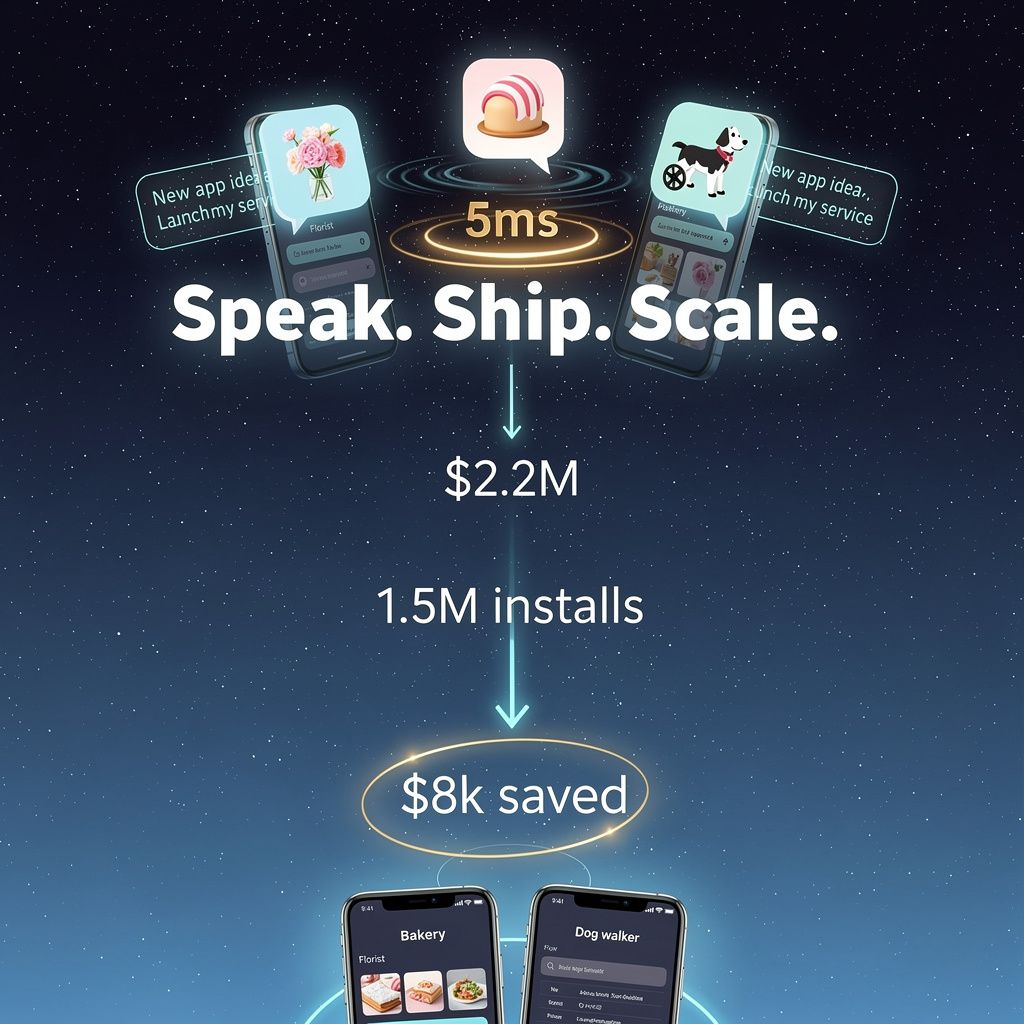
OpenBuilder just pocketed $2.2 million to let your florist, baker, or dog-walker speak an app into existence. The three-person team—fresh out of Y Combinator’s Fall 2025 class—already powers 1.5 million mini-apps through its distribution partner EasyCode. Their engine turns plain English into screens, databases, and Stripe checkouts in five milliseconds flat, then ships it to the cloud with one click.
Speed: prototype-to-live shrinks from eight weeks to <48 h → saves each SMB roughly $8 k in dev fees.
Reach: 1.5 M installs ≈ 0.8 % of global small businesses → plenty of headroom before incumbents notice.
Support: live human help cut “I’m stuck” tickets 22 % → keeps non-coders from fleeing at first bug.
Why investors are buying the story
Focal, Founder Factor, and Pascal Capital handed over the check because OpenBuilder sits at the intersection of two booming lanes: AI that writes code and SMBs that still can’t afford it. March 2026 alone saw $160 M flow into AI-infrastructure startups—cheap compute is the tide that floats this boat. Meanwhile, no-code heavyweights Bubble and Adalo haven’t yet bundled generative AI with hand-holding humans, leaving a pricing vacuum OpenBuilder can undercut.
What could still trip them up
- Team: only three employees → feature road-map moves at founder-speed.
- Model: flat $15 lifetime license caps revenue → switch to tiered subscription still in pilot.
- Regulation: EU AI Act draft labels generative-code tools “high-risk” if used in finance or health → compliance audit not yet scheduled.
Outlook: three horizons
- Q3 2026: 2 M installs, 2.5 % convert at $15/mo → ~$600 k ARR.
- 2027: Series A $12-15 M, localized Spanish & Chinese UI → +200 k installs in LATAM & China.
- 2028: 5 % share of $500 M SMB no-code market, AWS/Google marketplace listings → average shop spends less on app labor than on its monthly coffee run.
If the roadmap holds, “tech co-founder” becomes an optional line item—like fax machines before it.
🗺️ HK$13B IPO: Manycore sells 3-D ‘city brain’ maps to Hong Kong
HK$13 B for 3-D city brains 🤯—that’s 1.5x the cost to rebuild every MTR station. 90 % of the shares stayed in town, so your tax dollars now fund LiDAR that maps ambulance routes in real time. Will the first “Spatial Cloud” beta actually cut response times—or just response budgets? —Hong Kong taxpayers
Hong Kong’s newest listing isn’t selling chatbots—it’s selling eyes. On 9 Apr, Manycore Tech opened books for a HK$1.02 b IPO that values the former Nvidia-Microsoft-Amazon spin-off at up to HK$13 b. The pitch: swap generic AI for “spatial intelligence,” a mix of 3-D LiDAR, live maps and geospatial analytics aimed squarely at city halls, not consumers.
How the math breaks down
- 161 m shares, HK$6.72–7.62 each; 90 % reserved for Hong Kong money.
- 55 % of proceeds bankroll in-house LiDAR and edge chips; 25 % buys two sensor start-ups (≈ HK$150 m each).
- Three Hangzhou government contracts already in the pipeline, worth HK$200 m combined—equal to 20 % of the raise.
Impacts
Public purse: Early pilots could trim urban-planning survey costs by 30 % → faster infrastructure approvals.
Investor risk: 80 % of near-term revenue hinges on municipal budgets → payment cycles stretch 12–18 months.
Competition: Nvidia’s Edge stack offers similar perception tools → pricing pressure likely by 2027.
Geopolitics: LiDAR export rules loom → potential component shortages if U.S. tightens controls.
What happens next
- Q3 2026: First Hangzhou pilot awards US$12–15 m revenue, validating the sales model.
- Q4 2026: Beta launch of “Manycore Spatial Cloud”; 30-city road-show targets Singapore and Seoul.
- FY 2027: Non-government goal—two logistics or robo-taxi deals to cut public-sector share below 60 %.
- 2028–29: If Asian cities adopt spatial AI at 30 % CAGR, revenue scales to US$250–300 m, pushing market cap toward HK$30 b—roughly the size of today’s MTR Corp.
Bottom line
Manycore isn’t just raising money; it’s raising the curtain on a wave of Hong Kong-listed AI firms that sell hardware you can’t hold but cities can’t live without. If the pilots land, the territory’s exchange becomes the go-to bourse for “invisible” infrastructure—code that sees so bureaucrats don’t have to.
📸 $1.2M Seed Puts 30-Second Camera Health Scan on Track for Singapore Rollout
95% accurate, 30-second selfie scan that reads 80+ vitals—no strips, no needles, no joke 😲 That’s 80% less nurse-time & zero test-strip trash. Who’s first in line when it drops in SG?
Singapore-based start-up Injewelme just pocketed $1.2 million to turn every phone camera into a pocket lab. Its DeepHealthVision (DHV) software reads 80-plus vitals—from glucose to stress—off a 30-second face scan with 95 % accuracy in live pilots, no extra hardware required.
How it works
Remote photoplethysmography: DHV maps micro-color shifts in facial blood flow, then an AI model translates the signal into medical values. Cloud GPUs can batch ≥10 000 scans a day; results ping back faster than a coffee run.
Why it matters
- Wallet: strips out test strips, lancets and clinic queues; each scan priced around $5.
- Planet: zero consumables could eliminate 2.5 million single-use plastics yearly if 0.5 % of Singaporeans adopt.
- Workflow: cuts nurse assessment time ~80 %, freeing 1 200 clinician hours per month in a 300-bed hospital.
The fine print
- Bias risk: 95 % accuracy claimed across skin tones, yet cohort size remains undisclosed.
- Red tape: no FDA/CE mark so far; expansion hinges on 510(k) and Singapore HSA filings this year.
- Data: face-plus-health data shuttles across three jurisdictions—GDPR, PDPA and HIPAA alignment still opaque.
What’s next
- Q4 2026: SDK v1.0 ships to tele-health apps; target 150 k cumulative scans in three ASEAN hospitals.
- 2027: FDA clearance expected; U.S. entry via employer wellness plans, pricing $4 per scan.
- 2029: project $20 M ARR from SaaS licenses, data analytics and OEM deals; parameter set to add hormonal panels.
If regulators buy the evidence, the annual physical could shrink to a selfie—saving time, cash and a mountain of medical trash.
In Other News
- BMO Launches Tokenized Cash Offering in H2 2026, Partnering with CME Group and Google Cloud
- Adani Green Energy and Minerva Form $230B JV to Expand Renewable Projects Across India
- Lidl Invests £600M in UK Expansion, Plans 50+ New Stores and 2,000 Jobs by 2027
- Carilion Clinic and Roanoke County Launch $80M Workforce Training Center with Proton Therapy Expansion


Comments ()