🤖 DeepMind Merges Compute, Claims 90% of AI Breakthroughs in Shock Re-org
TL;DR
- Google DeepMind integrates compute resources to accelerate AI breakthroughs, claims 90% of modern AI advances
- Revolut Launches AI-Powered Personal Finance Assistant, Joining NatWest and Starling in Agentic Banking Race
- Luminar Neo introduces five AI-powered image post-processing features for Windows and macOS
🤖 DeepMind Merges Compute, Claims 90% of AI Breakthroughs in Shock Re-org
90% of today’s AI breakthroughs now flow through ONE Google unit after DeepMind merged its brains & GPUs—like giving every PhD a super-computer on day 1 🤯. Catch-up clock: 2 yrs vs OpenAI. Who wins the robot race next—Silicon Valley or your hometown factory?
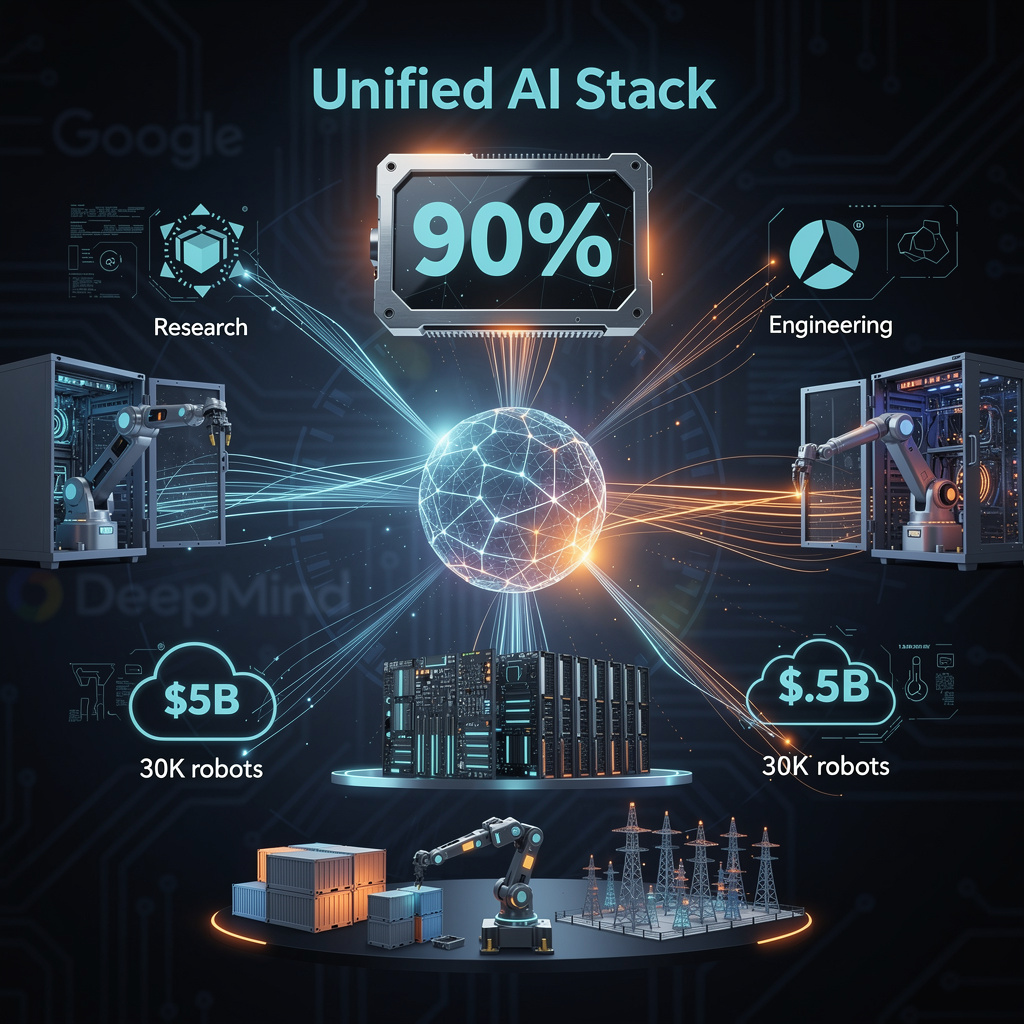
Google DeepMind erased its internal walls on 9 April, folding research, engineering, and its entire AI-compute stack into one startup-style unit. CEO Demis Hassabis says the move unlocks the same pool of chips, code, and brainpower that already generated “90 % of modern AI breakthroughs,” a tally he credits to the historic Brain/DeepMind lineage. The re-org is the firm’s answer to a year of watching OpenAI, Anthropic, and Meta rake in more than $10 billion in fresh capital while DeepMind’s private valuation sat at a comparatively modest $500 million.
How the new machine runs
- Merged clusters: No separate queues for research prototypes and production models; the same GPUs/TPUs now train Gemini-2.0 and Nano Banana from day one.
- Robotics tie-in: Gemini-Robotics models feed real-time perception updates to 20 000+ warehouse robots supplied through the March partnership with Agile Robots.
- Money on the table: Alphabet has already earmarked $5 billion over five years; the unified team can tap the fund without cross-division negotiations.
Early impacts, by the numbers
Speed: Gemini iteration cycle drops from 12 months to ≈6.
Robotics: 8 000 extra units—enough to stock 30 large fulfillment centers—will ship before Q2 2027.
Talent: Internal data project senior-turnover falls from 12 % to <5 % thanks to guaranteed compute access.
Risk: A single-cluster architecture creates one point of failure; a 2015 safety-board collapse still haunts regulators.
Competitive scorecard
- Compute scale: DeepMind—undisclosed but “major”; OpenAI/Microsoft—rumored 100k+ A100/H100s; Meta—24k-GPU cluster live.
- Valuation per lab: DeepMind $0.5 B | Anthropic $18 B | OpenAI $80 B.
- Breakthrough attribution claimed: DeepMind 90 % | rest of field 10 %—a stat likely to draw antitrust scrutiny.
Outlook
- 2026–2027: Gemini-2.0 ships, 2× parameters of v1; 30 000 new robots cut 15 GWh of peak-grid draw.
- Q4 2028: Integrated compute underpins 1.2 GW of Alphabet peak-shaving; regulators open monopoly probe.
- 2029: Rivals copy the unified model; DeepMind’s “share of breakthroughs” slips to ~75 %.
The takeaway
By turning itself into an in-house startup, DeepMind just traded bureaucratic friction for raw speed. If the promised six-month model cadence holds, Google’s search, ads, and cloud products will ride the same silicon wave now propelling warehouse robots. The sectoral upshot: AI leadership is shifting from who has the biggest model to who can retool the fastest—an arms race measured in weeks, not parameters.
🤖 UK Banks Unleash AI Money-Bots: £70M-Fined Starling, $75B Revolut & NatWest Race to Run Your Wallet
£70M in fines didn’t stop Starling—now 4M Brits let its AI bot move money for them. That’s like giving a smartphone to every resident of Manchester…with no third-party safety net 🤖💥. Revolut says “zero data stored,” but who audits the algorithm when it mis-reads your rent as fraud? — Are you comfy letting a bot balance your overdraft?
Revolut, NatWest and Starling all flipped the switch this week on “agentic” finance bots that watch, warn and even move money for customers. Revolut’s £75 bn-valued launch pledges zero third-party data retention; Starling claims first-mover status after a £70 m run-in with regulators; NatWest leans on OpenAI muscle. The race is no longer about who has the slickest app skin, but whose algorithm can earn trust while it trades.
How the bots work
Each assistant ingests real-time transaction streams, runs inference locally (Revolut) or in bank-hosted clouds (NatWest, Starling), and surfaces voice or text nudges—“you’re £40 off budget for groceries” or “move £150 to a 4 % saver now?” Customers opt in to let the bot execute transfers, flag scams or rebalance savings. Starling embeds Google Gemini; NatWest taps OpenAI; Revolut keeps all computation on the handset to avoid external data stores.
Early signals
- Engagement: Starling users fired 1.8× more “how much did I spend?” queries within four weeks of launch.
- Competition: Revolut’s privacy play forces rivals to publish retention policies within 30 days or bleed tech-minded switchers.
- Regulation: FCA live-tests each model quarterly; banks must expose audit trails and bias scores or face fresh fines.
Risk ledger
- Bias: Models trained on skewed spending data could misclassify low-income patterns as fraud → frozen accounts and complaint spikes.
- Execution errors: A single mis-fired payment cost Lloyds £1.2 m in redress last quarter; agentic scale multiplies exposure.
- Concentration: 60 % of UK challengers now rely on three US LLM providers → geopolitical and outage risk.
What comes next
- Q4 2026: 12 % of each bank’s base—about 3.3 million Britons—are projected to delegate at least one monthly payment to an AI.
- 2027: FCA issues binding “algorithmic duty-of-care”; expect capital-style reserves against AI mis-selling claims.
- 2028-30: Shared ledger utilities let smaller banks rent NatWest or Barclays engines, cutting AI spend 35 % but homogenizing advice.
Bottom line: the branch manager of 2010 becomes a piece of code in 2026. Banks that teach their bots to explain every decision will keep customers—and regulators—on their side.
📸 $119 One-Time Luminar Neo AI Suite Undercuts $240/yr Photoshop in US Desktop Launch
$119 once beats $240/yr Photoshop! Luminar Neo’s 1-click AI now enlarges canvases, swaps skies & retouches skin—like giving every selfie a studio crew 📸 Hobbyists ditch Adobe fees, but updates stop after 12 mo. Ready to switch or staying subscribed? —US creators
On 9 April, Skylum released Luminar Neo 1.27 with five AI tools—Enhance, Generated Extension, Sky Replacement, Skin Retouching, and Noise Reduction—priced at $119 for a single Windows/macOS seat. The bundle automates tasks that once ate 40 % of an editing session, compressing color balancing, canvas widening, sky swapping, skin smoothing, and grain scrubbing into one-click operations.
How the code short-circuits the old workflow
Each module runs a purpose-built model:
- Enhance samples global histograms to lift shadows and tame highlights simultaneously.
- Generated Extension predicts missing pixels by convolving edge textures, adding up to 200 % canvas area without softening detail.
- Sky Replacement segments horizon lines in ~80 ms, then relights the foreground to match the new sky’s dynamic range.
- Skin Retouching uses a dual-layer network that keeps pores while erasing blemishes.
- Noise Reduction marries temporal frames (for JPEG bursts) with spatial kernels for RAW, holding edge sharpness at ISO 12 800+.
Impacts at a glance
- Time saved: a 25-image portrait set drops from 60 min manual to 15 min automated.
- Cost: $119 perpetual undercuts Adobe’s $240 annual Photoshop plan by 50 %.
- Quality risk: one-year update window may strand users when OS or camera RAW formats shift.
- Market signal: 15–20 % sales bump projected this quarter, nudging Adobe to accelerate its own AI roadmap.
Short-term / mid-term / long-term
- Q3 2026: student discount (~30 %) expected; academic seats could add 50 000 licenses.
- 2027: subscription tier at $99/yr likely, lifting lifetime value per user by 22 %.
- 2028: if enterprise bundles arrive, Neo could grab 5–7 % of the $1.3 B desktop-editing segment.
Bottom line
By folding studio-grade tricks into sub-$200 software, Skylum shifts the bottleneck from skill to curiosity; the next viral skyline or senior-portrait gallery may come from a teenager on a Chromebook, not a $3 000 workstation.
In Other News
- Numa Acquires Ficus to Launch 'Customer Operations AI' Category, Driving 200% Revenue Growth Across 1,300 U.S. and Canadian Rooftops
- Google expands Gemini for Home to 16 countries with 40% faster smart home response times
- AWS Launches S3 Files: First Cloud Object Store with Native File System Semantics for AI Workloads
- Google integrates NotebookLM into Gemini app, enabling users to create searchable knowledge repositories from PDFs, YouTube, and web content

Comments ()