✈️ 5,300-Aircraft Gap: Global Fleet Shortfall to Hit 9,000 by 2035 as Engine Gold-Rush Grounds Jets
TL;DR
- Global Commercial Aircraft Shortfall Reaches 5,300 Units as Retirement Rates Surge to 800–900 Annually by 2030
- Ascendance Secures €12.2M Funding to Scale STERNA Hybrid Pack for Decarbonized Aerospace in Europe
- Bahrain Reopens International Airport After 39-Day Closure Due to Iran-Israel Conflict, Resumes 13 International Routes
✈️ 5,300-Aircraft Gap: Global Fleet Shortfall to Hit 9,000 by 2035 as Engine Gold-Rush Grounds Jets
5,300 planes missing: airlines are cannibalizing 5-yr-old jets for $15M engines ✈️💥—enough to park 15 mega-airports empty. Your next flight ticket pays the price. Who’s grounding India’s summer travel?
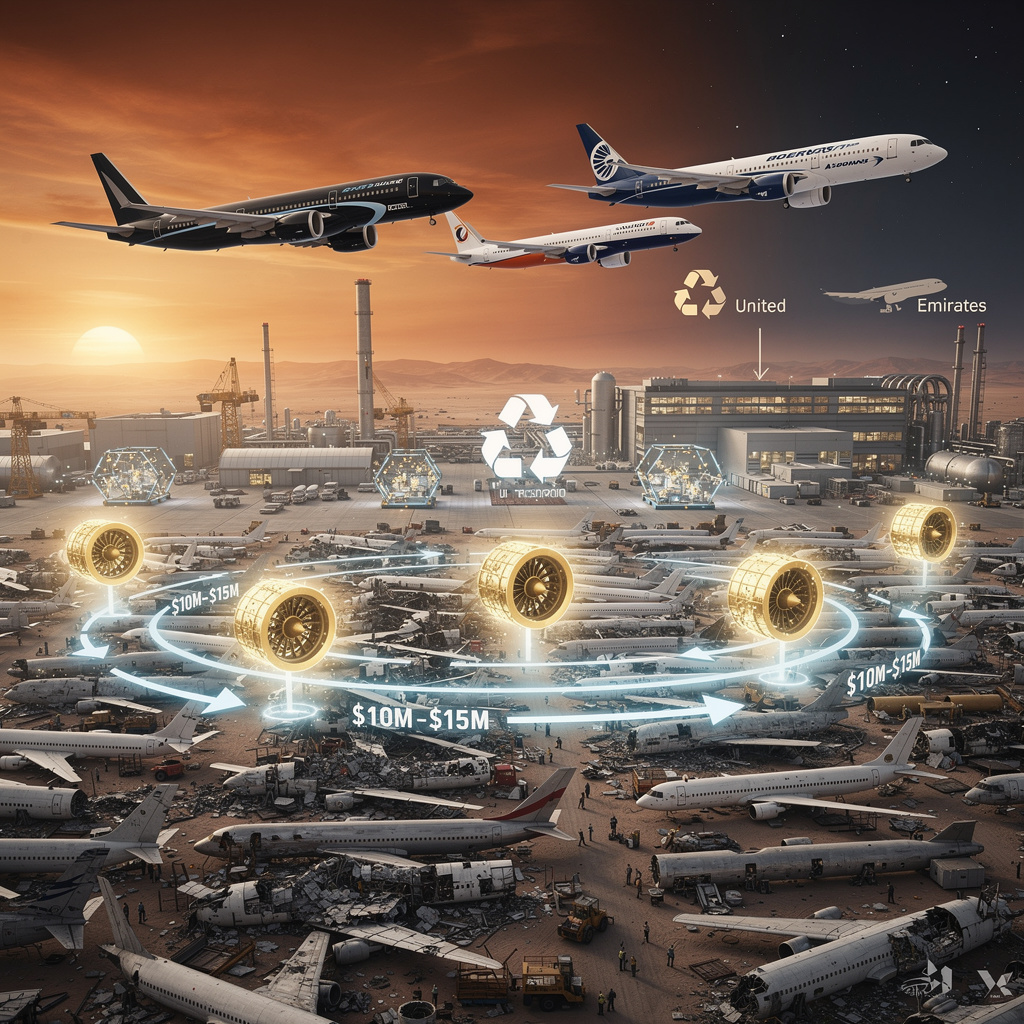
Last year the world’s airlines parked, parted-out or scrapped roughly 500 airliners while Boeing, Airbus and the rest delivered only 1,500—equal to 4.5 % of the active fleet. The arithmetic is brutal: retirements are accelerating toward 800–900 a year by 2030, widening a shortfall already pegged at 5,300 aircraft. With 16,000 jets on order but still on paper, the gap is becoming structural, not cyclical.
Why engines are grounding young jets
A320neos and 737-800s barely a decade old are being broken up because their engines trade at $10–15 million each—more than the aircraft’s remaining book value. Pratt & Whitney’s PW1000G shortage and similar bottlenecks leave airlines with no spares, so they harvest the powerplants and ground the airframe. The trend converts a 24 % retirement dip in 2024-26 into a surge that will peak after 2028.
Impacts: who pays, who gains
- Passengers: 5–7 % higher fuel burn on 20-year-old jets keeps ticket prices elevated.
- Airlines: maintenance cost per cycle rises 12–15 %; each cancelled A320neo order costs ~$50 million to replace.
- OEMs: ~12 % of the $300 billion order book—$36–40 billion—faces cancellation if output stays below 2,200 jets a year.
- Recyclers: a $52 billion, 7.4 % CAGR market emerges, absorbing up to 30 % of retired metal by 2040.
Can factories reopen fast enough?
Boeing and Airbus plan 1–1.5 million extra line-hours each by 2029, aiming for 2,500 more deliveries annually. Yet even that pushes combined output only to ~2,800, short of the 3,000-plus needed to stabilise the fleet. Refurbishing 25 % more engines by 2028 and certifying alternative powerplants are now critical hedges.
Outlook
- 2026–2028: 600–700 retirements/year; shortfall grows to 6,200; up to 1,200 orders cancelled.
- 2030–2035: 800–900 retirements/year; cumulative gap hits 8,000–9,000 unless output tops 3,000.
- 2040: recycling revenue tops $70 billion, turning scrap into a strategic asset.
The aviation industry is learning that aluminum and titanium now compete with semiconductors for supply-chain attention. Unless engine lines, fuselage plants and spare-part pools scale in sync, the world will enter the next decade with 3,000 fewer airliners than needed—equivalent to losing the fleets of United and Emirates combined.
✈️ €12.2 M State-Backed STERNA Hybrid Pack Targets 25 % Jet-Fuel Cut in EU Skies
€12.2 M buys a 25 % fuel cut: Ascendance’s STERNA pack will trim 110 kg kerosene every ATEA flight—like removing 90 cars from the road per plane 🌍. EU skies could save 1 M t/yr by 2030. Will your next short-haul be hybrid?
France 2030’s €12.2 million cheque to Ascendance turns a laboratory curiosity—the 350 kWh STERNA Hybrid Pack—into a scheduled product line at Muret L’Herm airfield by 2029. The lithium-sulfur module and its in-house operating system already shaved 25 % off kerosene burn and CO₂ on test benches; that equates to 110 kg of fuel and 0.9 t of CO₂ saved on every two-hour ATEA sector. With aviation kerosene at €1.35 L, airlines recover €150 per flight before counting carbon-price relief.
How the pack works
STERNA couples 450 Wh/kg Li-S cells with software that arbitrates power in real time, keeping temperatures inside a fault-tolerant architecture protected by 12 patents. The same code will talk to EASA-certified hybrid envelopes for Airbus and Dassault variants now in the pipeline.
Why this matters now
- Fuel bills: 25 % cut drops specific consumption by 0.55 kg kN⁻¹ h⁻¹.
- Carbon budget: 0.45 t CO₂ avoided every flight hour—15 % of the EU airline average per passenger-km.
- Industrial spill-over: Each public euro is expected to pull €2.5 in private orders, pushing total downstream value to €35–40 M by 2030.
Competitive field
- Ascendance: state-backed, EU certification path, 15–20 units yr⁻¹ by 2029.
- Hermeus (US): $350 M funded, Mach 5 hypersonic hybrid, no EU regulator on record.
- Aura Aero (FR): 80 % higher CO₂ than conventional; electric share too small to offset engine emissions.
Risks to watch
- Supply: sulfur cathodes hinge on two qualified vendors—one plant closure stalls output.
- Rules: EASA hybrid-propulsion guidance is still evolving; a six-month slip per certification stage is already baked into the schedule.
- Technology leapfrogs: solid-state batteries could reach maturity before 2028, eroding Li-S advantage.
Outlook
- Q4 2026: first five packs roll off Muret line; ATEA flight tests start Q2 2027.
- 2027: EASA signs off on software; Airbus and Dassault orders lift production to 12 packs yr⁻¹.
- 2030: three aircraft families flying, saving >1 Mt kerosene yr⁻¹ across Europe.
- 2035: 5–8 % of new short-haul fleet hybridised, spurred by €30 t⁻¹ EU carbon levy and a local supplier cluster worth 250 jobs.
The cheque clears, the clock starts, and Europe’s first hybrid-propulsion assembly line now has four years to prove that cleaner flight can pay its own fuel bill.
✈️ Bahrain Airport Reopens After 39-Day Gulf Shutdown, Just 13 Routes Return
39-day silence ends: Bahrain airport reopens with ONLY 13 of 53 Gulf Air routes back 😱—like flying with 1 wing. 1.2M passenger-km still stranded. Who’s next to restore YOUR city link?
Bahrain International Airport lifted its 39-day shutdown on 9 April, allowing Gulf Air to touch down again on 13 routes from Delhi to London-Heathrow after a Iran-Israel missile duel emptied the island’s airspace. The first radar blips showed 384 flights—52 % of the pre-clash 531 daily movements—yet the pause has already cost the carrier an estimated US $150 million in forgone revenue.
How 507 missiles grounded a mini-hub
When the first alerts flashed on 28 February, Bahrain closed its runway within minutes. Gulf Air shifted its operating base 75 km up the causeway to Dammam, reaching 72 % of normal capacity in 48 hours. Over the next five weeks, regional defences intercepted 507 ballistic missiles, 48 cruise missiles and 2 191 drones; every spike in interceptions—such as the 300-missile salvo on 5 April—coincided with a 10–12 % drop in neighbour-state departures. Jet fuel prices doubled in some corridors, pushing carriers to fly half-empty to stay within margin.
Who still feels the turbulence
- Airlines: Emirates is back to 56 % of February levels; Qatar Airways lags at 35 %.
- Passengers: 1.2 million passenger-kilometres remain delayed; flexible re-booking covers tickets through 15 June.
- Treasury: Bahrain’s civil aviation lost US $45 M in 39 days—equal to roughly 3 % of the sector’s annual contribution to GDP.
- Defence: GCC states added 5 % to Q1 military budgets to fund drone-detection systems.
What happens next
- 10 days: All 13 reopened routes should reach daily frequency if no new missiles appear.
- 30 April: Regional capacity projected at 70 %; cancellations expected under 10 per day.
- 30 June: Target 100 % pre-war schedule; dual-hub plan (BIA + Dammam) formally adopted as a standing contingency.
- Year-end: Passenger-confidence scores forecast to rise 8 points, restoring roughly US $30 M in tourism spend.
The runways are humming again, but the 39-day lesson is permanent: in a region where airspace can close overnight, an alternate tarmac 45 minutes away is now as essential as the fuel in the tanks.
In Other News
- Artemis II Crew Sets New Distance Record at 406,771 km from Earth Ahead of Reentry

Comments ()