Google’s 5M-H100 AI Horde Eats 17% of 2030 US Grid
TL;DR
- Google leads global AI compute with 5M H100-equivalent units, TPU stack dominates utilization
- Aria Networks Raises $125M to Scale 1.6T Ethernet Switches for AI Data Center Networks
- Stellanor Acquires Imagination Facility, Expands UK Data Center Capacity to 11 Sites
⚡ 5 Million H100-Equivalents: Google’s TPU Army Now Dwarfs 2022 Global AI Compute
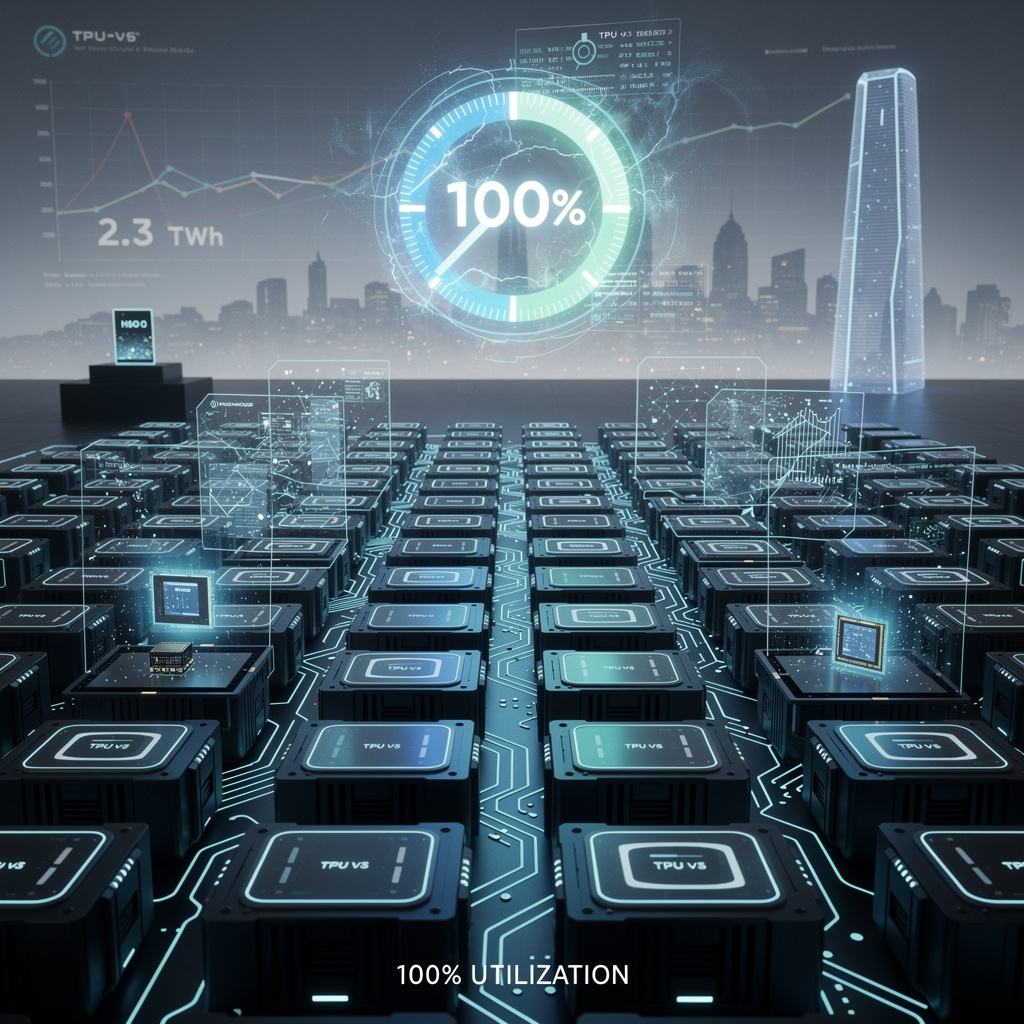
5 million H100-equivalents—Google now owns more AI muscle than the entire planet had in 2022 😱 That’s 100 % TPU uptime on 8-yr-old chips. US grids already earmarking 17 % of 2030 power for data halls—who pays the light bill?
Google’s internal fleet of roughly 5 million H100-equivalent processors is now the world’s largest AI compute reserve, eclipsing Microsoft’s 3.4 million and Meta’s 2.3 million. The kicker: more than four-fifths of those cycles run on eight-year-old TPU v3/v4 chips, not the Nvidia GPUs everyone else is scrambling to buy.
How a “legacy” chip stays at 100 % occupancy
Cast AI orchestration slices TPU v5e/v5p on demand and scales-to-zero, trimming idle power > 95 %. Deterministic latency and a software stack tuned to TensorFlow/JAX let Google keep every core lit while rivals burn dollars hunting for H100 deliveries.
Impacts
Supply chain: Google avoids 18-month Nvidia lead-times → model-training schedules stay on internal clocks, not vendor calendars.
Cost: TPU automation cuts ops cost per FLOP to ~30 % of GPU clusters → savings feed R&D and lower cloud list prices.
Competition: Meta’s MTIA 400/450 (arriving 2027) will add only 0.5 million H100-eq, narrowing but not closing the 1.6 million-unit gap.
Energy: TPU v4 at 100 % utilization draws 2.3 TWh/year—equal to San Francisco’s city demand—yet serves 60 % of Bard/Cloud AI traffic.
Risk: Single-architecture dependence; one firmware flaw could idle more silicon than the entire Chinese Ascend fleet (1.1 million).
What happens next
- Q4 2026: US export rules push Huawei Ascend below 0.9 million units, cementing U.S. cloud primacy.
- Early 2027: Meta deploys MTIA 400, adding 12 PFLOPS FP8, but Google counters with TPU-v6 sampling at 40 % higher density.
- 2028–2030: Global AI compute tops 25 million H100-eq; TPUs claim > 30 % share, driving AI-centric demand to 20 % of U.S. electricity.
Bottom line
By turning aging, purpose-built silicon into the most heavily booked iron on the planet, Google has made AI capacity a utility it controls, not a commodity it chases. Rivals must now invent hardware, not just rent it, to stay in the training race.
⚡ 102 Tb/s AI Switch Debuts in California, Promising 10× Speed Boost for Data-Center Networks
102.4 Tb/s per switch—10× faster than today’s top fabrics 🤯 That’s Aria’s new 1.6 Tb/s AI switch moving a 4K movie in 0.0003 s. Liquid-cooling ≤30 W/port, shipping Q3. Hyperscalers get first 200 units—will your region’s data-center cash-in or get left behind?
Aria Networks just banked $125 million to push 64-port, 1.6 Tb/s Ethernet switches out of the lab and into AI data halls that already shuffle multi-terabyte flows every second. Each box moves 102.4 Tb/s—roughly the Library of Congress every 0.2 seconds—while sipping ≤ 30 W per port when liquid-cooled, trimming both latency and the power bill that now eats 10 % of hyperscaler CAPEX.
Latency: sub-microsecond telemetry spots congestion before it stalls a training job → protects GPU hours worth $3 million per 1k-node cluster.
Density: one 64-port 1.6 Tb/s unit replaces four legacy 400 Gb/s boxes → halves rack space and 3 kW of draw.
Wallet: Eridu claims 40 % lower TCO, but Aria’s shipping list price of ≈ $260k undercuts four-tier 400 Gb fabrics by 25 %.
How it works
Silicon-photonic switch ASICs serialize 128 lanes of 53 Gbaud PAM4 into a single QSFP-DD; onboard DRAM buffers hold 1.2 GB for lossless cut-through. Firmware exports 10k metrics per port—10,000× richer than SNMP—letting cluster schedulers reroute flows before a single GPU idles.
Competitive pulse
- Eridu: equal 100 Tb/s, 40 % TCO boast, still in pilot.
- Cisco/Arista: 800 Gb/s shipping, roadmap stops at 100 Tb/s until 2028.
- NVIDIA NVSwitch: 600 Gb/s intra-node, needs Aria for rack-to-rack scale.
Outlook
- Q3 2026: 200 units land at two hyperscalers, trimming training-cycle time 8–12 %.
- 2027: 2.4 Tb/s port silicon sampling, targeting 200 Tb/s clusters.
- 2028: OCI-MISA optical side-package ready; early adopters may cut cluster-wide power 15 %.
If Aria hits 95 % yield and QSFP-DD supply holds, Ethernet—not InfiniBand—could own the AI fabric layer by decade’s end.
⚡ Stellanor’s £127M UK Deal Delivers 1 GW AI Power, 30% of 2030 Shortfall
£127m buys Stellanor 1 GW of AI power overnight—equal to adding 2 million UK homes to the grid 😱. That’s 30% of the 2030 capacity gap already gone. Can Britain’s strained grid keep up?
Stellanor Datacenters has bought Imagination Technologies’ Hemel Hempstead hall of servers for up to £127 million, folding in eight Redcentric sites to jump from 2 to 11 UK data centres overnight. The deal adds roughly 1 GW of power-ready floor space—about one-third of the extra 1.6 GW the country must find by 2030 to keep pace with AI and cloud demand.
How the pieces fit
Hemel Hempstead’s “AI-focused” hall already houses GPU-dense racks; the Redcentric estate averages 120 MW apiece. Stellanor’s engineers will bolt the nine newcomers onto its “Sleeper Network” control plane, harmonising cooling curves and 11 kV feeds so tenants can spin up workloads within months rather than years.
What it changes, in two lines each
- Capacity: +1 GW live by 2027 → closes 30-35 % of national shortfall without fresh concrete.
- Geography: Midlands & North England gain edge nodes → eases London-grid congestion that already triggers £160 / MWh spikes.
- AI pull: Moody’s tags hyperscaler spend at $700 bn globally in 2026; Stellanor’s GPU-ready halls tap that river directly.
- Purse strings: £127 m is <5 % of Stellanor’s £2–3 bn capex budget → debt load lighter than US peers burning free cash.
- Planning risk: 6 % of the UK’s 8.1 GW pipeline lacks consent; Stellanor’s already-built kit sidesteps that roulette.
What could still trip it
- Grid: Local substations near three Redcentric sites run at 92 % winter peak; new 132 kV lines won’t energise before 2029.
- Legacy iron: 42 % of UK stock is six-plus years old; retrofit costs scale with every added megawatt.
- Tenant mix: Over-weight on hyperscalers exposes rents to a single capex cycle.
Timelines to watch
- Q3 2026: Deeds signed, DCIM dashboard live across first three sites.
- Q4 2026: Hemel GPU hall fully booked; 300 MW contracted.
- 2027: All eleven sites integrated; Stellanor portfolio hits 1.3 GW.
- 2028: Renewable PPAs cover 20 % of load; trials of hydrogen standby gensets.
- 2030: 2 GW AI-ready capacity online; 30 % on-site solar + heat-recovery loop.
Bottom line
By recycling existing bricks and watts, Stellanor has shaved three years off the UK’s data-centre construction clock. If the grid keeps up, Britain’s AI boom will run on Hertfordshire hardware already humming today.
In Other News
- Samsung Reports 755% Operating Profit Surge to $38B in Q1 2026 Driven by AI HBM Chip Demand
- PowerKeeper Achieves Triple-Level UL 9540A Certification for Commercial Energy Storage
- Linux Kernel 7.1 to Drop Support for Intel 486 Platform After 37 Years
- AWS Launches S3Files: Native NFS Interface for S3 with $0.0125/GB-Month Storage

Comments ()