🤖 $600M Rockwell-Clearpath Deal Blocks AI on Weapons, Shakes Defense Market
TL;DR
- Clearpath Robotics acquired by Rockwell Automation for $600M, with military use of AI models explicitly banned
- Baidu's Apollo Go Robo-Taxis Disabled in Wuhan After System Glitch Strands Passengers
- Japan invests $6.3B in robotics to counter 15M-worker shortfall by 2040, targets 30% global market share
🤖 $600M Rockwell-Clearpath Deal Blocks AI on Weapons, Shakes Defense Market
$600M deal bans "killer robots": Rockwell-Clearpath blocks Claude AI from weapons & mass surveillance—first major robotics firm to hard-code ethics. Civilian logistics boom ahead, DoD loses a vendor. Would you pay a premium for "military-free" bots in your factory?
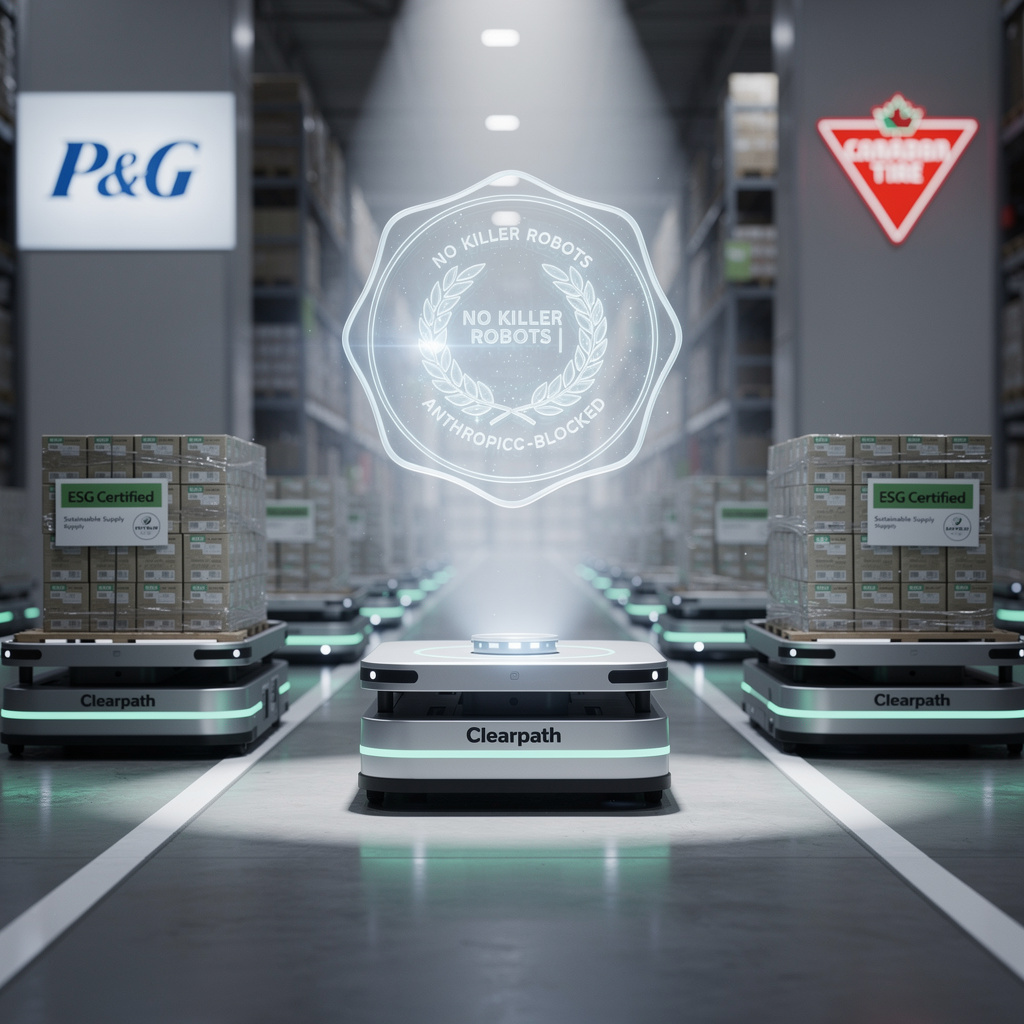
Rockwell Automation closed its $600-million purchase of Kitchener-based Clearpath Robotics on Tuesday, instantly giving the Milwaukee giant a fleet of self-driving factory carts and warehouse “Hylio” units. The contract, however, carries a clause that has no analogue in recent industrial deals: every byte of Anthropic’s Claude AI is barred from operating in weapons or mass-surveillance mode. Clearpath becomes the first robotics firm to embed a “no killer robots” covenant inside a U.S. takeover.
How the ban works
- Anthropic models remain available for route planning and voice interaction inside Rockwell’s FactoryTalk software.
- Firmware checks a hard-coded manifest; any module tagged “lethal autonomous” or “domestic bulk-surveillance” forces an immediate shutdown.
- Violations trigger a $25-million liquidated-damage clause and loss of source-code escrow—terms lifted verbatim from Anthropic’s own July 2025 red-line contract with the Pentagon.
Impacts
Defense revenue: Clearpath forgoes an estimated $50–70 million a year in Pentagon logistics tenders, equal to 42% of its 2025 sales.
Market signal: The deal trades at a 33% premium to the 2024–25 robotics M&A average, showing investors will pay extra for “military-safe” labels.
Vendor pool: If three more suppliers adopt similar bans, the DoD’s qualified AI-robotics vendors shrink 10–12%, congressional analysts project.
Ethics premium: Non-defense buyers—food, pharma, ports—gain a one-vendor shortcut to ESG compliance, accelerating procurement cycles by 4–6 months.
Short-term outlook
- Q3 2026: Clearpath AMRs certified on Rockwell’s safety stack; first 2,000 units ship to Procter & Gamble and Canadian Tire distribution hubs.
- Q4 2026: Anthropic-free navigation stack passes TÜV safety audit, opening EU markets that restrict U.S. defense-linked AI.
- H1 2027: DoD lawsuit vs. Anthropic reaches discovery; Rockwell remains off the docket, shielding integration timeline.
Long-term outlook
- 2028–2029: North-American non-defense autonomous-mobility share projected >20%, adding $180 million annual recurring software revenue.
- 2030: Industry M&A templates adopt “Clearpath clauses,” making ethical-use riders standard diligence items—mirroring today’s cybersecurity questionnaires.
The takeaway: A single sentence in a takeover pact just rerouted half a billion defense-dollars toward factory floors and warehouse aisles, proving that ethical AI can be priced—and bought—at scale.
🤖 100+ Baidu Robotaxis Paralyze Wuhan Traffic in Mass Software Freeze
100+ Baidu robotaxis froze dead on Wuhan’s ring roads—like turning every lane into a parking lot 😱. 150 riders stuck, 3 rear-end crashes, no kills…this time. Commuters pay the price while regulators probe. Would you still hop in a driverless cab tonight?
At 9 p.m. last Sunday, Baidu’s Apollo Go fleet executed the largest self-imposed shutdown in Chinese autonomous-vehicle history: 100 driverless taxis stopped dead on the Second and Third Ring Roads, marooning ~150 riders and causing three rear-end crashes. No one died, but the gridlock—amplified by social-media clips—has become a national case study in software fragility.
How the fleet works—and why it quit
Each Apollo Go car carries six cameras, four LiDARs and twin electronic brains. A cloud command centre pushes over-the-air updates to every vehicle simultaneously. Investigators traced the freeze to a lost handshake between the perception stack and motion-planner; the safety protocol responded with an instant “safe-stop,” a design meant to protect riders but which turned them into roadway obstacles.
Immediate ripple effects
- Traffic: three expressway lanes blocked for up to two hours; Wuhan’s evening congestion index jumped 38 %.
- Safety perception: Baidu’s ride-hailing app rating fell from 4.6 to 3.9 stars within 24 h.
- Regulation: Ministry of Industry & IT opened a formal probe; competitors WeRide and Pony AI paused their own expansion filings.
- Revenue: ¥150 million in weekly fares now at risk if Wuhan’s 500-vehicle permit is revoked.
Strengths vs. exposed flaws
Strengths
- 200 million km of real-world data—largest China archive.
- Cross-border revenue already flowing in Abu Dhabi.
Weaknesses
- Single software thread can paralyse an entire city.
- Cloud dependency: no on-board “limp mode” to pull over smoothly.
What happens next
- 48 h: fleet-wide rollback to last stable code; patch deployed OTA.
- Mid-May: service resumes with ≤200 cars while regulators audit stop-logic.
- Q4 2026: dual-redundant perception pipeline mandated; next-gen Hesai LiDAR (99 % cost drop) slated for retrofit.
- End-2027: WeRide projected to siphon 5-7 % of Wuhan rides; Baidu growth plan cut by 10 % nationwide.
Bottom line
A single coding hiccup converted 100 algorithmic chauffeurs into 100-ton traffic cones, proving that scale magnifies fragility. Until Baidu hardens its on-board fail-safes and convinces regulators, China’s robotaxi revolution will proceed one cautious kilometre at a time.
🤖 Japan Spends $6.3B to Swap 15M Missing Workers for Robots, Eyes 30% Global Market
Japan will lose 15M workers by 2040—so it’s building 15M robot coworkers. $6.3B bet = 30% global robot share by 2040 🤖⚙️ That’s every lost human replaced 1-for-1 with a machine. Who gets your future desk mate—AI or immigrant colleague?
Japan’s cabinet quietly approved the largest robotics cheque in its history last month: ¥930 billion (US$6.3 bn) to create a domestic “physical AI” sector that can man the factories, warehouses and hospitals a shrinking nation will soon lack the humans to run. With 600 000 industrial posts already empty and the workforce set to contract by 15 million before 2040, Tokyo is swapping immigration quotas for servo motors.
How does a country hire robots?
Two-thirds of the new money flows to hardware—precision arms, sensors and actuators—while the balance seeds orchestration software and digital twins that let engineers debug a production line on a laptop. Microsoft’s parallel US$5.5 bn data-centre deal supplies the cloud muscle, and SoftBank’s vision-language pilots teach machines to read both kanji and floor plans. The goal: 150 000 units rolling off domestic lines each year by 2035, enough to push Japan’s share of the world’s installed base from today’s 12 % to the target 30 %.
What changes, and who feels it first
- Factory output: 55 000 new robots by 2029 → lines keep running despite 10 % fewer human shifts.
- SME survival: 40 % of midsize makers to sign software contracts → smaller lots become profitable, halting plant flight to Vietnam.
- Taxpayer risk: Hardware exports still 70 % of robot revenue → yen swings or EU tariffs could undercut payback.
- Talent gap: Shortfall of 3 million AI/robotics engineers → wages for control-system grads already 30 % above 2023 levels.
Short, mid, long
- 2026–2027: Installations rise 10 % yearly; 30 000 robots cut 15 GWh of peak power, offsetting 2.5 Mt CO₂.
- 2030: 1 200 digital twins active; orchestration software lifts Japanese plants to 25 % higher energy efficiency versus U.S. peers.
- 2040: If 8 % export growth holds, domestic bots fill 12–13 million “phantom” jobs, leaving a 3 million human slot gap plugged by selective immigration.
The takeaway
Japan is not chasing sci-fi; it is balancing a national ledger. Every 1 000 robots installed keeps a ¥2 bn electronics line at home and buys time for a society that will soon have one retiree for every worker. If the software keeps pace with the hardware, the world’s oldest major economy could show the rest of us how to stay rich while growing older.
In Other News
- Artemis II Mission Breaks Record: First Human Lunar Flyby in 50 Years
- NHTSA closes Tesla's 'Actually Smart Summon' probe after six OTA updates, finding only 1% incident rate


Comments ()