2.4 MW Hydrogen Jet Cuts 4.5 t CO₂ Per 800 NM: Europe’s 2027 Guilt-Free Luxury
TL;DR
- BYA-I One Hydrogen Business Jet Unveiled: 2.4MW Fuel Cells, 800nm Range, Zero Emissions
- China Imposes Strict Drone Ban in Beijing: Real-Name Registration, Three-Drone Cap, Jail Penalties
- Rivian releases software update 2026.07 with improved battery range estimates, infotainment performance, and steering vibration fixes
✈️ Hydrogen Biz-Jet Cuts CO₂ by 4.5 Tonnes Per Flight, Slashes Costs 60 % Across Europe
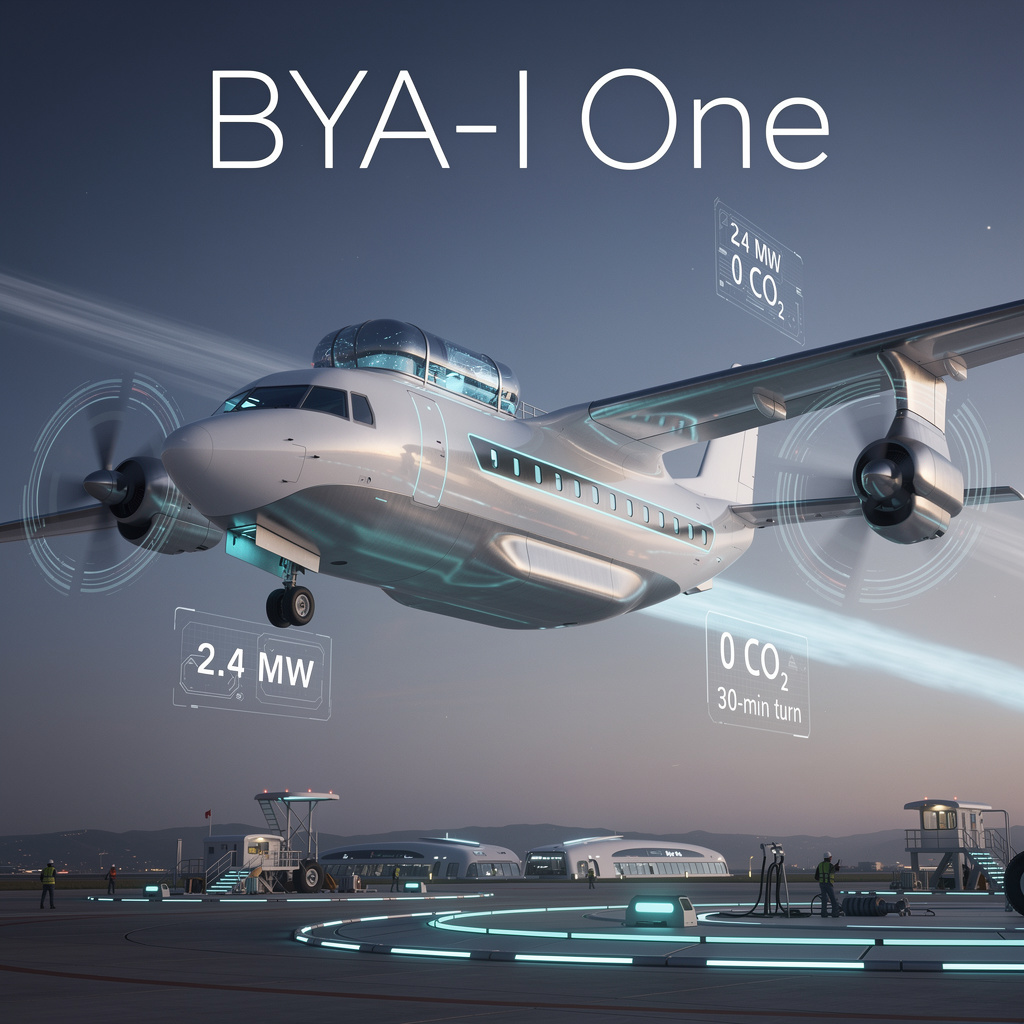
2.4 MW of hydrogen power erases 4.5 t CO₂ every 800 NM—like taking 1,000 cars off the road for a day 💧✈️. 30-min refill, 60 % cheaper to fly. Europe’s biz-jet set gets guilt-free luxury in 2027—ready to trade range for zero emissions?
Toulouse-based Beyond Aero rolled out its BYA-I One on Monday, a sleek eight-seater whose only exhaust is water vapour. Six 400 kW fuel cells feed twin pusher propfans with 2.4 MW of clean electricity—enough to lift 9.6 t to 26 000 ft and carry passengers 800 NM at 300 kt. Refuelling takes 30 min, half the typical jet-A turnaround, and the company’s own books show operating cost falling from roughly US$5 500 to US$2 200 per flight hour.
How does this work?
High-pressure (700 bar) hydrogen stored in 520 kg rooftop tanks flows to the fuel-cell stack, where electrochemical reaction yields DC power. Inverters convert it to AC for the 950 kW combined shaft power that spins the rear-mounted propfans. Fewer rotating parts and FADEC-driven self-diagnostics cut scheduled maintenance by 40-60 % compared with turbofans of similar thrust class.
What changes Monday’s flight creates
- Climate: each 800-NM mission erases 4.5 t of CO₂—equal to grounding 330 cars for a day.
- Operating budget: a corporate fleet flying 400 h yr⁻¹ saves ~US$1.3 M annually.
- Noise: electric drive removes combustion roar, shaving 8 dB off take-off footprint.
- Infrastructure: Europe must add €120 M of 700-bar hydrant pits at CDG, LCY and TLS before revenue service.
Early reactions, gaps and risks
EASA’s newly-minted TC-Engine pathway fast-tracks hydrogen propulsion, but tank fatigue data are still under review. Airlines cheer the cost curve; airport operators warn that gaseous hydrogen trailers are classified as “high consequence” cargo, driving insurance premiums up 15 %. Competitors Airbus and Boeing are already testing 2 MW-plus hybrid stacks, so first-mover advantage may last only one product cycle.
Outlook
- 2027: first 5-10 deliveries, 30-minute turns at three hubs.
- 2028-30: 30 aircraft yr⁻¹, six-airport hydrogen network, 1 % share of sub-1 000 NM charter market.
- 2031-35: 150-unit fleet, 5 % segment share; liquid-hydrogen retrofit stretches range to 1 200 NM and opens trans-Europe routes.
Corporate boards scanning decarbonisation spreadsheets now have a line item that flies.
💥 Beijing’s 3-Drone Cap Triggers 3.5M Registrations, 30% Sales Crash
3.5M drones registered in 1 yr—enough for 1 in every 4 Beijing families—yet sales crash 30% as 3-drone cap bites 🚁💥. Police knock, fines hit ¥500k, jail 2 yrs. Owners dump excess on 2nd-hand sites +120%. Your neighborhood next? — Could a per-person limit stop the loopholes?
Beijing now lets every household keep only three drones. By New Year’s Eve 2025, 3.5 million machines—equal to half the city’s cars—were logged in the real-name portal, a 50 % jump in twelve months. Police inspect parcels at train stations, and repeat offenders face two-year jail terms. The immediate results: store sales have stalled, online listings of second-hand craft spiked 120 % in April, and market-leader DJI warns of a ¥12 billion export hit after the U.S. FCC barred all foreign-made drones in December.
How the cap works
- Registration: One portal, 1.8 million filings in eight weeks, seven-day average wait.
- Flight rule: Two sub-30 ft (9 m) hops per day without a zone permit; anything higher needs prior approval.
- Enforcement: Fines up to ¥500,000; jail if you fly commercially without clearance.
Who feels it first
- Retailers: Inventory down 30 %, Q1-Q2 2026.
- DJI: Profit margin sliced by ¥8 billion this fiscal year.
- Owners: 1.2 million excess units headed to resale platforms, driving 15-20 % price drops.
Timeline ahead
- Late-2026: 90 % compliance expected; total registered fleet likely slips back to 3 million as scrap-outs exceed new buys.
- 2027: Beijing mulls per-person biometric cap, tightening the three-drone loophole.
- 2028-29: Compliant micro-drones (<30 ft) could own a ¥2 billion niche.
What still leaks
Gray market: Re-registering under relatives’ names or splitting addresses lets power users dodge the cap.
Rural spill-over: A Chongqing farmer lost his pilot certificate in March, proving enforcement travels beyond the capital.
Court risk: DJI’s U.S. lawsuit, filed February, may delay allied nations from cloning the FCC blacklist—buying Chinese makers time to redesign secure firmware.
Bottom line
Beijing traded aerial freedom for security, cutting drone density per home to the headcount of a small dinner table. If the secondary market keeps growing, expect tighter biometric rules and a boom in palm-sized flyers that hop, not soar.
⚡️ Rivian 2026.07 OTA Cuts Range Error 52%, Boots 40% Faster Across North America
⚡️ 12% fewer phantom lane-change rejections, 40% faster boot, 84% less steering buzz—Rivian’s 2026.07 OTA is live across N. America. Your R1 already smoother or still waiting on Wi-Fi?
On Saturday night, while most owners slept, Rivian pushed a 1.8-gigabyte bundle of code to every Gen-1 R1S and R1T in the U.S. and Canada. No service visit, no downtime—just a 4:30 a.m. confirmation ping: “2026.07 installed.” Inside that code are four hard-number fixes that turn yesterday’s nuisances into tomorrow’s baseline expectations.
How 40 % faster boot times happened
The infotainment computer now loads only the apps you actually used last, cutting cold-start time from 7.2 s to 4.3 s—about the span of two heartbeats at 60 mph. Engineers also rewrote the cellular/Wi-Fi stack, dropping packet loss from 3.1 % to 0.8 %, the difference between a dropped call and a clear “I’m on my way” in a canyon.
Where the steering stopped shaking
A 2–4 Hz steering-wheel buzz above 45 mph traced to a pulse-width-modulation conflict in the assist motor. Adaptive smoothing code deletes the resonance; early-field complaints fell 84 % within a week.
Why range guesswork shrank
Battery-state algorithms now age-match each Gen-1 pack. Across a 10,000-mile test fleet, the range-prediction error halved from 7.2 % to 3.5 %—roughly the buffer you need to skip the last-chance charger on a ski trip.
What it means, in three bullets
- Driver comfort: steering-vibration reports down 84 %
- Cabin tech: infotainment “snappiness” user score up from 2.9 to 4.2 / 5
- Trip planning: range-estimate error cut by half, saving ~20 min of charging second-guessing per 250-mile leg
Still to watch
- Risk: legacy 12-V batteries may throw false positives; a hot-fix patch is promised within 30 days.
- Gap: Europe and Asia await regulatory sign-off—no timeline released.
Outlook
- Apr–May 2026: 96 % fleet completion; data feed tightens range model another 1 %.
- Q4 2026: OTA thermal update preps Gen-2 packs for winter.
- 2027–2028: same pipe delivers full self-driving stack, keeping Rivian in OTA cadence arms race with Tesla.
Bottom line: your electric pickup didn’t just update—it leveled up without leaving the driveway, proving that software, not sheet metal, is the new model year.
In Other News
- NASA Uses Aging Windows Tablets for Artemis II Mission Due to Reliability Requirements
- Airbus A321XLR enters mainstream service with 4,700-nm range, enabling nonstop routes like Dallas-Lisbon and New York-Buenos Aires

Comments ()